

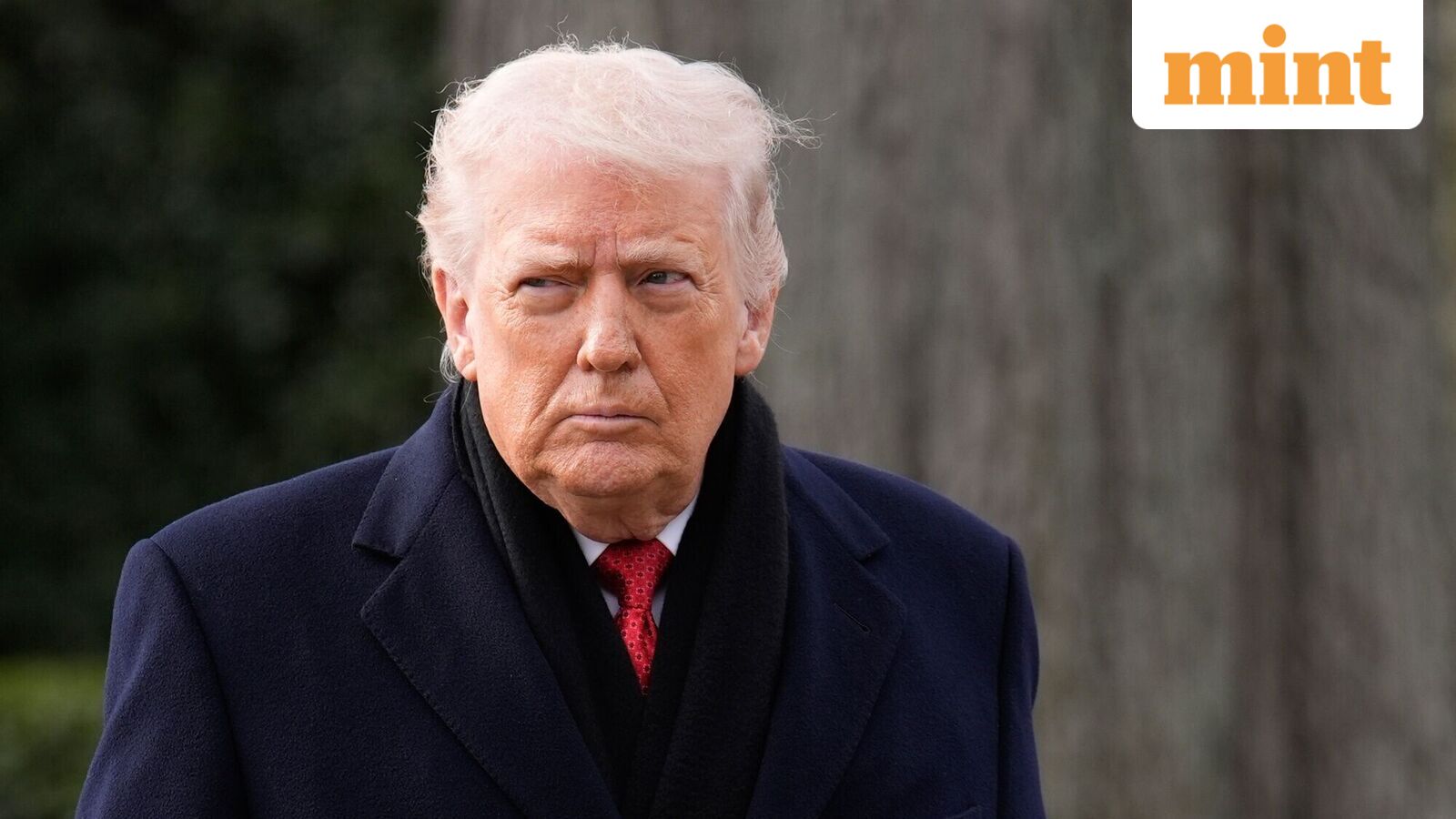
Trump tariffs: US President Donald Trump’s tariff threats against European countries—and the risk of a trade war between the US and Europe—have weighed heavily on market sentiment. The Sensex has fallen more than 1,000 points, while investors have lost nearly ₹10 lakh crore over just two consecutive sessions.
On January 17, Trump said that eight European countries—Denmark, Norway, Sweden, France, Germany, the United Kingdom, the Netherlands and Finland—would face a 10% tariff on all goods exported to the US. He added that the tariffs would be raised to 25% from June 1, 2026.
Trump’s threat attracted a sharp response from European leaders. According to media reports, they are considering activating the anti-coercion instrument, a trade defense mechanism designed to counter economic pressure from foreign governments. French President Emmanuel Macron suggested on Sunday that the EU should consider using the tool.
Tariffs: Trump’s key strategy
Tariffs remain Trump’s key strategy in dealing with the trading partners of the US. This has raised the possibility of a trade war between the US and other major economies in the world. At present, all major economies of the world are facing Trump’s tariff heat—in the range of 10-50%.
His recent tone on Greenland has added fresh worries for global economies.
He has also greenlit a Russia sanctions bill, as claimed by Republican Senator Lindsey Graham, which could raise tariffs up to 500% on countries that import Russian oil.
Moreover, according to news agency Reuters, Trump threatened to hit French wines and champagnes with 200% tariffs as French President Emmanuel Macron refused to join his “Board of Peace” initiative, aimed at resolving global conflicts.
“Recent developments have introduced new complexities into the trade and diplomatic relationship between the US and EU, suggesting a potential resurgence of trade tensions, where tariffs now carry political implications,” said Radhika Rao, Senior Economist and Executive Director at DBS Bank.
“The future trajectory of this situation remains uncertain, with possibilities ranging from administrative interventions and potential compromises to de-escalation driven by international or domestic political pressures. Each of these scenarios carries the potential for significant impact on political relations, fresh threats to territorial sovereignty, security alliances, and, ultimately, growth,” Rao added.
Are Trump’s tariff threats a serious risk?
Trump’s unpredictability is a factor that makes it difficult to factor in the impact of these moves on economies and markets.
“Anything can happen at any point in time because Trump is totally unpredictable.
That said, if you look at global market behavior over the past week or through January so far, they have largely ignored the threats—particularly around Greenland. Trump has repeatedly said the US would like to buy Greenland, and if not, may use force,” VK Vijayakumar, Chief Investment Strategist, Geojit Investments, observed.
“I attach more importance to his actions than his words. It’s quite possible that sane voices within the US administration will prevail. Ultimately, I believe he will see reason. I don’t think the proposed 10% tariff from February 1, which could later rise to 25%, will actually come into effect. But if it does, markets will react very negatively,” said Vijayakumar.
DBS Bank’s senior economist highlighted that other nations are likely to experience initial repercussions through shifts in risk sentiment, changes in capital flows, alterations in the dollar’s valuation, and impacts on asset markets.
Investment strategy for equities
Experts suggest investors should avoid aggressive bets and add quality stocks for the long term, as hopes remain intact that India and the US will finalize a trade deal soon.
“Indian investors should watch developments rather than take immediate action. The situation is fluid. If markets correct sharply in response to these developments, investors can consider slowly accumulating,” said Vijayakumar.
“Investors should therefore watch and wait. Valuations are not compelling at this stage. Ultimately, any sustained market rally will depend on earnings recovery,” Vijayakumar said.
Vijayakumar suggests investors can look at the banking and auto sectors at this juncture.
“Banking and auto are key sectors to watch. Additionally, digital and new-age companies could bounce back strongly once global conditions normalize. Stocks in this space continue to see buying interest even when foreign investors are selling, mainly because they offer 15–20% revenue growth potential over the next five to ten years,” said Vijayakumar.
“Periods of panic or sharp corrections have been the best times for long-term investors to accumulate quality stocks. Short-term investors may panic if markets fall another 10% in a week, but long-term investors who buy strong businesses during uncertainty tend to benefit,” Vijayakumar said.
Ajit Mishra, SVP of Research at Religare Broking, said participants should maintain their focus on earnings and accumulate quality stocks on dips in a staggered manner.
“Exposure to domestic-facing sectors definitely looks more prudent at this stage until we see some stability on the global front, and any announcement on a trade deal with the US will be closely watched,” said Mishra.
Investment strategy for gold, silver
Recent geopolitical events and changes in international trade policies underscore the need for an insightful and diversified investment strategy.
Aksha Kamboj, Vice President for India Bullion and Jewelers Association (IBJA) and Executive Chairperson of Aspect Global Ventures, highlighted that the strategic use of tariffs can generate periods of uncertainty in global markets; Investors should position for stability instead of reacting to short-term market fluctuations.
Kamboj highlighted that historically, gold and silver have served as effective hedges during periods of global uncertainty, offering stability when markets experience volatility.
Additionally, silver not only has its safe-haven characteristics but also its growing industrial uses.
“A measured allocation to precious metals serves to balance risk without creating overexposure. Investors are best served by gradually building positions aligned with their long-term financial goals and risk tolerance,” said Kamboj.
“The environment, defined by shifting global dynamics, again calls for disciplined diversification and a longer-term perspective as a means of navigating uncertainty effectively,” Kamboj said.
Read all market-related news here
Read more stories by Nishant Kumar
Disclaimer: This story is for educational purposes only. The views and recommendations expressed are those of individual analysts or broking firms, not Mint. We advise investors to consult with certified experts before making any investment decisions, as market conditions can change rapidly and circumstances may vary.

