

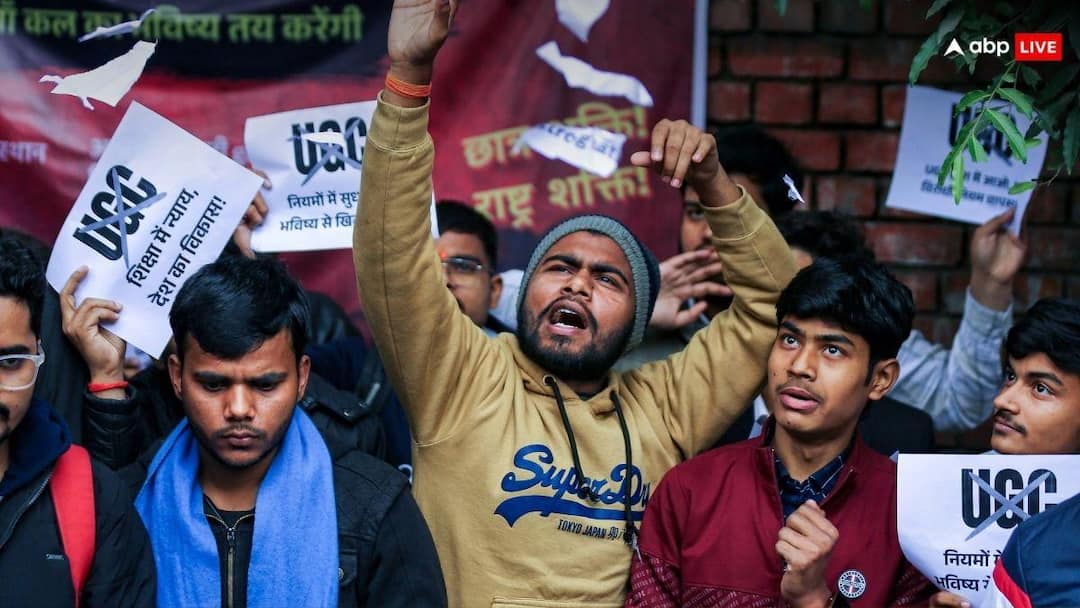
The Supreme Court has banned the new law made by UGC to stop discrimination against students on the basis of caste. A bench of two judges led by Chief Justice Surya Kant has put a stay on this new rule till further orders and said that UGC will have to follow the law made in 2012, but the real question is what will happen next. Will the protests of the students, student organizations and general category leaders who were opposing this law on a large scale stop or will the student organizations and leaders from SC-ST-OBC community who were supporting this law, get angry because of the ban on this law and start protesting. And the bigger question is what will the government do now, which has started seeing a well on one side and a ditch on the other. After all, what major change will come in the country’s politics due to the Supreme Ban on the new rules of UGC, today there will be a clear cut discussion on this issue.
13 January 2026 was the date when a gazette was issued by the University Grant Commission i.e. UGC. The name of the gazette was Promotion of Equity in Higher Education Institutions Regulations, 2026. Its objective was to implement a strong and uniform law against discrimination in every educational institution of the country. But not only the students but also the leaders belonging to the general category had serious objections to some of the provisions of this law and the language of the law and they believed that because of this new law, the general category students will be considered guilty forever. There were protests across the country regarding this. The biggest protest was seen in Uttar Pradesh, where massive demonstrations took place from Kashi Hindu University to Allahabad University and Lucknow University.
On these demonstrations, the ruling party and especially Union Education Minister Dharmendra Pradhan said that there will be no discrimination against anyone. So Akhilesh Yadav got a very measured reply from the opposition. Whereas Mayawati openly supported this new law. So MK Stalin, the Chief Minister of Tamil Nadu, an electoral state in South India, had also welcomed this new law with an open heart.
Amidst this political rhetoric, demonstrations continued and at many places anger erupted against the BJP and the central government, in which many BJP leaders even resigned from their posts. But the afternoon of January 29 brought relief news for all these protesters, because while hearing the case, Chief Justice Surya Kant put a stay on this new rule and said that till further orders, only the 2012 rules will remain applicable in the university.
Now let us briefly understand what the rules of 2012 are and then talk about the impact of the Supreme Court’s decision. So the system in 2012 was that there was a divided system in the university for the students.
- There was a separate anti-discrimination cell for SC/ST students.
- There was a separate complaint mechanism for women.
- There were separate rules and regulations for the disabled, which prevented any kind of discrimination against them.
But there was not such a common, strict and time-bound decision system for the entire campus. This meant that many complaints were buried or remained pending for years. In such a situation, through Promotion of Equity in Higher Education Institutions Regulations, 2026, UGC made two arrangements mandatory in every college and university.
1. Equal Opportunity Center (EOC), where any student or teacher can say that he or she has been discriminated against, for whatever reason.
2. Equity Committee, which will investigate these complaints and recommend action.
Under the new law, the committee was to consist of the Vice-Chancellor or Principal, SC representative, ST representative, OBC representative, women member, minority or disabled representative and a senior professor or expert and the decision was not to be taken by any one person but by a collective committee. The job of the committee was to register the complaint, hear both the sides, look at the evidence and records, prepare a timely report and recommend action if found guilty. But the real controversy started from here, because there was no such provision in this committee that any student or teacher coming from general category could be a member of this committee. Therefore, general category students started a movement against the new law, which spread from the streets and university campuses and reached the Supreme Court. And finally the Supreme Court banned this new law.
As soon as the decision came, the students who were protesting started celebrating by blowing Abir-Gulal and started thanking the Supreme Court. But now the question is about the class for whom this rule was made. The rule was specifically made to ensure that there is no discrimination against SC, ST and OBC students. But now that the law has been banned, what will these students do now? Will these students wait for the next order of the Supreme Court or is it their turn to protest? This question is now standing before the government. Because till now only general category students were agitating, the scope had become so big, if the students of SC, ST and OBC category come out on the movement, then it can be easily estimated how wide its impact can be.
It is also possible that in the next hearing i.e. on March 19, that expert committee will be formed, which Chief Justice Surya Kant and Justice Joymalya Bagchi have talked about in their decision. But there is still time for that. And with the political rhetoric that has just started on this issue, this issue is sure to gain momentum. And the central government is facing the biggest problem in this. Because this year there are assembly elections from Bengal to Tamil Nadu, Kerala, Puducherry and Assam. And it is possible that the impact of UGC rules may be a little less in these elections, but keeping in mind the movement seen in Uttar Pradesh, the BJP government at the Center may have to adopt a middle path because there are assembly elections in Uttar Pradesh also in 2027. And it is not hidden from anyone how caste equations influence any election in UP. Most of the BJP leaders who resigned in protest against the new UGC rules are from UP and if this new law gets shelved somewhere after the Supreme Court order, then BJP’s SC, ST and OBC leaders can also be seen sitting with their resignations.
That means that big leaders of BJP have a well on one side and a ditch on the other side. If the new rules of UGC are supported then the general caste people are angry, if they oppose then the SC, ST, OBC are angry and if the government tries to shirk it by citing the order of the Supreme Court, then the message will certainly be sent that the government is not taking any interest in this law. Because if the government wants, it can solve the issue by making a law through the Parliament and every student and every big and small leader active in politics knows this very well.

