


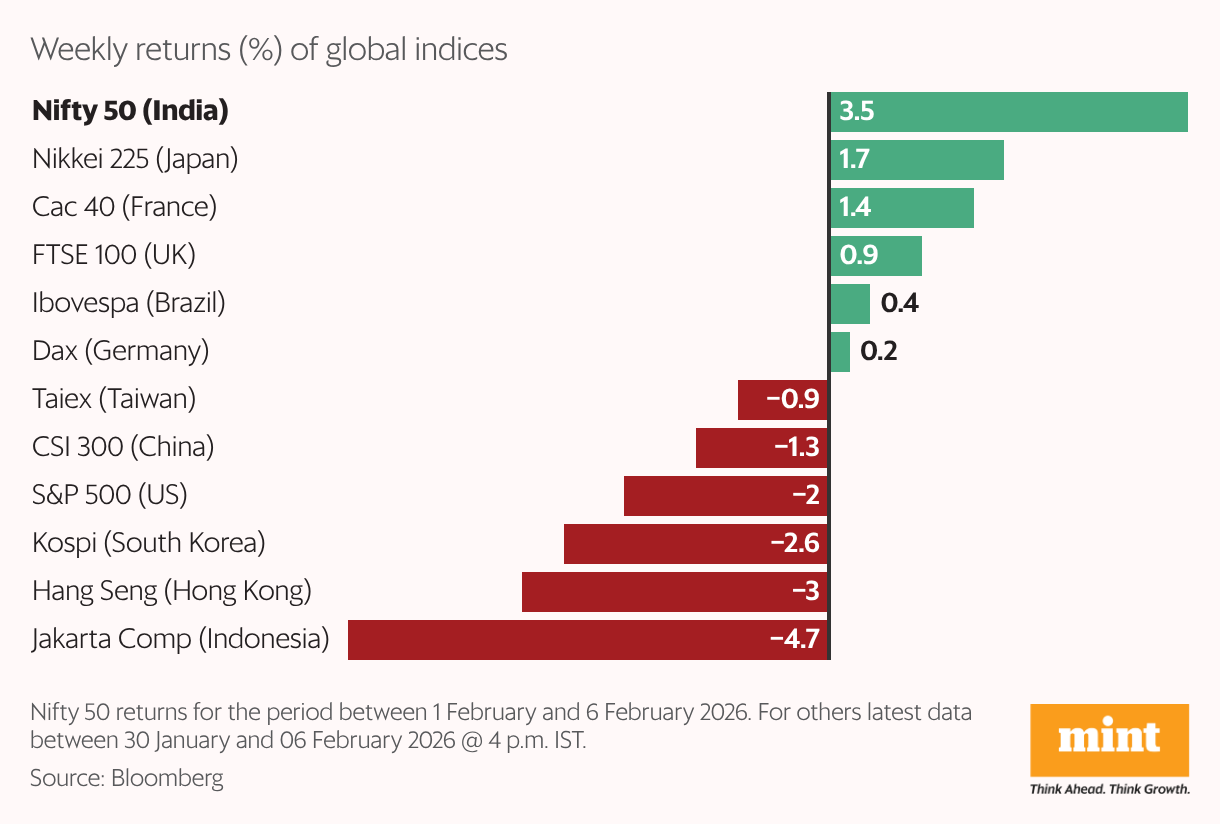
MUMBAI: Indian equities logged their strongest weekly performance in 38 weeks and emerged as the world’s top-performing major market after the announcement of a US–India trade deal, even as its finer details remain unclear.
Headline-driven optimism lifted the Nifty 50 and the Sensex 3.5% over a week that also included a special Sunday trading session for the Union budget. The Nifty 50 currently trades at 25,693.70, while the Sensex stands at 83,580.40.
According to a mint analysis, this marks the benchmarks’ best weekly showing since the week ended 16 May 2025, when the Nifty 50 had gained 4.2% and the Sensex rose 3.6%.
The rally, however, came with sharp turbulence. The frontline indices recorded both their steepest single-day fall and biggest single-day jump in nine months within the same week, as investors digested twin triggers – the Union budget and the long-awaited US–India trade pact.
Volatility spiked on Budget day, 1 February, when both benchmarks fell nearly 2%. Investors judged the government’s proposals as lacking sufficient firepower to revive growth, while a surprise hike in securities transaction tax (STT) on derivatives trading further dampened sentiment.
Experts flagged concerns that higher STT on futures and options could deter foreign investors at a time when they are already exiting Indian markets. foreign portfolio investors (FPIs) sold almost ₹36,000 crore worth of equities in January before turning net buyers this week. FPIs injected ₹9,442 crore in the first week of February after US President Donald Trump announced a breakthrough in trade negotiations with India, easing a key uncertainty overhang. This shift in sentiments catapulted the index 2.5% on 3 February alone.
Meanwhile, the India VIX, Dalal Street’s fear gauge, fell 19% over the week, signaling a sharp drop in risk aversion. The decline suggests trade-deal optimism buoyed domestic sentiment even as a fresh innovation shock from Anthropic, an artificial intelligence (AI) security and research firm, rattled global technology stocks later in the week.
As a result, major global markets ended the week in the red, with the Kospi and Hang Seng snapping their month-long winning streaks. Whereas, India, aided by its relatively lower exposure to global AI development and supply chains, emerged as the top global performer.
IT meltdown
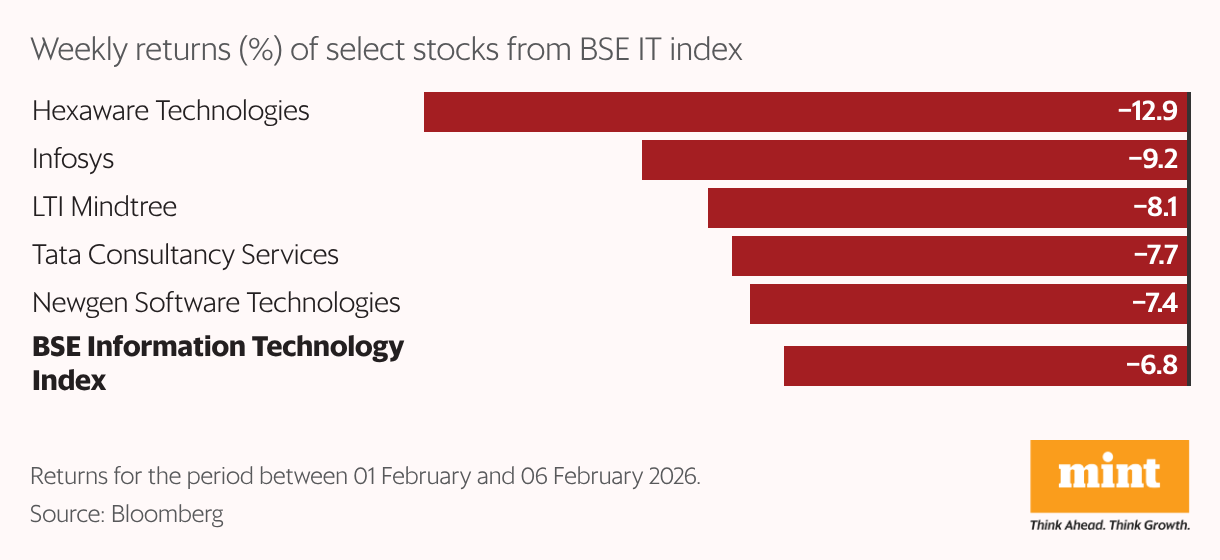
IT stocks were the week’s worst performers, with the BSE IT index sliding nearly 7% after Anthropic unveiled new plugins for its Claude Cowork platform, which automate non-technical tasks across 11 sectors. The development has stoked fears of automation encroaching on Indian IT firms’ core services.
Nearly two-thirds of listed Indian technology stocks ended the week lower, with heavyweights such as Infosys Ltd and Tata Consultancy Services falling 9.2% and 8%, respectively.
While markets are still assessing the potential impact on IT companies, VK Vijayakumar, chief investment strategist at Geojit Investments, said the development could structurally weaken India’s IT sector unless firms adapt quickly.
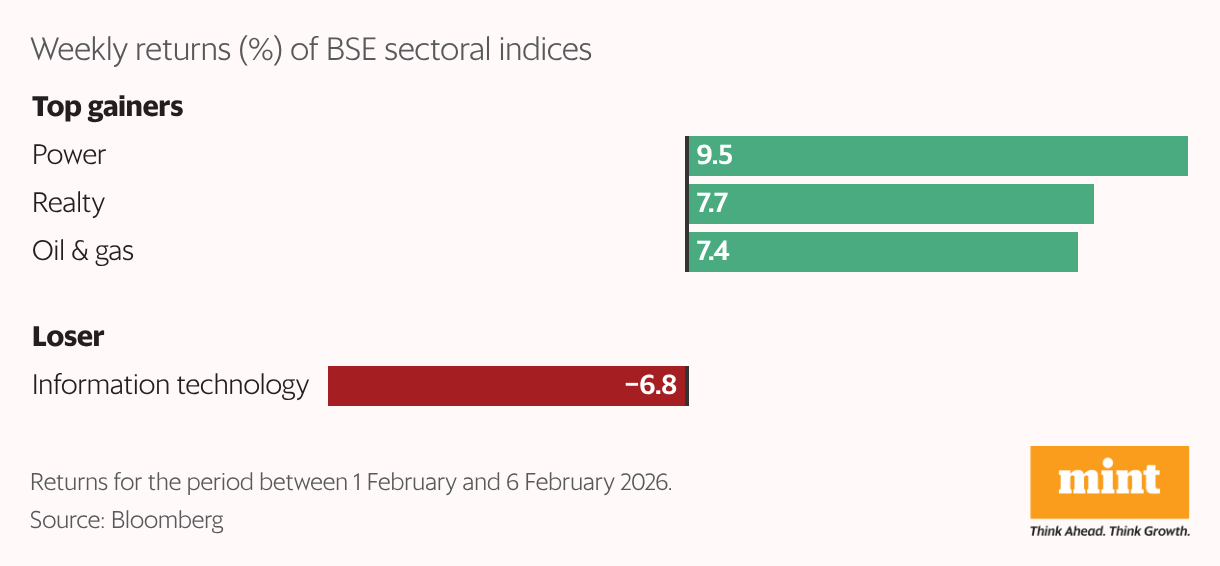
The broader market, however, staged a largely broad-based rally. Utilities and power stocks led the gains, rising nearly 10% over the week, followed by real estate with close to 8% gains.
“The market expects power companies to do well amid surging demand, especially if the Budget’s 20-year tax holiday for data center investments attracts large-scale capital inflows,” said Vijayakumar.
Vijayakumar expects broader markets to consolidate around current levels next week, with caution still prevailing amid elevated geopolitical uncertainty.
“Sectoral churns are happening sharp and swift in response to news and events,” he said, cautioning that adverse news flows could unsettle markets as valuation concerns and earnings weakness persist.

