

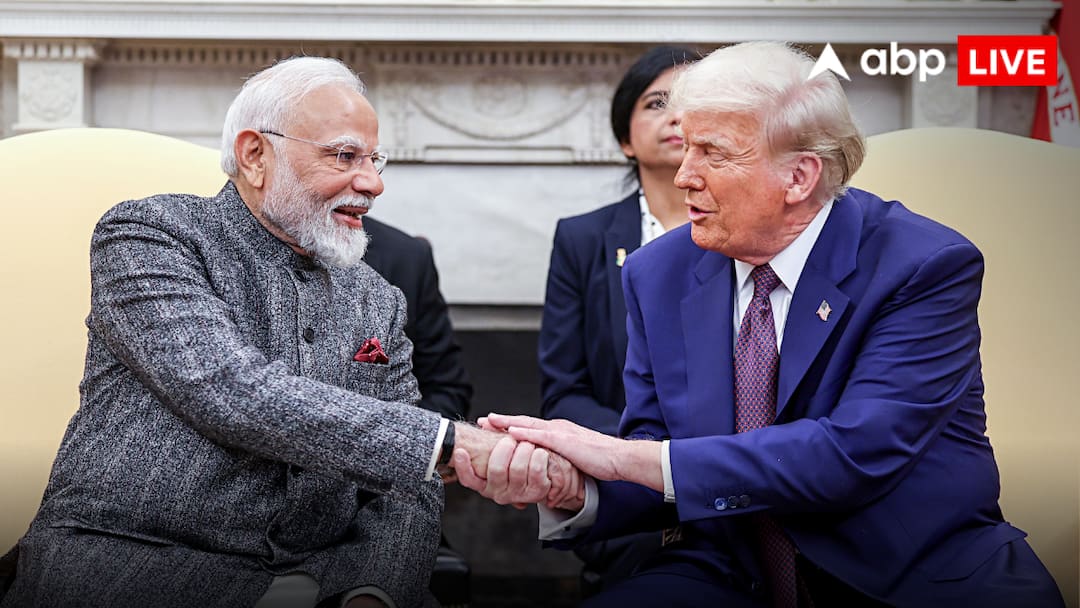
While the Free Trade Deal (FTA) between India and the European Union (EU) was considered beneficial for both the parties, there are still many controversies going on regarding India’s interim trade deal with the US. Experts are calling this trade agreement between the two countries a ploy by US President Donald Trump to use it as a weapon to control India’s foreign policy.
There is no equality in US-India trade deal – Chellani
Strategic expert Dr. Brahma Chellani said that through several unilateral steps in the US-India trade deal, the Trump administration has presented this arrangement as a patron-client narrative instead of an equal partnership. He said in a post on social media platform In which he described this agreement as a favor given at the request of Modi and said that it was done out of friendship and respect.
He said that about 40 minutes after Trump’s announcement, Prime Minister Narendra Modi, while reacting on
Unlike the EU–India free trade agreement, which was almost universally celebrated as a “win-win” outcome, the US–India interim trade deal has sparked significant controversy. Through a series of unilateral moves, the Trump administration has framed the arrangement in a…
—Dr. Brahma Chellaney (@Chellaney) February 8, 2026 .
US tried to show India as subservient – Chellani
Chellani said that a few days later, on Saturday (February 7, 2026) at 5 am Indian time, the US White House issued a joint statement, which was considered a serious violation of diplomatic protocol. In this, the timing, various terms and key points of the deal, especially India’s commitment to purchase $500 billion and the alleged promise to stop buying oil from Russia, were presented in a unilateral manner to make India appear submissive.
He said that an hour after issuing the joint statement, the White House revealed the most pressing thing in this deal, which was the snapback mechanism included in President Trump’s executive order. Under this, 25 percent tariff imposed on India has been removed only on the condition of stopping the purchase of crude oil from Russia directly or through any third country. Similarly, America has used trade as a weapon to control India’s foreign policy.
This is an arrangement made on the condition of trade deal – Chelani
Chellani said, ‘Although the Indian government has presented the tariff reduction as an economic achievement, this agreement also creates a permanent situation of sensitivity. In this, America also gets the right to monitor India’s compliance with the conditions, whereas if India insists on its strategic autonomy, then heavy tariffs of up to 50 percent can be immediately imposed on it again.
He said that what is being presented as a trade deal actually turns out to be a conditional arrangement, in which India’s economic stability and energy security appear to depend on being in line with Washington’s geo-political priorities.

