

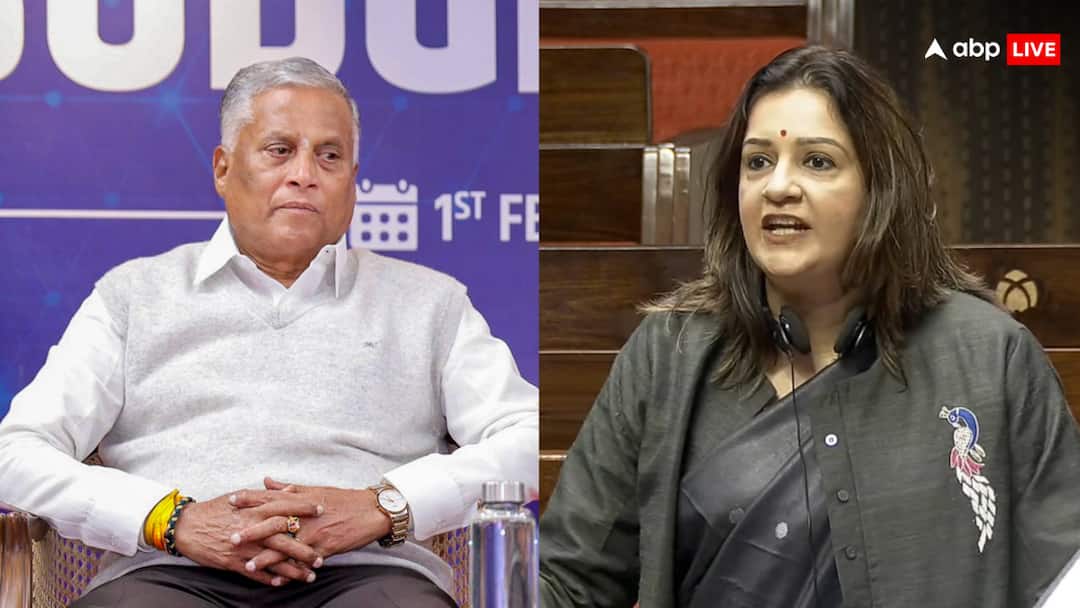
During the budget session of Parliament, Shiv Sena (UBT) MP in Rajya Sabha Priyanka Chaturvedi on Monday (February 9, 2026) questioned the central government regarding India’s water crisis. He asked whether the government accepts the fact that India ranks 120th out of 122 countries in terms of availability of safe drinking water, while government agencies have also pointed to uranium pollution in ground water, adulteration of sewage and toxic rain.
Along with this, he asked, what are the details of the audit report of the Comptroller and Auditor General (CAG), which states that there is a risk of pollution exceeding the permissible limits regarding the quality of drinking water in Delhi? Is this crisis a result of actual water scarcity or mismanagement? Even though India receives about 4,000 billion cubic meters of rainfall annually, water scarcity still persists.
Further, the Shiv Sena (UBT) MP asked in the House what concrete measures are being taken to deal with uranium pollution, separation of sewage, replacement of pipelines and disposal of toxic waste? And what is the time frame for providing safe piped drinking water or will citizens have to permanently rely on costly water treatment measures?
Central government answered Priyanka Chaturvedi’s question
V. Somanna, Minister of State for Jal Shakti Ministry, on behalf of the Central Government, answered the question asked by Shiv Sena (UBT) MP Priyanka Chaturvedi in the House. He said that there is no universally accepted global ranking available regarding the water quality of countries. Jal Jeevan Mission (JJM) – Har Ghar Jal, was launched in August 2019 in collaboration with States/UTs, with the objective of providing tap drinking water to rural households in adequate quantity, of prescribed quality, on a regular and long-term basis.
He said that under Jal Jeevan Mission, as per the current guidelines, Bureau of Indian Standards (BIS) 10500 has been adopted as the standard for the quality of drinking water being provided through piped water supply schemes. Since drinking water is a state subject, the responsibility for planning, design, sanction, implementation, operation and maintenance of water supply schemes lies with the respective state and union territory governments. The Government of India supports the efforts of the states by providing technical and financial assistance.
Till now, tap water connections have been installed in more than 15.79 crore houses in the country.
According to the JJM-IMIS report, at the time of the launch of Jal Jeevan Mission (August 2019), only 3.23 crore rural families had tap water connections. According to the information provided by the states and union territories so far, more than 12.56 crore additional rural families have been provided tap water connections under the Jal Jeevan Mission. Thus, by February 5, 2026, out of the total 19.36 crore rural families in the country, more than 15.79 crore families are reported to have tap water connections in their homes.
Finance Minister has announced for Jal Jeevan Mission in the budget speech.
The Union Minister of State for Jal Shakti said that with the objective of achieving 100 per cent coverage through sustained implementation of the Mission, ensuring long-term sustainability and citizen-centric water services with special focus on quality of infrastructure and operation and maintenance of rural piped water supply schemes, the Finance Minister has announced in the Budget Speech 2025-26 to extend the Jal Jeevan Mission till December 2028 and increase the total outlay for it.
He said that as per the Standard Operating Procedure (SOP) approved by the Central Ground Water Board (CGWB) for assessment of groundwater quality, data is collected at the regional level across the country through groundwater quality monitoring programs and scientific studies. Recently the Annual Ground Water Quality Report-2025 has been released by CGWB.
CPCB monitors water quality at 4,922 places in the country – Somanna
Union Minister V. Somanna said that the Central Pollution Control Board (CPCB) informed that the Central Government through Notification GSR 1265(E) dated October 13, 2017 has prescribed standards for effluent discharge into rivers from sewage treatment plants (STPs), which are implemented by the State Pollution Control Boards. At present CPCB, under the National Water Quality Monitoring Program (NWMP), in collaboration with State Pollution Control Boards/Pollution Control Committees, monitors water quality at 4,922 locations across the country, including rivers, lakes, ponds, tanks, ground water and other water bodies.
He said that under Jal Jeevan Mission, States/UTs have been advised to adopt source recharge measures like dedicated borewell recharge structures, rain water harvesting, rejuvenation of existing water bodies, grey-water re-use etc. This work is being carried out in convergence with the Integrated Watershed Management Program (IWMP), 15th Finance Commission grants, State Schemes, CSR funds and other schemes of the Ministry of Rural Development. Additionally, Jal Shakti Abhiyaan: Catch the Rain (JSA: CTR) was expanded to the entire country in 2021, aimed at harvesting rainwater where it falls, when it falls. Five major interventions have been made under this campaign, these include-
- Water conservation and rain water harvesting
- Census of all water bodies, geo-tagging and preparation of scientific plans.
- Establishment of Jal Shakti Kendras in all districts
- extensive tree planting
- Includes spreading public awareness.
He said that the sixth edition of this campaign was launched on March 22, 2025 with the theme Water Conservation, Public Participation: Towards Public Awareness.

