

After initially pushing for DeepSeek-like large language models (LLMs) last year, the Center has recalibrated its stance. The emphasis now is on building smaller AI models tailored for enterprise use cases. Startups, too, say it is “too early” to unveil sweeping LLMs capable of competing with US and Chinese counterparts.
The AI Impact Summit, scheduled in New Delhi from 16–20 February, will showcase a collection of early-stage, in-development AI models from startups backed by the Centre’s $1.2-billion India AI Mission, four industry executives and two officials aware of the plans told mint.
Strategy reset
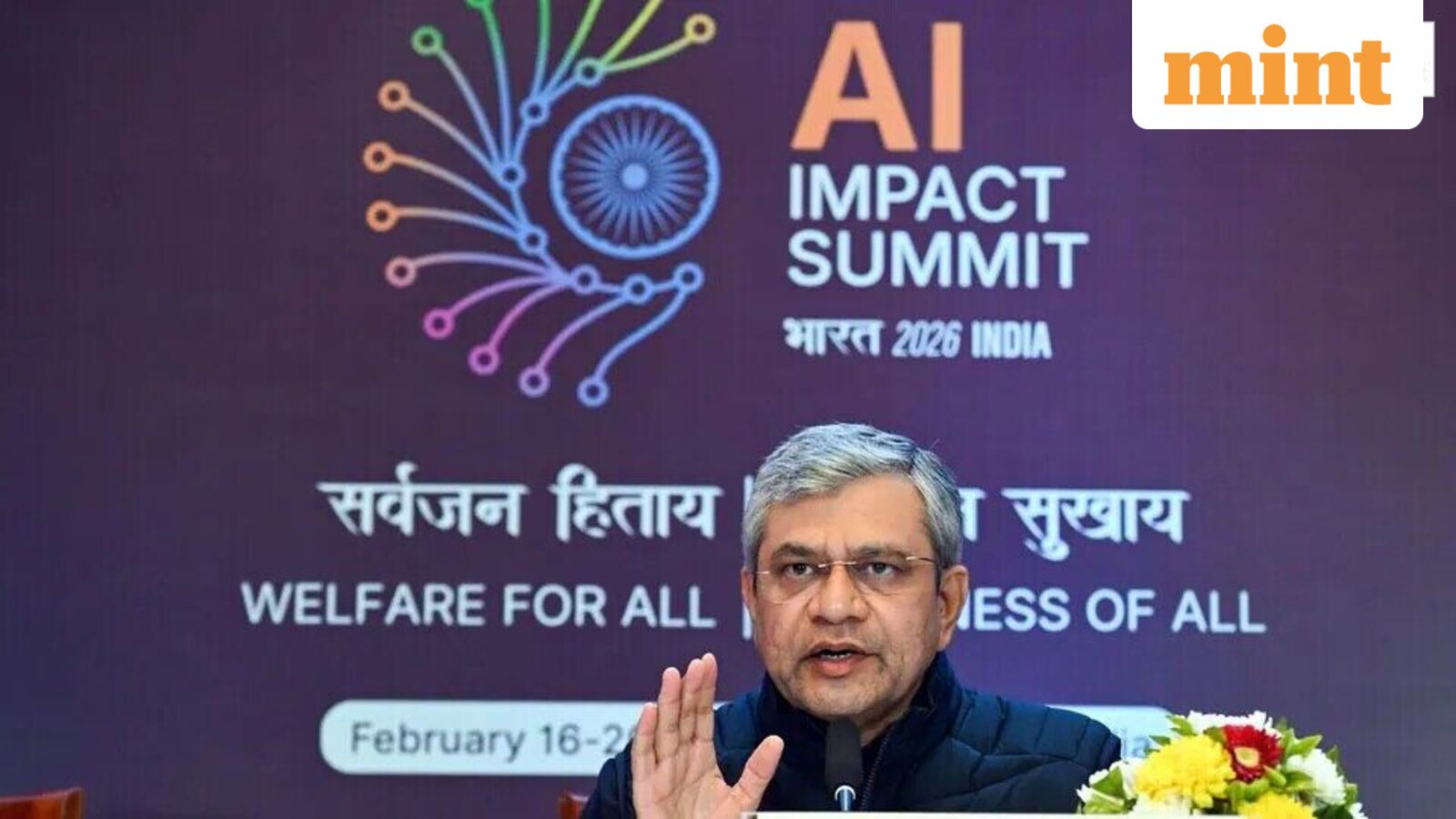
On 30 January, Union IT minister Ashwini Vaishnaw said at a press briefing in New Delhi that “building large AI models, that require heavy capex, is not the only way to become a leading nation in AI.”
“In fact, most experts I spoke with at the World Economic Forum, as well as generally, said that small AI models of 20-50 billion parameters are good enough to serve enterprise AI use cases. At the upcoming AI Impact Summit, India will showcase a bouquet of AI models—of which such sovereign models will be a part,” the minister added.
Vaishnaw also confirmed that India will showcase a “bouquet of models” during the Summit, without specifying their details.
What India presents at its first marquee global AI event carries immense significance, especially after International Monetary Fund managing director Kristalina Georgieva said at the World Economic Forum in January that India was a “second grouping” nation in AI—triggering a widely publicized rebuttal from Vaishnaw.
Although Georgieva later described India as “one of the major forces in developing AI,” analysts say the burden of proof remains on India to demonstrate progress in foundational technologies.
Early builds
Companies mint spoke with echoed Vaishnaw’s assessment: most models on display will be early-stage proofs of concept.
Bengaluru-based Gnani, one of 12 AI Mission-backed startups, will showcase “an early build of the sovereign voice-to-voice AI model” at the Impact Summit, founder and chief executive Ganesh Gopalan said.
“The fully-developed commercial version of the model will take some time, since we got access to 1,000 GPUs through E2E Networks only late last year. The full-scale model will be trained on 70 billion parameters of data, and will be released later this calendar year,” he added.
IIT Mumbai-incubated BharatGen—the highest-funded AI startup in India, backed by $112 million from the AI Mission—will showcase an early AI model based on 17 billion parameters, built before receiving Mission support, one executive said.
“BharatGen was only approved under the Mission in September. It has taken about a quarter for them to get the infrastructure, and it is only now that they are integrating their models and cloud platforms with the new GPU infrastructure. Building large LLMs is a complex affair that takes time, so the showcase won’t be of anything as striking as what China did this time last year with DeepSeek,” the executive said.
The only exception, according to four people with direct knowledge of the matter, could be IIT Madras-incubated, Peak XV-backed Sarvam. The startup may showcase a commercial, multi-modal, 120-billion-parameter foundational LLM with native support for inputs and responses across all of India’s 22 official languages.
Sarvam did not respond to ‘Mint’s emails and messages seeking comment.
An LLM is trained on vast datasets to generate human-like speech, cognition and decision-making. While most global models operate primarily in English and text, India’s focus has been on voice-first, local-language AI systems.
At a pre-Summit briefing on 29 December, S Krishnan, secretary at the Ministry of Electronics and IT (MeitY), said India aims to export LLMs as digital public infrastructure to non-English-speaking nations.
global benchmark
China’s DeepSeek and Qwen surprised US Big Tech firms last year by unveiling LLMs that rivaled Google’s Gemini and OpenAI’s ChatGPT—at a claimed fraction of the cost.
The so-called “DeepSeek moment” became symbolic of how innovation could sharply reduce the cost of building and operating foundational AI models, challenging the capital-heavy US approach.
India wants to spend public taxpayer’s money on backing private entities to build AI models like China’s DeepSeek because New Delhi expects AI to become a potential point of leverage that could halt economies and affect businesses, in a period of the most active geopolitical conflicts since World War II.
The AI Impact Summit is expected to host global AI leaders including Alphabet chief Sundar Pichai and Google DeepMind founder and Nobel laureate Demis Hassabis.
Geopolitical stakes
Industry leaders warn that progress on foundational LLMs will be closely watched.
“The pace of innovation that India follows is to build an early-stage proof of concept, and then wait and see the development of business use cases before investing further. AI, though, is different. Here, the core LLMs are owned by other nations, which means that if India doesn’t get its DeepSeek moment, it becomes geopolitically dependent,” said Sudarshan Seshadri, partner for AI at Tiger Analytics.
“This could risk India becoming a secondary-layer or application-layer deployer of AI, and not be at par with core technology ownership that the US and China are showing.”
Saibal Chakraborty, managing director and senior partner at BCG India, said that India’s approach to AI innovation does not compulsorily need to be on the same vein as others.
“There are two schools of nuanced thinking: one on whether India should keep pace with the scale of innovation that nations such as the US and China have pursued in AI, and the other being a focused approach majoring on sectoral and use case-specific small language models (SLMs), because the world is still waiting and watching if AI can actually sustain its growth buzz, or faces a crash,” he said.
Chakraborty, thus, added that India’s foundational AI investments are also likely to be led by returns on business investments. “While that’s not necessarily a bad thing, it’s important to note that the progress in the US is largely driven by private capital, and isn’t government-attached. So, India would still need significantly more time and investment, both by government and private sectors, to build large-scale AI models.”