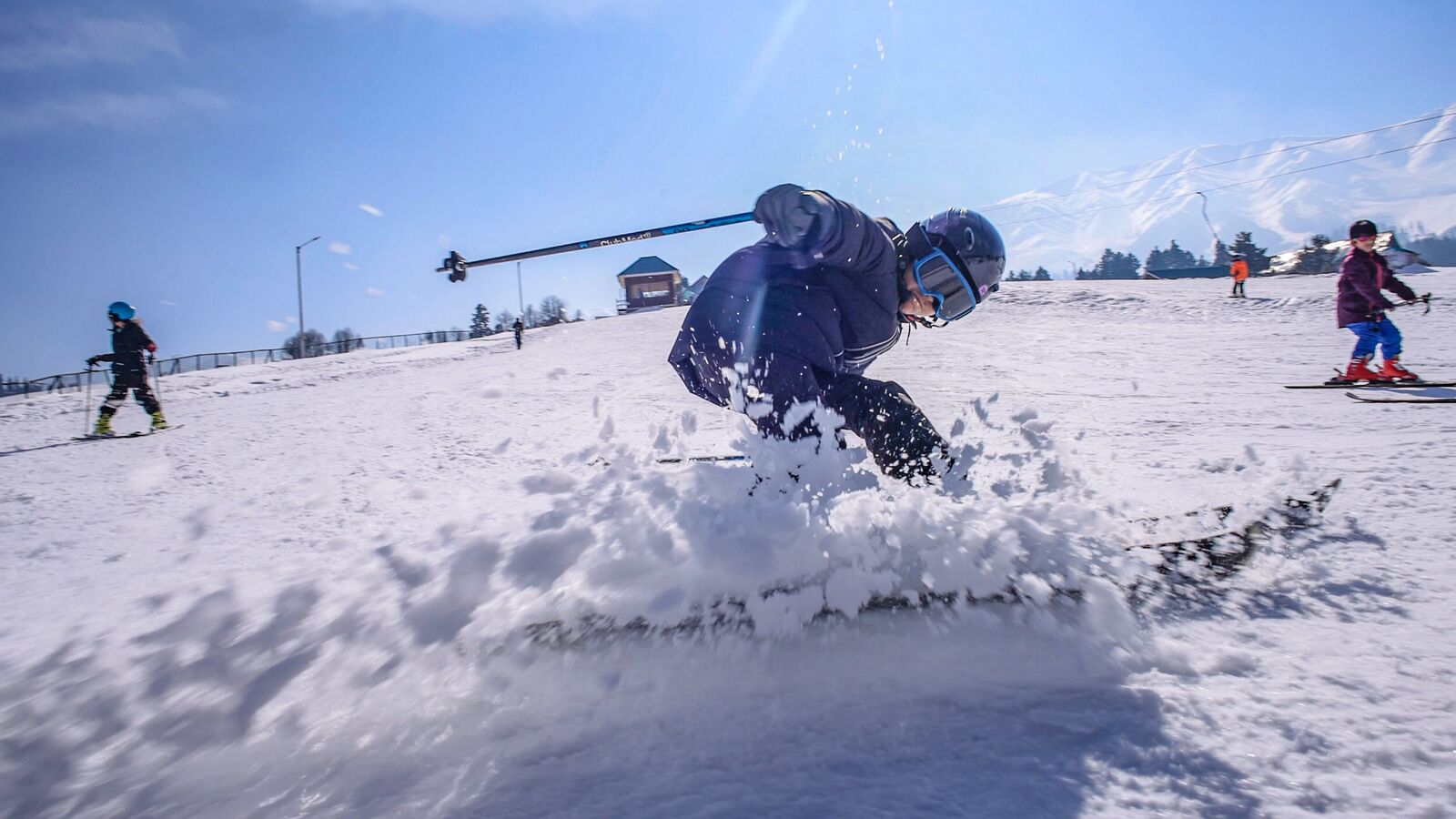
On February mornings in Gulmarg, the world feels quiet. The first Gondola hums upward, pine trees sag under fresh snowfall, and the Pir Panjal glows pink in early light. On the slopes below, India’s winter sports athletes are hard at work. They slice through corduroy snow, practicing turns that will last seconds but define seasons.
Gulmarg will host the sixth edition of the Khelo India Winter Games (KIWG) from February 23 to 26, 2026. The first leg featuring ice sports like skating and hockey were held in Ladakh from January 20-26.
This will be the sixth year in a row the games take place in this Himalayan bowl. No other Indian town can claim such a monopoly over a national sporting event. This continuity has earned Gulmarg the title of “India’s Winter Sports Capital.”
Since the inaugural 2020 edition, the games have changed – expanding, contracting, and adjusting – but they have never moved. Gulmarg remains the fixed point around which India’s winter ambitions revolve.
Gulmarg will see four medal events: Ski mountaineering, Alpine skiing, Nordic skiing (cross-country) and snowboarding. At least 400 athletes, mostly skiers, are expected to participate in the snow events, with the maximum in Alpine skiing.
In past speeches, Hon’ble Prime Minister Narendra Modi described the Khelo India Winter Games as a “symbol of a new sporting confidence.” He pointed out that Gulmarg had become India’s winter playground, drawing athletes from all 36 states and Union Territories into one snowy arena. The Games showcase India’s diversity and the slopes of Gulmarg are where geography disappears and talent unites.
These words ring true now as competitors from Ambala, Hyderabad, Indore, Pune, Madhya Pradesh, and other places prepare their gear. This year, the excitement is greater, and the snow feels significant. At nearly 8700 feet above sea level, preparation is a challenge with altitude.
On the upper slopes near Kongdoori, Ankush Bazala from Jammu leans into a slalom gate, sending up a plume of powder behind him. His skis chatter briefly over uneven snow before stabilizing. “You don’t just train your legs here,” Bazala says, taking off his goggles. “You train your lungs, your nerves, your patience. Gulmarg pushes you to be better.”
Nearby, Kanika Shan from Jammu practices edge-control drills. Between runs, she studies footage on her phone, examining her body position frame by frame. “This platform changed winter sports,” she says. “Before Khelo India, you felt invisible. Now you feel recognized.”
Hrishi Gulhane from Pune describes the altitude shock frankly. “The first two days, your chest feels tight. But once you get used to it, it sharpens you. Racing here is like racing on a blade,” he says.
Atul Vaid from Indore refers to Gulmarg as “India’s answer to the Alps.” “The terrain is technical, the snow shifts, and you can’t relax for even a second,” he says. “That’s what makes winning here significant.”
What does newcomers say about KIWG?
Even newcomers are pursuing the mountain. Yashwant Reddy from Hyderabad, a skydiver learning to ski, laughs when asked about the switch. “Jumping from planes is easier,” he jokes. “Here, gravity is constant and you have to respect the slope.”
Muhammad Sinan, who traveled from Kerala, describes the experience as transformative. “We don’t grow up with snow,” he says. “But here, you feel part of something bigger – athletes from every corner of India sharing the same slope.”
Rohit Sunny from Ambala acknowledges the pressure. “When you stand at the start gate, it’s silent,” he says. “Then you push off and everything disappears except the next turn.”
Saurabh Sahu from Madhya Pradesh believes the games have raised standards across the country. “The athletes train year-round now. There’s accountability. There’s pride,” he says.
Adwith Kesi Reddy from Hyderabad calls Gulmarg “a dream stage.” “You grow up seeing pictures of snow,” he says. “Then one day you compete on it.”
For Jammu and Kashmir athletes, the stakes feel personal. “This is home,” Kanika Shan says softly. “When we win here, it feels different.” As February 23 gets closer, Gulmarg is transforming. Flags will go up, timers will sound, skis will carve into fresh powder, and cheers will echo off the pine-covered ridges.
For four days, the slopes will decide who makes it to the podium, but beyond medals and games something even bigger is happening. Army will be defending the team championship crown. A town once known mainly as a tourist destination is now a national sports hub.