

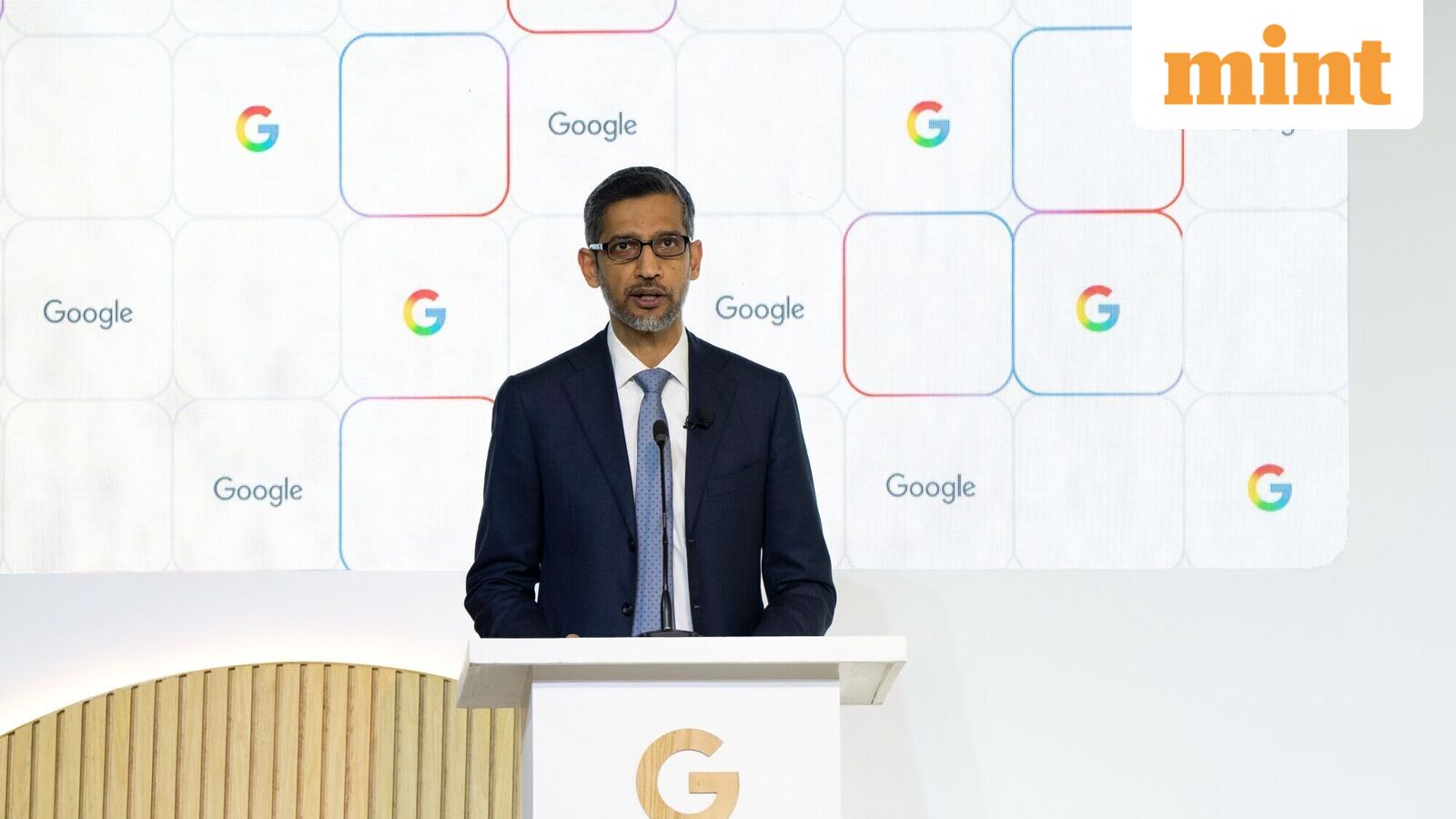
Taking the stage at the AI Impact Summit on Thursday, Sundar Pichai, chief executive officer of Google and Alphabet Inc., outlined an ambitious expansion of the company’s artificial intelligence footprint in India, anchored by a $15 billion infrastructure investment and a new full-stack AI hub in Andhra Pradesh.
Calling AI “the biggest platform shift of our lifetimes,” Pichai positioned India at the center of Google’s next phase of growth, combining gigawatt-scale computing power, subsea connectivity and workforce training to drive what he described as “hyperprogress.”
The sharp takeaway: Google is making one of its largest global infrastructure bets in India, aiming to turn Visakhapatnam into a global AI node while pushing for responsible deployment to avoid a widening AI divide.
Vizag vision
Recalling his early life, Pichai said he would cross Visakhapatnam on his way to Indian Institute of Technology Kharagpur from Chennai on the Coromandel Express.
“I remember it being a quiet and modest coastal city, brimming with potential. Now, in that same city, Google is establishing a full-stack AI hub, part of our $15 billion infrastructure investment in India.”
He added that sitting on that train, he never imagined Vizag becoming a global AI hub.
The Andhra project will house gigawatt-scale computing capacity and a new international subsea cable gateway. It forms part of the wider America-India Connect initiative aimed at bridging the digital divide and linking Indian businesses to global markets through four new fiber-optic systems.
Pichai emphasized that the infrastructure push will create jobs and make cutting-edge technology more accessible to businesses and individuals across India.
Responsible progress
“No technology has me dreaming bigger than AI. It is the biggest platform shift of our lifetimes. We are on the cusp of hyperprogress and new discoveries that can help emerging economies leapfrog legacy gaps,” he said.
“But that outcome is neither guaranteed nor automatic. To build AI that is truly helpful for everyone, we must pursue it boldly, approach it responsibly and work through this defining moment together,” he further added.
While projecting optimism, Pichai cautioned that the benefits of AI will require deliberate governance, collaboration and inclusion to prevent a new technological divide.
He concluded by calling for deeper partnership between technology companies and governments, urging regulators to set the rules of the road while also acting as innovators. The real value of AI, he said, will be realized only when embedded in public services—from rural electrification to urban infrastructure management.
Real-world impact
Pichai pointed to concrete examples where AI is already delivering impact. He cited NeuralGCM models that provided critical monsoon forecasts to millions of Indian farmers last summer.
Beyond agriculture, he highlighted the work of Google DeepMind, whose AlphaFold system—an AI breakthrough in protein folding that won a Nobel Prize—is now being used by three million researchers in more than 190 countries to develop malaria vaccines and tackle antibiotic resistance.
He also referenced global use cases in public administration: from the Ugandan government deploying AI and satellite imagery to identify priority electrification areas, to Memphis, Tennessee using AI scans of road surfaces from buses to fix potholes more efficiently.
“Tech companies must also step up — building products that boost knowledge, creativity and productivity to help people achieve their dreams,” he said.
Acknowledging workforce disruption risks, Pichai underlined the need for large-scale skilling.
“Training is crucial,” he said, noting that Google has trained 100 million people in digital skills and rolled out a new AI Professional Certificate designed to help workers integrate AI into their jobs.
In a lighter moment, he joked that his 83-year-old father would be more impressed if he could take him on a fully autonomous ride in a Waymo car on India’s busy roads. “Still working on that one, Dad.”
By combining world-class digital infrastructure, local engineering talent and regulatory partnership, Pichai argued that India is uniquely positioned to lead in the AI era.
The capability and intent to improve lives at scale already exist, he said. The task now is collaborative execution—ensuring that AI enhances productivity, strengthens public systems and drives inclusive growth across citizens and businesses alike.

