

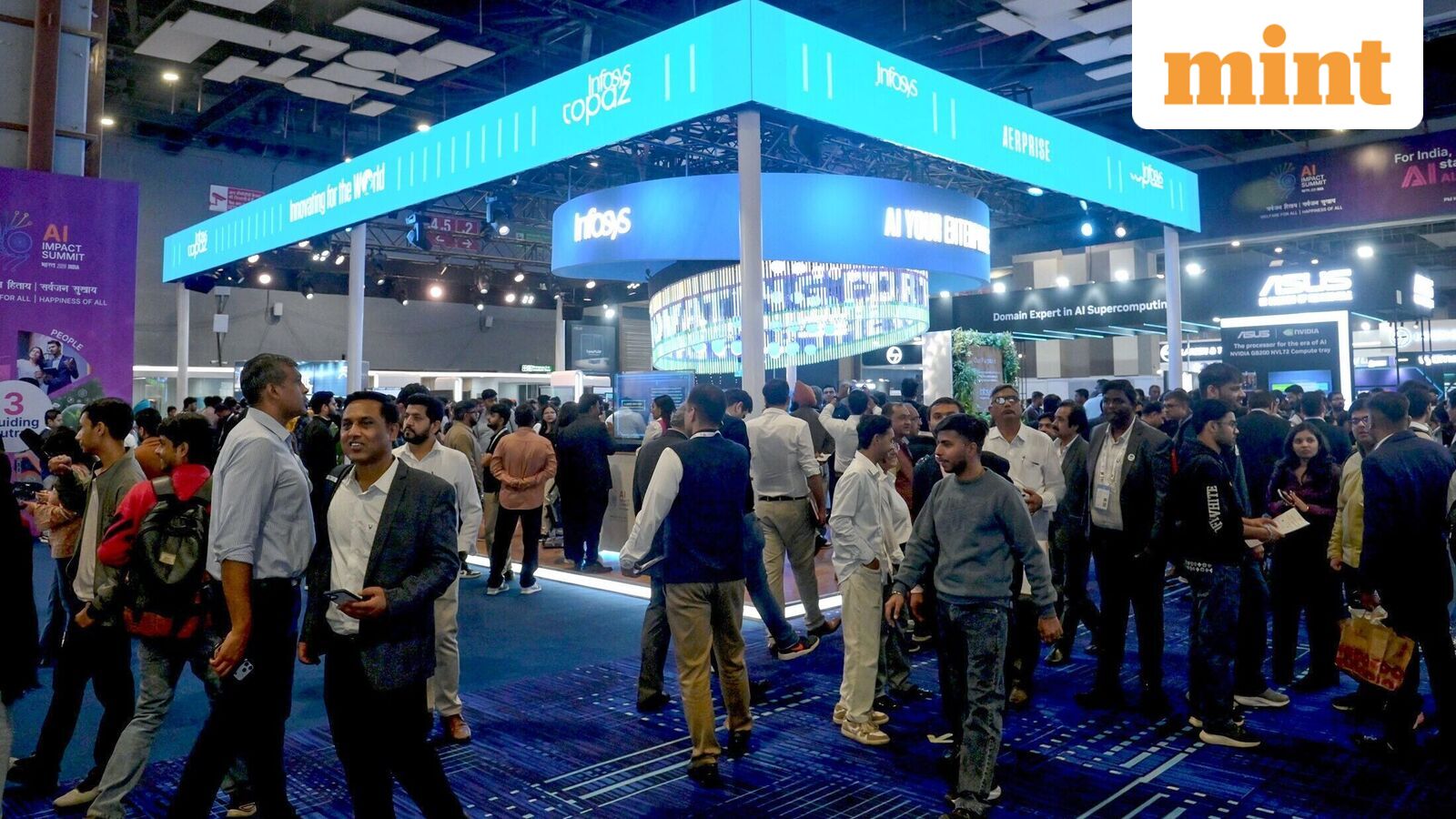
New Delhi: India’s grand artificial intelligence (AI) showcase concluded on Friday after a week of investment announcements and, despite organizational hiccups, was widely seen by industry participants as a valuable platform for networking, partnerships and talent discovery.
The unveiling of a potential New Delhi declaration was extended by a day, with Union IT minister Ashwini Vaishnaw saying at a concluding media briefing that “over 70 countries” have already signed the declaration.
“By the time the Summit officially wraps up on Saturday, we’re likely to see close to 80 countries signing. All parties have already signed it—there’s no sign that any major country has not signed it,” he said.
An early copy of the declaration that mint saw mentioned key points of consensus including charter for democratic diffusion of AI, global AI impact commons, trusted AI commons, international network of AI for science institutions, and voluntary guiding principles on resilient, innovative and efficient artificial intelligence.
The five-day India AI Impact Summit 2026 brought to a close a week in which two of the country’s largest conglomerates, Reliance and Adani groups, announced a cumulative $210 billion in data center investments.
This was bolstered by a coalition of venture capitalists announcing a $1 billion AI startups fund, three Centre-funded startups launching their AI models, and a spate of world leaders making their presence felt in New Delhi.
To be sure, the Summit had its share of controversies. The first day saw a lack of organizational directives, followed by exhibitors highlighting that at least two full days out of five were marred at the expo as a result of security restrictions.
While the ministry of electronics and IT (Meity), the nodal ministry behind the organization of the Summit, added an extra day for the expo to remain open on Saturday, this didn’t do much to assuage exhibitors, who had made prior hotel and flight bookings.
The bigger controversy was around Greater Noida’s Galgotias University, which was asked to leave the expo on Wednesday after its quadruped robot was found to be a commercially bought unit, not indigenously developed as claimed.
On his part, Vaishnaw acknowledged the incidents, but said that “we took immediate action to ensure that India’s legitimate AI startups are not affected”.
Industry stakeholders largely agreed.
“This is the first event of this scale in the Global South, and it is extremely important for us to have been here,” said Ana Paula Assis, IBM’s chairperson for Asia-Pacific, Middle-East and Africa. “We’ve succeeded in meeting many valuable clients, and an event of this scale is crucial especially for smaller companies building key niche technologies that could be invaluable for us to see as vendor partners.”
Startups, too, felt that the Summit presented a strong opportunity. Saravanan Thangadurai, chief executive of Chennai-based tech services startup Sysmedac, said the platform “was a great place to meet exhibits that align with what we are working on”.
”You don’t get such a consolidated platform often, where you get to see, hear and meet so many people and have like-minded conversations. As a small tech business in India, such a Summit was invaluable even if we did not become an exhibitor,” Thangadurai, who was in attendance since Tuesday, said.
Disclosing that more than 500,000 visitors participated in the event, Vaishnaw said, “We’ve had practically every major AI player in the world, and so many startups getting the opportunity to showcase their work.”
“Overall, the quality of discussions were phenomenal,” he added. “This is AI of the humans, for the humans and by the humans. We’ve seen over $250 billion investments in AI infrastructure, and the important takeaway is that the world showed confidence in India’s role in the future of AI.”
Consultants also found the Summit a “productive ground” to meet the right AI talent at one place.
Hari Balaji, partner for technology consulting at EY India, said the firm’s booth saw strong footfall from industry professionals, startups and many young students, several of whom came with resumes and inquired about job opportunities at EY.
Amit Zavery, president and chief operating officer of ServiceNow, echoed IBM’s Assis to say that “we had many fantastic conversations with partners and client-vendors, the likes of which are unusual to see in one consolidated place. From the lens of having such an exhibition for AI, the Summit has been great for us”.
It is this that analysts, too, feel will be the key takeaway. Anushree Verma, senior director analyst at Gartner, said that “the focus of the Summit was never going to be on AI models, or the declaration—it is a key platform for small Indian ventures to meet and network with a wide range of large global firms.”
Kashyap Kompella, founder of tech consultancy firm RPA2AI Research, concurred, adding that despite its controversies, “the Summit showcased confidence in India’s AI ecosystem, and the volume of companies on the ground is proof that despite hiccups, this was the main gathering to be at for small AI upstarts”.

