

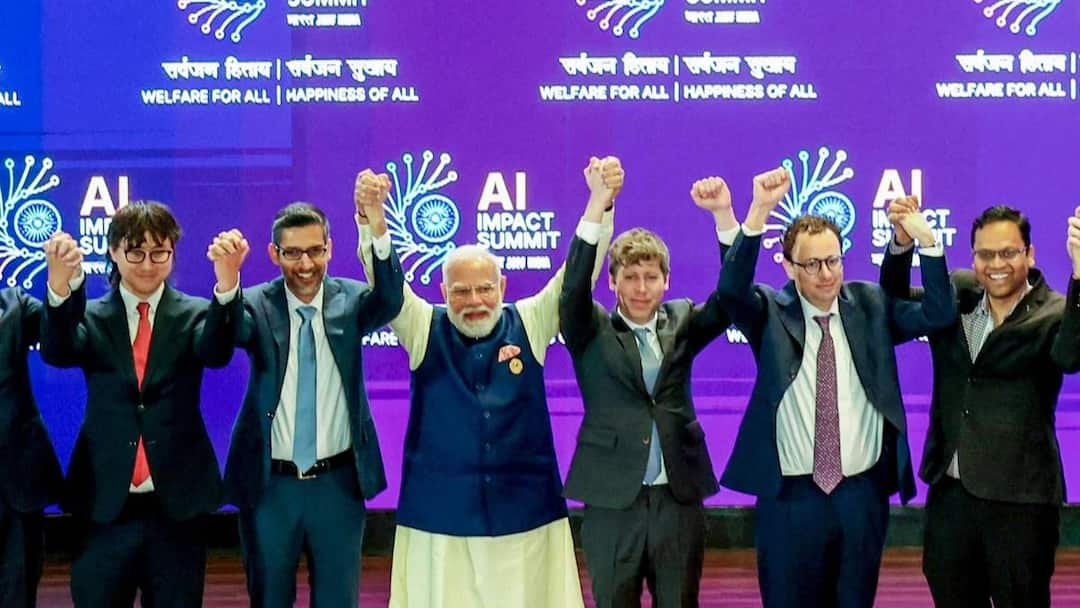
The five-day India AI Impact Summit organized under the chairmanship of India concluded successfully on Friday. During this period, 88 countries and international organizations including America, China, France, Australia and Britain signed the ‘New Delhi Declaration on AI Impact’.
This manifesto sets a direction for the future of AI and also shows India’s growing role at the global level.
Big diplomatic success for India
This agreement is being considered a big victory for India. Last year, during the AI Impact Summit, America and Britain refused to sign the declaration citing European rules. But in New Delhi, India was successful in bringing all the countries on one platform. India aims to democratize AI, so that this technology is not limited to a few big companies or a limited number of people.
What things were agreed upon in the manifesto?
Under the declaration, the signatory countries have agreed to create several voluntary structures and platforms.
Democratic Diffusion Charter
Under this initiative, it has been said to increase everyone’s access to the basic resources of AI and to promote new experiments at the local level.
Global AI Impact Commons
This will be a common platform, which will help in adopting and replicating successful AI experiments in different sectors.
Trusted AI Commons
A common repository of technical tools, standards and good practices will be created to strengthen the security and trust of AI systems.
International Network of AI for Science Institutions
Under this initiative, institutions around the world will be connected to increase the use of AI in scientific research.
Focus on society and employment also
It is believed in the manifesto that AI has the potential to advance all sections of the society. For this, it has been said to create a ‘Social Empowerment Platform’. Also, in view of the changing employment due to AI, voluntary guidelines have also been agreed upon to teach new skills to people and strengthen the workforce.
The biggest challenge will be to implement
Although 88 countries and organizations have signed this declaration, the real challenge will be to implement these promises on the ground, as all commitments are voluntary. According to sources, the European Union had initially objected to some points because they resembled the Charter of the United Nations. But considering India as an important trading partner, the European Union finally agreed to sign this declaration.

