

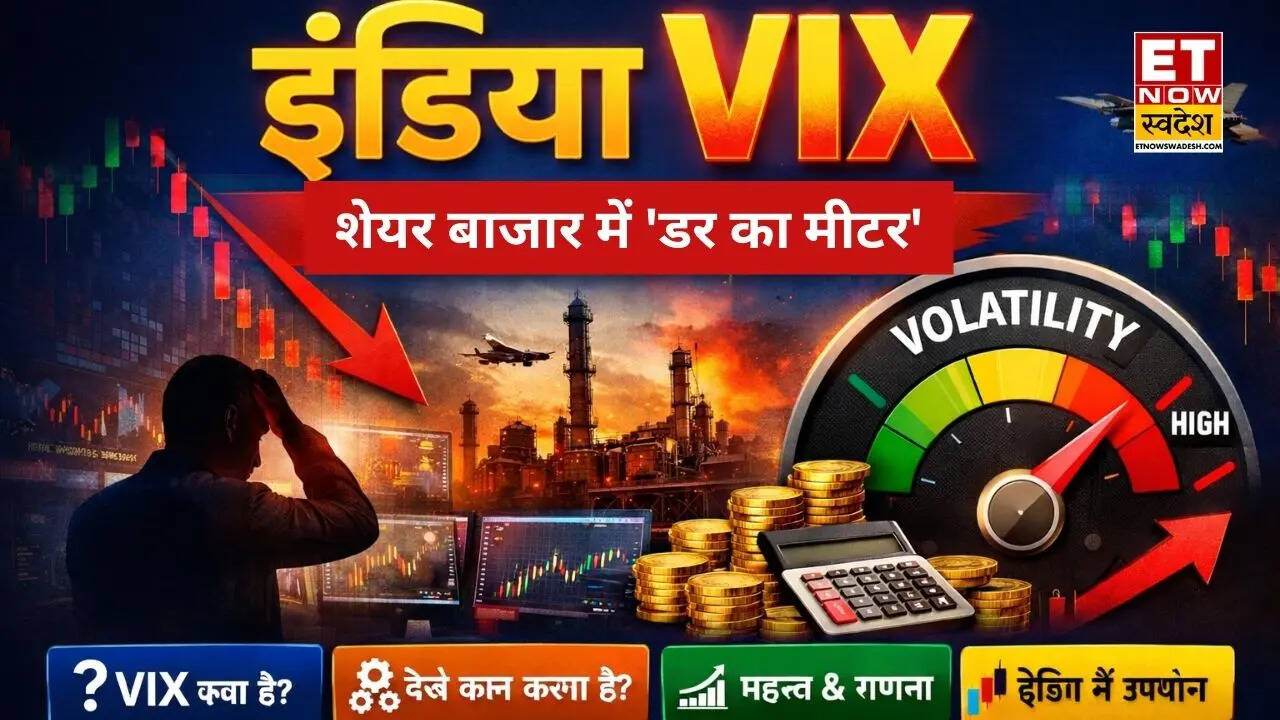

India VIX: If India VIX is high, it means there is more fear and uncertainty in the market…
highlights
- Market fluctuations bring both concerns and opportunities for every investor.
- In such a situation, it becomes very important to understand the possible market movements in advance.
- India VIX, which is also called the ‘fear gauge’ of the market, fulfills this need.
What is India VIX?
When there is a sudden sharp fall or rise in the stock market, investors often keep an eye on a particular index – India VIX. In common language, it is called “fear gauge” i.e. the scale that measures fear in the market. But what is it and how does it work?
Read full article
The full form of India VIX is India Volatility Index. It is calculated by the National Stock Exchange (NSE) on the basis of the order book of Nifty options. It was started by NSE in the year 2003. This index tells how much the market can move up or down in the coming 30 days.
- VIX is high – means more fear in the market and possibility of sharp fluctuations.
- VIX is low – that means the market is somewhat calm
India VIX estimates the expected volatility of Nifty 50 over the next 30 days. High VIX indicates that it is time for investors to remain cautious at the moment. The thing to note is that this is not a price index like Nifty 50. Nifty is based on the prices of 50 stocks, while VIX reflects the volatility derived from the prices of options.
The highest recorded level of India VIX (Volatility Index) was 92.5, which was reached in November 2008 during the Global Financial Crisis. The second highest peak came in March 2020, reaching about 87, during the beginning of the COVID-19 pandemic. In the general range, VIX usually fluctuates between 15 and 35.
Why is it called the market’s ‘fear gauge’?
- Increasing VIX means increasing panic and uncertainty in the market.
- Falling VIX means stable and calm markets.
- VIX going above 16 indicates that sharp fluctuations may be seen in the coming days.
- India VIX is the pulse of the market. It does not directly tell the prices, but gives an indication of the fears and expectations going on in the minds of investors.
- A high VIX indicates that the road ahead may be bumpy, while a calm VIX points to a stable environment.
- Both experienced traders and fund managers keep a close eye on this index.
How is India VIX calculated?
India VIX is based on the technology of the Chicago Board Options Exchange (CBOE) with some modifications to suit the Indian market.
Simple formula-
India VIX = 100 × √((Sum of Weighted Implied Volatility²) / Total Weight)
Here total weight means the sum of open interest of all the options which are included in the calculation.
What factors are taken into account?
- Time-to-Expiry – Time until expiry is counted in minutes.
- Interest Rate – Risk-free rate is charged for a period of 30-90 days.
- Forward Index Level – The latest price of Nifty futures of the respective expiry.
How did it start?
In 1973, three economists Fischer Black, Robert Merton, and Miron Scholes developed the famous Black–Scholes model for option pricing. Even today, this model is the foundation for measuring volatility at the global level.
Why important for option traders?
- Vicks has special importance for option traders.
- Buying options may be beneficial if VIX is expected to rise
- If VIX is falling then option sellers can benefit
- Traders adopt strategies like ‘straddle’ or ‘strangle’. However, they may become expensive in anticipation of higher volatility.
- Another approach is to buy VIX futures, which allows you to simply bet on volatility without worrying about market direction.
Relationship between India VIX and Nifty
Generally a negative relationship is seen between VIX and Nifty. When the VIX is at a low, the market is often near a top. When the VIX reaches a high, the market may be near a bottom. This trend gives important signals in index trading.
help understand risk
- If India VIX is high, it means there is more fear and uncertainty in the market.
- If the VIX is low, the market is considered calm.
beneficial for traders
Helps intraday traders set stop-loss and reduce risk. Based on this, option traders decide whether to buy or sell the option. Buying options in high volatility can be beneficial
What is important for investors?
- Long-term investors can understand the level of risk in the market by looking at VIX and can make investment strategies accordingly.
- Helps in portfolio management.
- Portfolio and mutual fund managers decide on the basis of VIX whether to buy high-risk (High Beta) shares or increase investment in low-risk (Low Beta) shares.
How to read India VIX?
Suppose if India VIX is at 17 right now, it simply means that traders are expecting 17% volatility in the next 30 days.
How to use India VIX in trading?
India VIX shows the potential volatility of the market. If it is understood properly, it can become a very useful tool for traders and investors.
What should long-term investors do?
If VIX is rising, it means fear and uncertainty are increasing in the market. At such times, investors can shift to defensive sectors (like FMCG, Pharma). Can increase hedging (protection) in your portfolio
If the VIX is decreasing, the market is considered relatively calm.
Trading VIX Futures
VIX futures can be traded directly on the National Stock Exchange (NSE). If you think there will be more volatility in the market going forward, then you can buy VIX futures.
With this, one can earn only from volatility without guessing the direction of the market (up/down).
Mean Revision Strategy
It has been observed on long-term charts that VIX often moves within a certain range (e.g. 13–17). If the VIX goes too low then there is a high possibility of the market moving forward, if the VIX goes too high then the possibility of a subsequent fall increases.
Traders take positions in the hope of a return to this mean level (Mean Reversion).
Main factors affecting India VIX
- There are many important factors influencing India VIX, which determine the potential volatility of the market.
- Firstly, economic data such as GDP growth, inflation rate, interest rates and consumer spending influence the market direction and investor confidence.
- If these figures are different from expectations, then sharp fluctuations are seen in the stock market, due to which India VIX can go up or down.
- Apart from this, global events like geopolitical tensions, trade wars, natural disasters or international crises also shake the market sentiments. In such circumstances, uncertainty increases, trading activity intensifies and VIX rises as volatility increases.
- Quarterly results of companies also play an important role. If corporate earnings are better or weaker than expected, there is a sharp movement in the shares, which changes the sentiment of investors and its effect is visible on India VIX.
- It plays an important role in risk assessment, investment decisions, portfolio management, option pricing, hedging and asset allocation.
- Influenced by economic data, global events and market sentiment, this index helps investors make better and wise decisions in changing market conditions.
related news
end of article

