
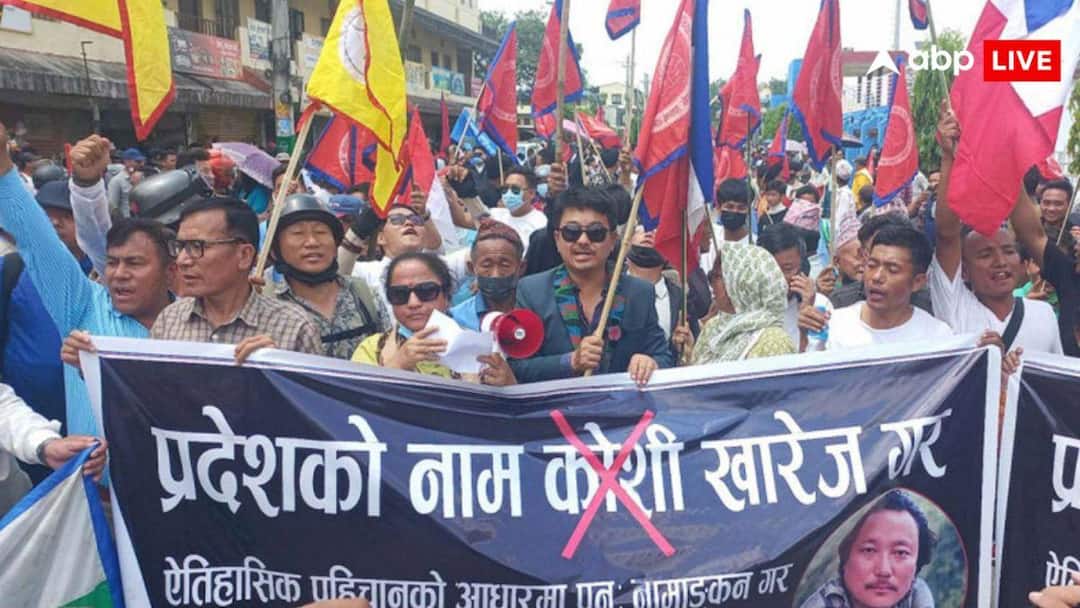
After the Gen-Z movement in Nepal, eastern Nepal became the center of conflicts. Slogans of ‘No Limbuvan, no entry’ kept echoing from Panchthar to Jhapa. These days there is an election atmosphere, but the issue of identity is silent. As the political consciousness generated by the movement is getting lost in the crowd of party changes, the issue of identity is also being marginalized. This is the same geographical area where a campaign to boycott those supporting the name ‘Koshi’ was once launched. After the mass movement, Panchthar became the center of the Limbuwan movement.
The then Federal State Council held its first national conference and resolved to establish the State of Limbuwan in 9 districts located east of Arun at the Sumhatlung Temple in Phidim-4. After this, many movements took place in the East. Along with the Federal Limbuwan State Council, several parties and pressure groups including the Federal Democratic National Forum, Limbuwan Revolution and Janmukti remained active in the movement for almost two decades. In this same movement, two people named Prince Mangatok of Jhapa and Manil Tamang have already lost their lives before 2079 BS.
After the naming of ‘Koshi Pradesh’, on Chaitra 5, 2077 BS, a group in support of the recognition was protesting in front of the Chief Minister’s Office in Biratnagar. The police lathicharged the protesters. Padam Bahadur Limbu (Lajehang), 42, central co-commander of the Limbuwan volunteers, was seriously injured. Five days later, he died during treatment at BP Koirala Institute of Health Sciences, Dharan.
Limbu was declared a martyr in the cabinet meeting on 24th of Chaitra month. It was decided to give compensation to the family. But on the main issue the government backed down and said it would cooperate in taking the ‘naming movement’ forward through talks with the provinces. This process of retreat continues till today.
Did not commit to Limbuwan
In the Constituent Assembly elections of 2064 and 2070, ‘No Limbuwan, No Entry’ campaigns were conducted in Panchthar against parties and candidates who had not committed to Limbuwan. In the 2074 Constituent Assembly elections, the issue also gained support in the parliamentary politics of the province, with the federal Limbuwan State Council led by Kumar Lingden of former Province 1 winning a seat in the Kosi Provincial Assembly through proportional representation. However, in the elections of 2079, the representation of pro-identity parties became zero. Despite street protests on 17 Phalgun the same year, the provincial assembly adopted the name ‘Koshi’.
Researcher Dilvikram Angdembe says that the parties which earlier dominated the Parliament and the government used the identity issue only as a stepping stone to gain power and the advocates of identity did not get access to it, which is why this identity issue could not be awakened.
Even after the former Province 1 was renamed Kosi, the movement for nomination continued in a phased manner. In this sequence, pro-identity forces united in the ongoing ‘Remove Cable Car’ campaign in Pathibhara. But even before these two issues were resolved, the leaders and activists supporting the identity themselves admit that the ‘Jan-Ji’ movement of 23 and 24 Bhadra took the country to a new level. There are very few candidates supporting the issue of identity in the House of Representatives elections to be held on Falgun 21. Most of the parties participating in the 2017 provincial assembly elections and the 2016 Constituent Assembly elections gave priority to the issue of identity.
Planning to raise the voice of your identity
In 2017, only the then CPN-Maoist Centre, Federal Limbuwan Forum and Janata Samajwadi Party had raised the issue, while UML and Congress were adopting a centrist stance. But this time, only three candidates, namely Federal Limbuwan Forum, JSP and National Progressive Alliance, contesting the elections have given priority to the issue of identity.
Sanjuhang Palungwa, the founding chairman of the Federal Limbuwan State Council, is the National Progressive Alliance’s proportional candidate in this election. His name was at the first place in the list presented by the party and now he is planning to raise the voice of his identity raised on the streets in the Assembly. In the past, they had focused on demanding the renaming of the former Province 1, including nine districts located east of Arun, to Limbuwan State.
He said, ‘In this election, they are seeking votes by moving away from the name controversy and saying that the influence of western culture should be stopped and multiple identities should be established. Identity cannot be established only through street conflicts. I will get this debated in the House with your votes. Now the challenge is not only to change the name of Limbuwan, but also to protect the original culture and civilization of Nepal.
For the original civilization, it is necessary to preserve the ancient Hindu culture, Buddhism and Kirat civilization here. The issue of identity has not been included not only in the candidates but also in the party manifestos.
The issue of identity was not raised even in the manifestos
Election analyst Balkrishna Mabohang believes that constitutionally this issue was marginalized. The issue of identity cannot be raised even in manifestos. He said, ‘The public opinion of the party raising the issue of identity is not visible in the areas where the issue of identity is raised. The main rivals are, therefore, it is doubtful that this issue will find a place in the constitutional discussion.
He said, ‘The silence of various parties on the issue of identity is surprising. The parties presenting impractical and baseless schemes in the name of development are standing silent on the issue which the public is demanding. Not only the party, but even the leaders and workers supporting the identity issue are gradually abandoning the issue. Most of the leaders and workers holding district, provincial and central level responsibilities in the Federal Limbuwan State Council and Democratic National Forum are joining old parties like Congress and UML, while some have taken refuge in new parties like Rashtriya Swayamsevak Sansthan, Ujjain Nepal and Shram Sanskriti.
Also read: Iran’s top leadership including Khamenei eliminated in US-Israel attack, Trump claims, who will take command now?