


That company is Acutaas Chemicals, traditionally known for advanced pharmaceutical intermediates. Today, it is expanding into semiconductor-grade photoresist chemicals and battery electrolyte additives, two niches that demand extreme purity, deep process control, and long qualification cycles. The opportunity is large, but so are the execution risks.
The timing matters. Global battery demand crossed 1 terawatt-hour for the first time in 2024, driven by electric vehicle sales that rose 25% to 17 million units. Battery pack prices have fallen below $100 per kWh, accelerating adoption across mobility and grid-scale energy storage. As deployment rises, demand for high-quality battery chemicals is growing in parallel.
In India, battery chemicals are emerging as a sunrise industry, expected to grow at a compound annual growth rate (CAGR) of over 15%, supported by policy initiatives such as the ₹18,100 crore Production Linked Incentive (PLI) scheme for Advanced Chemistry Cell battery storage.
The Atmanirbhar Bharat mission reinforces this opportunity by pushing localization across the value chain, from raw material processing to cell manufacturing, to reduce import dependence.
A similar structural shift is underway in semiconductors. India’s semiconductor market is projected to double from ₹4.5 trillion in 2024 to ₹9 trillion by 2030, driven by demand from mobile handsets, IT, telecommunications, consumer electronics, automotive, aerospace, and defense. Mobile devices and industrial applications already account for nearly 70% of industry revenue.
It is against this backdrop that Acutaas is placing its bet. Will it pay off?
Built on APIs
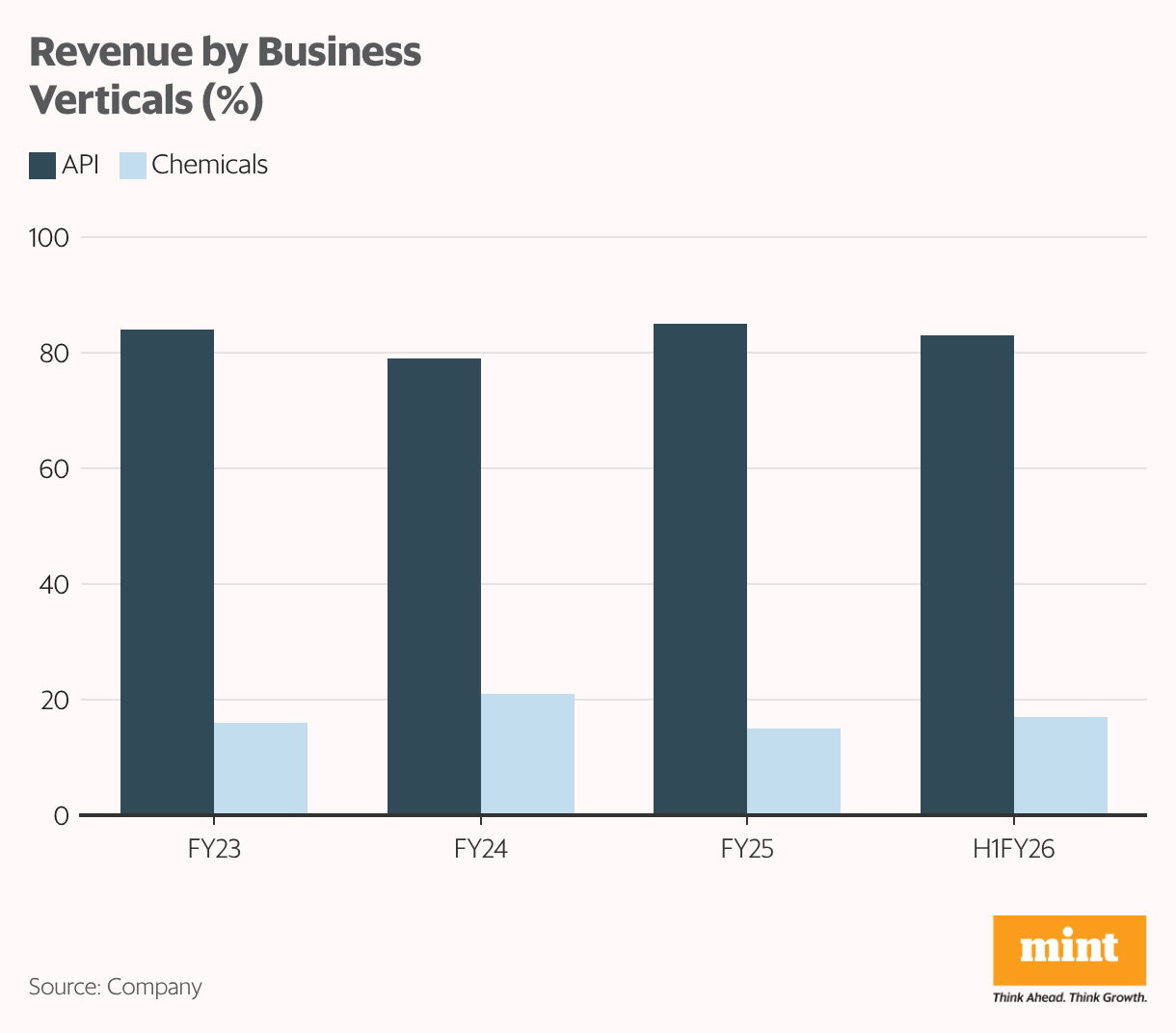
Acutaas is traditionally a specialty chemicals and advanced pharmaceutical intermediates (API) company, and APIs remain the backbone of its business. In FY25, the segment accounted for 84.8% of total revenue, making it the company’s largest revenue driver.
The API business focuses on the development and manufacturing of intermediates for regulated and generic APIs, as well as New Chemical Entities. It caters to more than 17 therapeutic segments, including anti-cancer, anti-psychotic, cardiovascular, and anti-depressant and anti-inflammatory drugs.
In several critical intermediates, Acutaas commands 50-90% market share, supported by its ability to manufacture products up to the N-1 stage through multiple synthetic routes. A key differentiator is its deep backward integration strategy, with over 90% of pharmaceutical intermediates integrated with basic chemicals.
This integration gives the company tighter control over supply, quality, and cost structures, while enhancing customer reliability. Aside APIs, Acutaas operates a specialty chemicals business that contributed 15.2% of revenue, supplying more than 30 established products, including parabens and methyl salicylate, to the personal care and cosmetics industry.
The company is export-heavy. Exports account for 74% of total revenue, with the remaining 26.2% coming from India. Acutaas serves customers in about 55 countries, with Europe accounting for 63% of exports and China 2.5%.
Chemicals for chips
Beyond its legacy businesses, the more strategic shift underway is Acutaas’ diversification into high-growth emerging segments, particularly semiconductors and batteries.
The company entered the semiconductor space in FY23 by acquiring a 55% stake in Baba Fine Chemicals, which specializes in electronic-grade photoresist chemicals used in the photolithography process of chip manufacturing. These products require ultra-high purity standards, with contamination control at parts-per-billion levels to meet global fab specifications.
As of 2025, Acutaas is the only manufacturer of semiconductor-grade photoresist chemicals in India. Its strength in this segment is anchored in advanced quality systems, clean process design, and experience handling highly technical chemical formulations.
Scaling up, slowly
To scale its semiconductor ambitions, Acutaas is expanding its footprint across major hubs, including South Korea, Japan, and Taiwan. A key milestone is the formation of Indichem Inc., a joint venture with South Korea’s J & Materials Co. Acutaas holds a 75% stake, while the Korean partner brings technology, production expertise, and market access.
Indichem will manufacture and supply advanced semiconductor chemicals, including photo acid generators, for Korean and global markets. Commercial production and revenue contributions are expected to begin in H2 FY27. Until then, semiconductor revenue is likely to remain lumpy.
The volatility stems from the business’s earlier reliance on a single large customer, creating concentration risk during demand slowdowns. This was evident in FY25, when Baba Fine revenue declined nearly 41% year-on-year to ₹17.6 crore, while net profit fell 70% to ₹3.8 crore due to weak demand.
Besides the JV, Acutaas has commercialized several new products. While initial volumes are modest, management expects these launches to support gradual growth. Over the medium term, the semiconductor portfolio is expected to broaden and become a meaningful contributor to overall revenue.
Riding the battery wave
Acutaas has also positioned itself as an early mover in battery chemicals, focusing on advanced materials for lithium-ion batteries. The global battery chemicals market is projected to exceed $107 billion by 2029, up from $70 billion in 2025, driven by EV adoption and falling battery costs.
This vertical is a core pillar of the company’s “Industries of the Future” strategy and aligns with the global effort to diversify battery supply chains away from China. Acutaas entered this segment in 2022, targeting high-value electrolyte additives that enhance battery performance, safety, and longevity.
The company is recognized as India’s first player (outside China) to develop electrolyte additives at a global scale. Its core products are Vinylene Carbonate (VC) and Fluoroethylene Carbonate (FEC), which form protective layers on electrodes, improving stability, extending battery life, and reducing the risk of thermal runaway.
Beyond VC and FEC, Acutaas has built an innovation pipeline of around 10 products for next-generation lithium-ion and alternative battery technologies.
To scale this business, the company is investing ₹180 crore to set up a dedicated electrolyte additives plant at Jhagadia, Gujarat, with planned capacities of 2,000 metric tonnes each for VC and FEC. The capacity aligns with signed customer contracts and is expected to reach optimal utilization within about three years.
Management expects a payback period of roughly 3.5 years. Production is scheduled to commence in Q4FY26, with revenue contribution from FY27. The facility is entirely export-oriented, with no current plans for domestic supply, and Acutaas already has contracts with customers across geographies.
While this vertical is a key growth driver, EBITDA margins are expected to remain below the 28–30% levels of the API business. The company is also setting up another battery chemicals plant in Greater Noida.
Locking in customers
Besides its expansion into new-age industries, Acutaas is accelerating its shift towards a contract development and manufacturing organization (CDMO) model to improve long-term revenue visibility. The company has set a target of achieving ₹1,000 crore in CDMO revenue by FY28, supported by rising customer inquiries and the addition of new molecules to its development pipeline.
Several CDMO projects are expected to begin contributing to revenue by the end of FY26, subject to regulatory approvals. At the same time, Acutaas is phasing out low-margin products and reallocating capacity toward higher-margin offerings, a shift expected to improve margins and the overall quality of earnings as the CDMO business scales.
Margins kick in
Acutaas reported robust financial performance in the first half of FY26. Revenue rose 21% year-on-year to ₹513 crore, with the API business accounting for 83% ( ₹428 crore). Growth was driven largely by the CDMO business, supported by strong contributions from advanced intermediates.
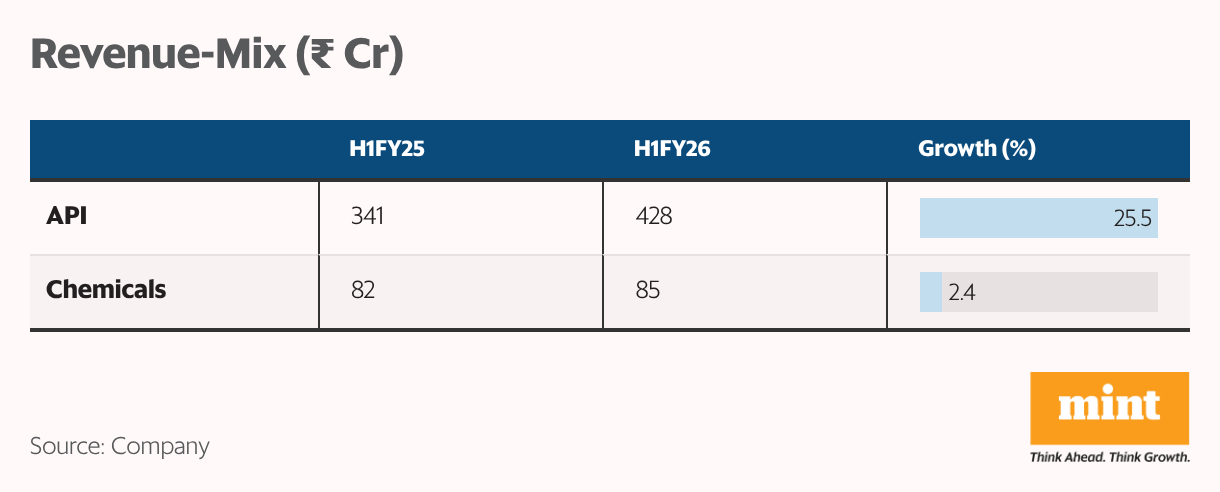
The remaining 17% ( ₹85 crore) came from specialty chemicals. Operating leverage drives EBITDA up to 86% ₹146 crore, with margins expanding to 28% from 19% a year earlier. As a result, net profit more than doubled to ₹116 crore, up from ₹52 crore in H1 FY25.
Return ratios remain strong, with ROCE at 25% and ROE at 23%, reflecting efficient capital use.
Premium valuations, execution risks
At ₹At Rs 1,710 per share, Acutaas trades at an EV/Ebitda multiple of 41x—not inexpensive. While the valuation is at a discount to larger peers such as Divi’s Laboratories (45x), it remains a premium to Torrent Pharmaceuticals (35x) and Sai Life Sciences (33x).
Risks remain. The industry has historically relied heavily on China for raw materials. Although Acutaas has reduced its China sourcing to 21% in FY25, from 70% a decade ago, supply disruptions remain a concern. Product and customer concentration also pose risks if key clients cut output.
That said, diversification into semiconductors and battery chemicals reduces reliance on a narrow set of products over time. Ultimately, execution, customer diversification, and timely scale-up across these newer verticals will determine whether Acutaas’ dual bet pays off.
Madhvendra has over seven years of experience in equity markets and writes detailed research articles on listed Indian companies, sectoral trends, and macroeconomic developments.
The writer does not hold the stocks discussed in this article.
The purpose of this article is only to share interesting charts, data points, and thought-provoking opinions. This is NOT a recommendation. If you wish to consider an investment, you are strongly advised to consult your advisor. This article is strictly for educational purposes only.

