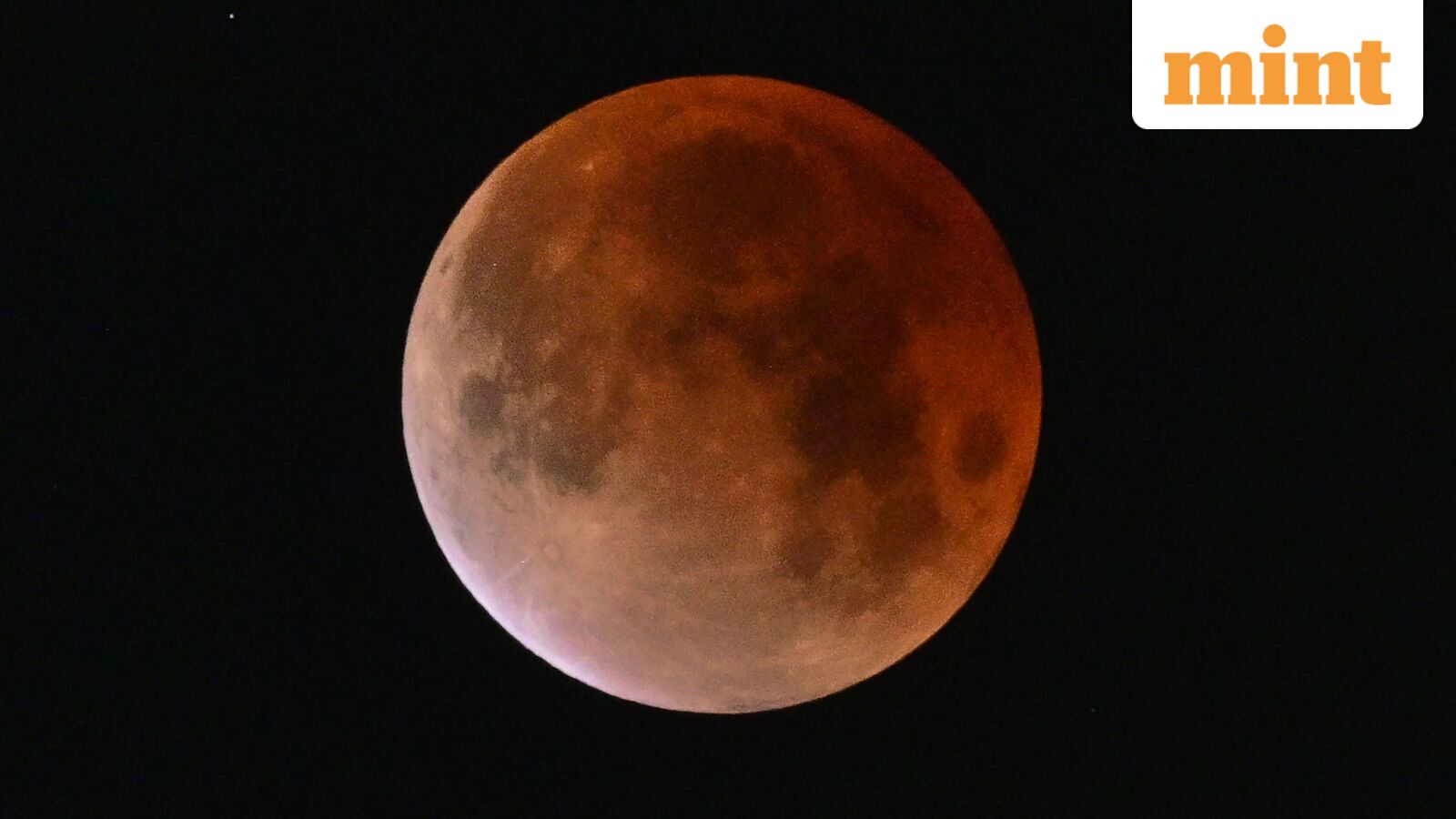
As a lunar eclipse — also known as Chandra Grahan — takes place, people across the globe are looking up to witness the rare spectacle. In some regions, the event is unfolding against the backdrop of the night sky. The phenomenon occurs when the Earth positions itself directly between the Sun and the Moon, causing its shadow to fall across the lunar surface and producing one of the most dramatic sights visible from our planet.
For those unable to view it because of cloudy skies or geographic limitations, a live stream of the celestial event is being provided, allowing audiences to watch the “Blood Moon” in real time.
Unlike a solar eclipse, this event poses no risk to the eyes and can be observed safely without special equipment. As the eclipse advances, the Moon slowly dims and, at its peak, can appear reddish or copper in color — a phase commonly referred to as the “Blood Moon.” Data and observations released by NASA explain that this hue is created when sunlight passes through Earth’s atmosphere, bends, and filters onto the Moon’s surface.
Visibility of the eclipse varies across regions, depending on local time zones and weather conditions.
Meanwhile, social media platforms are flooded with photographs and reactions from viewers worldwide, transforming the event into a shared global experience for astronomy enthusiasts.
Visibility Conditions in India
In India, the lunar eclipse will largely coincide with moonrise, meaning only the concluding stages of the celestial event will be visible in most parts of the country. The India Meteorological Department (IMD) has indicated that viewers across much of India will be able to observe the final phase of the eclipse as the Moon appears on the horizon at sunset.
Eastern regions are expected to get a better view. As the Moon rises earlier in the eastern parts of the country, residents of Northeast India and the Andaman and Nicobar Islands are likely to witness more striking visuals, including the closing moments of the “Blood Moon” totality.
Key Timings for India
Total Eclipse Phase: 4:34 PM – 5:33 PM (visible only in parts of Northeast India)
Maximum Visibility Window: 6:33 PM – 6:40 PM (ideal viewing time for most cities)
Partial Phase End: 6:47 PM or 6:48 PM
Unlike a solar eclipse, this event can be safely observed without protective eyeglasses. Experts recommend selecting a spot with a clear and unobstructed view of the eastern horizon for the best experience. Binoculars or a small telescope can further enhance visibility.
City-wise Moonrise Timings
Delhi and Mumbai: Moonrise is expected between 6:22 PM and 6:42 PM. Viewers in these cities will likely see only the final 5 to 25 minutes of the partial phase.
Bengaluru and Chennai: The Moon will rise around 6:20 PM, offering approximately 15 to 20 minutes of visibility.