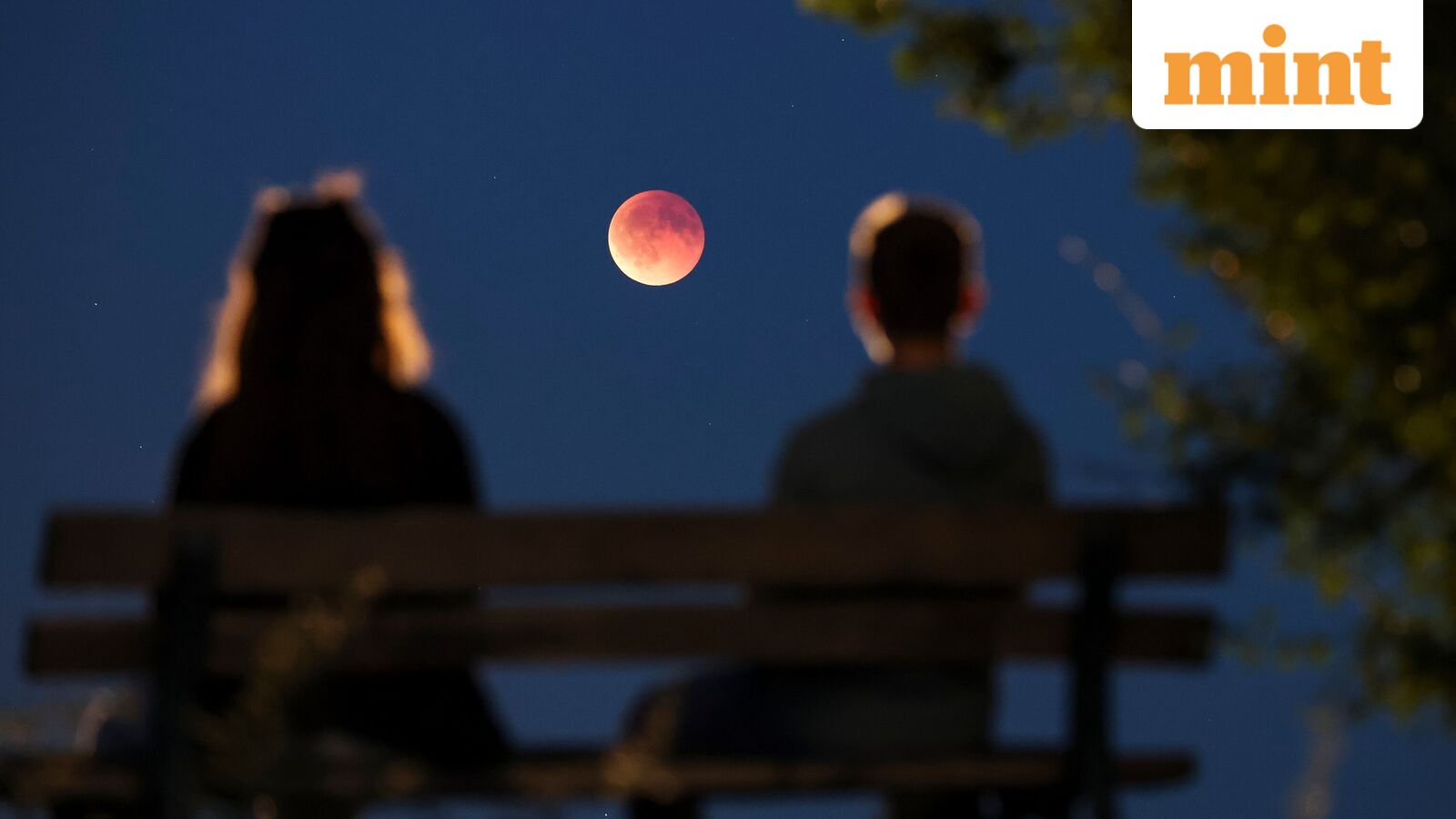
Chandra Grahan, also known as the lunar eclipse is set to occur today, 3 March. The first lunar eclipse of the year will be visible to 40% of the world’s population. During this astronomical event, the Moon will appear red, and this phenomenon is known as ‘blood moon.’ Let’s find out more details about Chandra Grahan 2026 which will be the last total lunar eclipse until late 2028.
Chandra Grahan 2026: Start and end time, duration
This time Chandra Grahan will stretch as long as 5 hours 39 minutes. This duration refers to the period between the beginning and end of all eclipse phases. The duration of totality will be 58 minutes, of partial phases it will be 2 hours 29 minutes and of penumbral phases it will be of 2 hours 12 minutes.
Chandra Grahan will begin in the afternoon at 3:20 PM on Tuesday while the totality phase will start at 4:34 PM and end at 5:33 PM. The eclipse will end in the evening at 6:48 PM, according to IMD.
- Eclipse Begins: 15:20
- Totality Starts: 16:34
- Totality End: 17:33
- Eclipse ends: 18:48
“Most of the places of India will observe the end of the lunar eclipse at the time of moonrise except some places of North-East India and Andaman and Nicobar Islands where the end of the totality phase of the eclipse will also be visible, the India Meteorological Department (IMD) in a post on X said.
In cities such as Delhi, Mumbai, Bengaluru and Kolkata, partial lunar eclipse will be visible between 5:41 PM and 7:53 PM, according to Time and Date.
Chandra Grahan time in Delhi
Maximum in Delhi: 6:27 PM
Duration: 1 hour 31 minutes
Penumbral Eclipse ends: 7:53 PM
Duration: 1 hour, 8 minutes
Penumbral Eclipse ends: 7:53 PM
Chandra Grahan time Bengaluru
Maximum in Bengaluru: 6:30 PM
Duration: 1 hour 25 minutes
Penumbral Eclipse ends: 7:53 PM
Chandra Grahan time in Kolkata
Maximum in Kolkata: 5:41 PM
Duration: 2 hours 14 minutes
Penumbral Eclipse ends: 7:53 PM
All you need to know about total lunar eclipse
A total lunar eclipse is a cosmic phenomenon when the Earth, Moon and the Sun align in a straight line on a Full Moon night. During the total lunar eclipse, anyone on the night-side of the Earth can see umbral shadow of the Earth on the Moon.
A significant part of this astronomical event will be visible in northeastern states — Assam, Tripura, Nagaland, Manipur, Sikkim, Arunachal Pradesh, Meghalaya, West Bengal and Andaman and Nicobar Islands— because the Moon rises earlier there.
How to watch lunar eclipse?
Lunar eclipses are some of the most easy-to-watch astronomical events as one just needs a pair of eyes and clear skies. Binoculars and telescope can be used for better viewing experience.