US-Iran war: West Asia, or, as some people call it, the Middle East, is in chaos, and Indian stock market investors have strong reasons to be worried.
The US and Israel have jointly attacked Iran, killing Iran’s Supreme Leader Ayatollah Ali Khamenei, who ruled the West Asian country for more than three decades.
Iran, too, has strongly retaliated, launching missiles at Israel and Gulf nations, including Saudi Arabia, Bahrain, Qatar, Kuwait and the United Arab Emirates, hosting US military bases, according to media reports.
The heightened tensions in West Asia have raised concerns that the US-Israel military offensive against Iran can potentially evolve into a major conflict in the region.
crude oil boiling
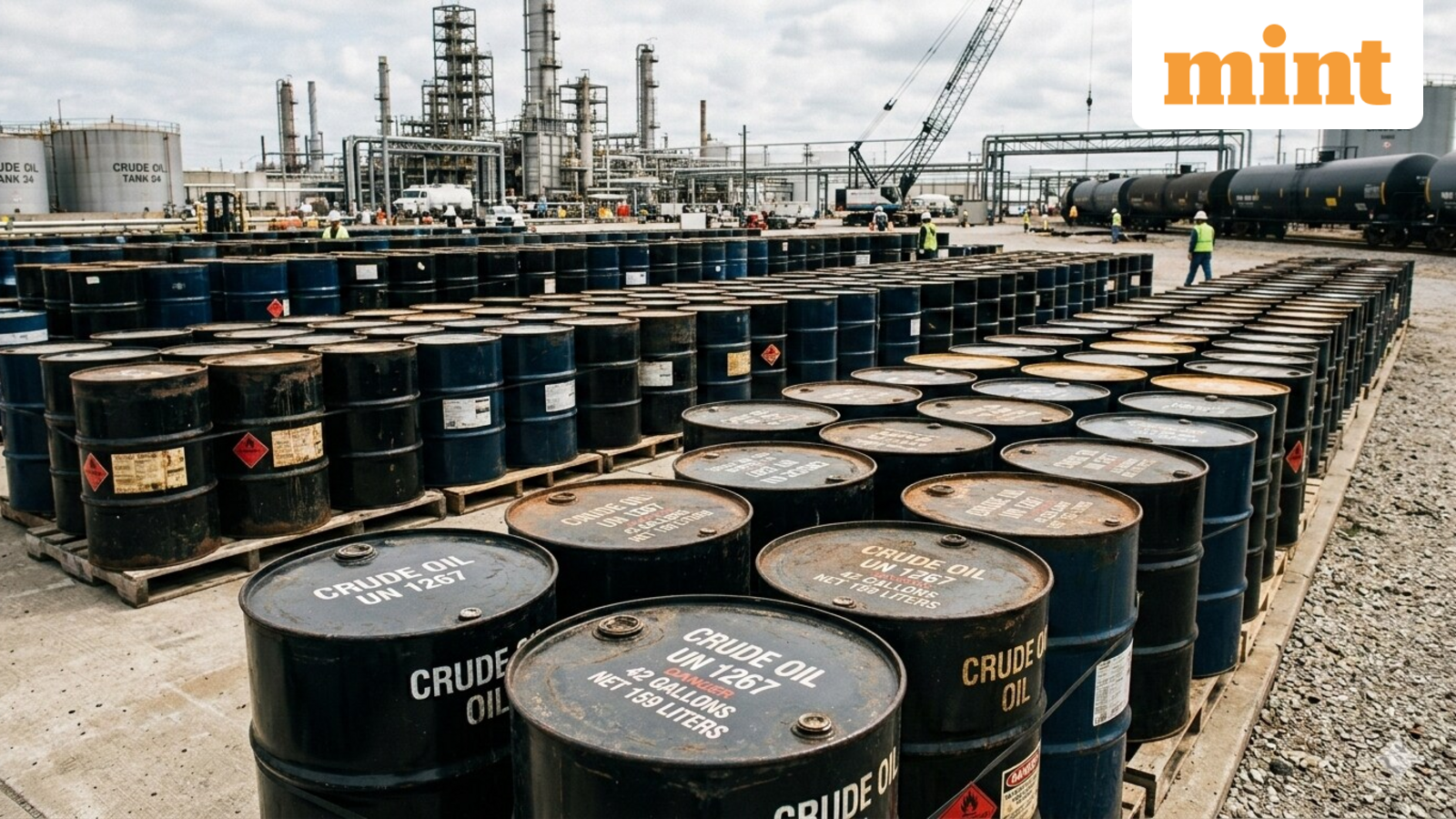
Oil prices have surged sharply amid concerns about supply disruptions. Brent Crude and WTI Crude surged 3%, trading near $73 a barrel and $67 a barrel marks, respectively.
The real concern is reports suggesting that the Strait of Hormuz, a narrow waterway and a strategic route for global oil supply, has been closed.
It takes little effort to see that if the war in West Asia continues, crude oil prices may jump to $100 a barrel or even higher. This will be a major fiscal risk for a country like India.
Escalating tensions in the Middle East pose material risks to global energy stability. Any disruption or blockage of the Strait of Hormuz, through which nearly 20% of global oil supply transits, could trigger a sharp spike in crude prices, push freight and logistics costs higher, and re-ignite inflationary pressures worldwide,” Sugandha Sachdeva, Founder of SS Wealth, observed.
Sachdeva highlighted that such a scenario would complicate central bank policy, forcing a delicate balance between inflation control and growth support, at a time when global trade remains vulnerable to policy uncertainty.
How can crude prices affect the Indian economy?
India is the world’s third-biggest oil importer and consumer. It meets about 85-90% of its crude oil requirements through imports.
According to data from the Petroleum Planning and Analysis Cell (PPAC), India imported crude oil worth ₹11,60,618 crore in FY25. Till January in FY26, crude oil imports stood at ₹8,80,149 crore.
According to economists, a $10-per-barrel rise in crude oil prices may increase the import bill by roughly ₹10,000- ₹15,000 crore annually.
Elevated crude oil prices for a prolonged period can raise India’s import bill, widen its current account deficit, strain its fiscal deficit targets, weaken the currency, raise inflation, and trigger foreign capital outflows.
What does it mean for the Indian stock market?
The immediate reaction could be weakness in the stock market, and FIIs may press more selling on Monday, March 2.
“The spurt in oil prices is certainly bad news for India. Our trade deficit and balance of payments (BoP) will be impacted if oil prices remain high for long. This, in turn, will depend on how long this conflict will last,” VK Vijayakumar, Chief Investment Strategist, Geojit Investments, noted.
Vijayakumar hopes oil producers- OPEC Plus- will increase oil production to stabilize oil prices, but if the Strait of Hormuz is closed and remains closed for some time, the impact will be higher.
Ajit Mishra, SVP of Research at Religare Broking, pointed out that the latest escalation involving the United States, Israel and Iran represents a significant geopolitical shock for global financial markets.
He underlined that whenever tensions rise in the Middle East, crude oil becomes the primary transmission channel to the broader economy. Even the possibility of supply disruptions in the Gulf tends to push oil prices higher, as traders begin factoring in a geopolitical risk premium.
For emerging economies such as India, which rely heavily on imported energy, sustained strength in crude prices can lead to higher inflation expectations, pressure on the currency and increased market volatility, Mishra noted.
In the near term, Mishra believes global investors may gravitate toward traditional safe-haven assets such as the US dollar and gold, while equity markets may remain sensitive to incoming headlines and any signs of further escalation.
For Indian markets, the key variable to monitor is whether the conflict disrupts energy supply routes or remains contained.
“If tensions remain limited, the impact on equities could be short-lived and largely sentiment-driven. However, a sharp and sustained rise in crude prices could weigh on rate-sensitive and consumption-oriented sectors, while also exerting pressure on the rupee and bond yields,” said Mishra.
“At the same time, segments such as energy producers and defence-related companies may attract renewed investor interest. Overall, markets will closely track developments in the coming days, with oil prices, currency movements and foreign investor flows acting as the primary indicators of risk,” Mishra said.
He added that participants should avoid reacting to early trades on Monday and wait for the market to stabilize before initiating new positions. For existing trades, it would be prudent to consider reducing exposure in anticipation of any recovery.
Read all market-related news here
Read more stories by Nishant Kumar
Disclaimer: This story is for educational purposes only. The views and recommendations expressed are those of individual analysts or broking firms, not Mint. We advise investors to consult with certified experts before making any investment decisions, as market conditions can change rapidly and circumstances may vary.