Indian equities have staged a sharp relief rally, emerging as the world’s top-performing market in the past week, while foreign portfolio investors (FPIs) have turned net buyers after relentless selling through January.
Whether that shift marks the start of a durable upcycle remains an open question. Can markets finally shake off volatility? And will the return of foreign capital prove sustainable?
To assess the durability of the rebound, from earnings pressures to signals in precious metals, mint surveyed 35 investment professionals, including fund managers, strategists, economists and research heads. The consensus: sentiment is improving, but conviction remains tentative.
A clear majority (85%) expect a cautious recovery in equities, arguing that markets have largely priced in the Union Budget, the EU trade agreement and the evolving US trade framework. Indian equities have gained 2% so far this month after falling a little over 3% in January.
Sentiment reset
Fundamentals will now drive the next leg, experts said. “Markets would be solely focused on corporate earnings recovery from here on,” said Uttam Kumar Srimal, senior research analyst at Axis Securities. “Since (December-quarter) earnings have been mixed, recovery would be cautious.”
While only 6% foresee continued stagnation, another 6% anticipate an immediate bull run here after.
Among the more optimistic voices is Seshadri Sen, head of research and strategist at Emkay Global Financial Services. “India’s main pressure point has been the currency. We expect a dramatic reversal hereon, given that it has depreciated 6.5% (against the US dollar) since tariff announcements,” Sen explained.
He argued that clarity on trade deals could stabilize the rupee and set off a supportive chain reaction for equities. Rupee has staged a significant recovery appreciating against the greenback in February so far.
Meanwhile, only 3% warned of heightened volatility with a bearish tilt. But the overarching takeaway is clear: confidence is returning, but the market currently lacks the exuberance of a full-fledged risk-on phase.
Trade deal impact
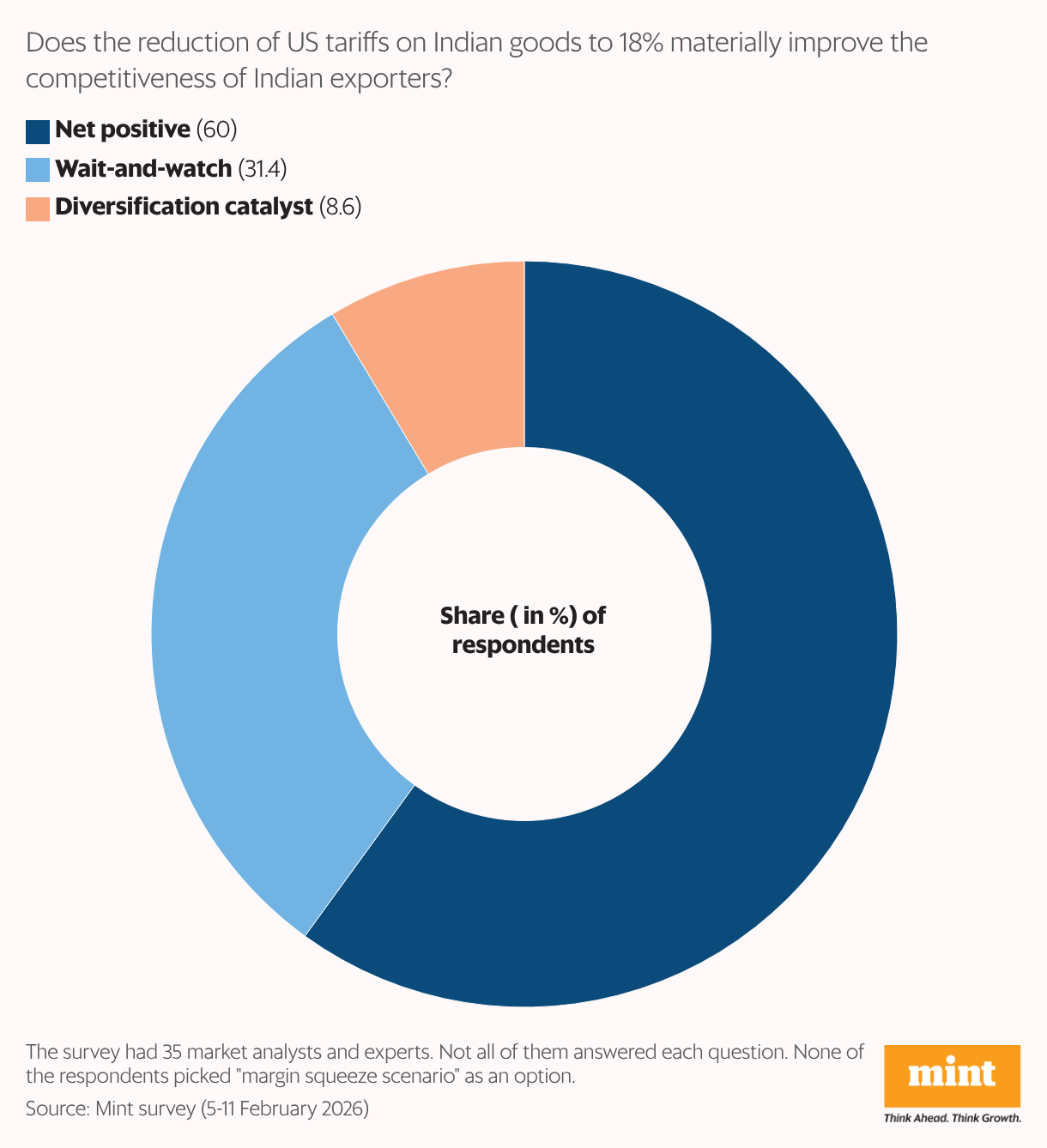
Sentiment turns more favorable when it comes to the new trade framework. Around 60% believe the US-India trade deal will be a net positive, as tariff reductions—from a punitive 50% to 18%—could revive exports in sectors such as textiles, pharmaceuticals and engineering goods.
However, 31%, adopted a wait-and-watch stance, with stalwarts like Kotak Securities, Edelweiss Mutual Fund and Anand Rathi Wealth, arguing that the real benefits will depend on sector-level transmission.
“The impact on (India’s) competitiveness will hinge on the deal’s product coverage, sectoral exemptions, rules of origin, and the final contours of the trade agreement,” said Ajit Mishra, senior vice president of research at Religare.
Under the interim deal, nearly $44 billion of Indian merchandise, representing about half of total. exports to the US will attract zero duty. This includes $30 billion in existing duty-free goods and $14 billion in newly exempted items like generic drugs, gems, and aircraft parts.
That said, 9% of the respondents see the move as insufficient or potentially negative. The split underscores that while markets welcomed the announcement, many participants are reserving judgment on whether earnings upgrades or capex cycles will meaningfully follow.
Foreign flows outlook
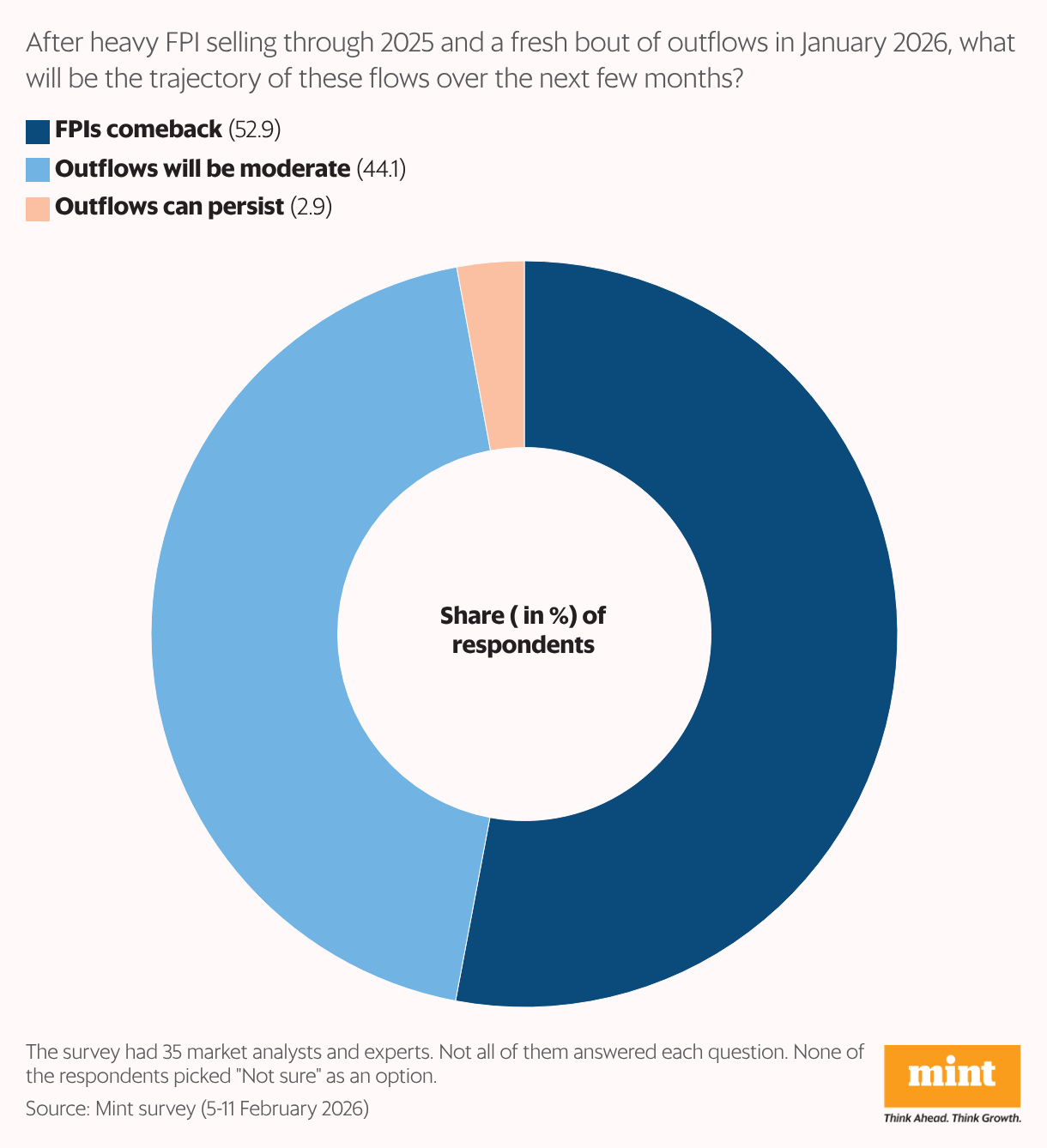
Will trade optimism be enough to pull foreign capital back? A slim majority (53%), including JM Financial Services, Centrum Broking and Avendus Wealth Management, believe improving earnings momentum and overcrowding in global AI trades could redirect flows to India.
FPIs sold almost ₹36,000 crore worth of equities in January before injecting nearly ₹16,000 crore into markets in February so far.
“With corporate earnings appearing to have bottomed out and positioned for improvement from the next quarter onwards, foreign investors are likely to gradually turn (prolonged) net buyers,” Dhiraj Relli, managing director and CEO of HDFC Securities said.
But 44% of the respondents, including experts from ICICI Direct and LIC Mutual Fund, believe outflows may persist, albeit moderately. Only 3% fear prolonged selling, and an equal share remain uncertain.
This indicates that while confidence in India’s relative attractiveness is rebuilding, expectations of aggressive inflows remain restrained.
Earnings pressure
Ultimately, the revival of FPI flows hinges squarely on India’s earnings trajectory. But with rising labor and input costs squeezing margins in the December quarter, there is a sense of caution around India Inc’s profitability in FY26.
Mint’s analysis of 2,088 companies reveals that aggregate net profit margins of firms retreated to a four-quarter low of 11.4% in Q3 FY26, from 14% in Q2.
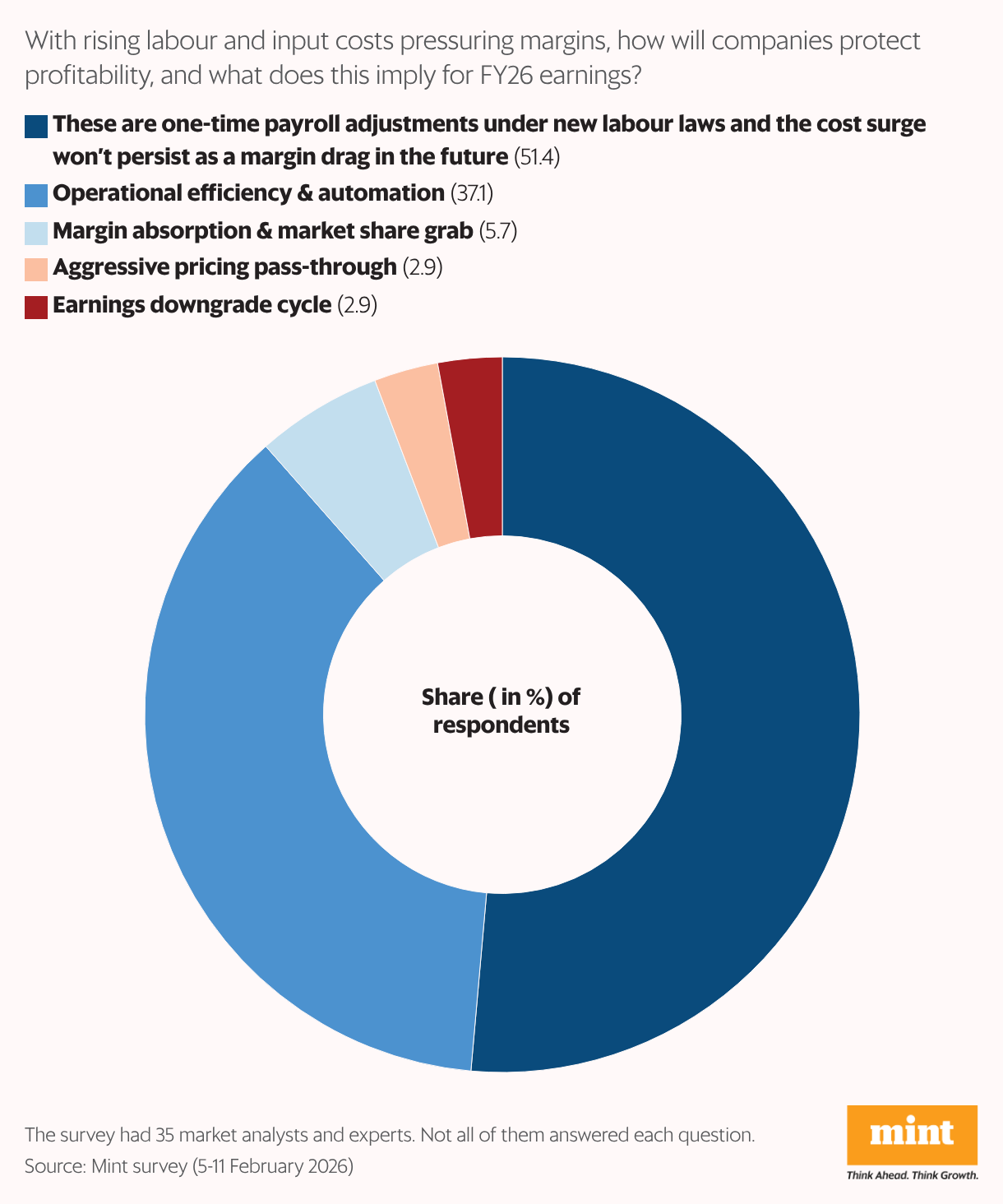
However, 51% of participants view this margin hit as transitory ‘one-time’ payroll adjustments under new labor laws and believe that the cost surge won’t persist as a margin drag beyond the current fiscal.
Another 37%, including LGT Wealth India and Mirae Asset ShareKhan, expect companies to rely on operational efficiency and automation to offset current hit in margins. This signals that India Inc. may further engage in structural cost control rather than raising prices aggressively.
A small minority (6%), consisting of Union AMC and trading app Lemonn, believes companies may absorb part of the cost pressures to grab market share. Meanwhile, close to 3% of them foresee aggressive pass-through from companies while others (3%) flagged risks of an extended earnings downgrade cycle.
This suggests that respondents do not expect earnings stress to spiral, but neither do they anticipate an immediate margin recovery.
Precious metals divide
While experts kind of converge on India Inc’s earnings resilience, they remain sharply divided on gold and silver’s near-term trajectory after recent volatility.
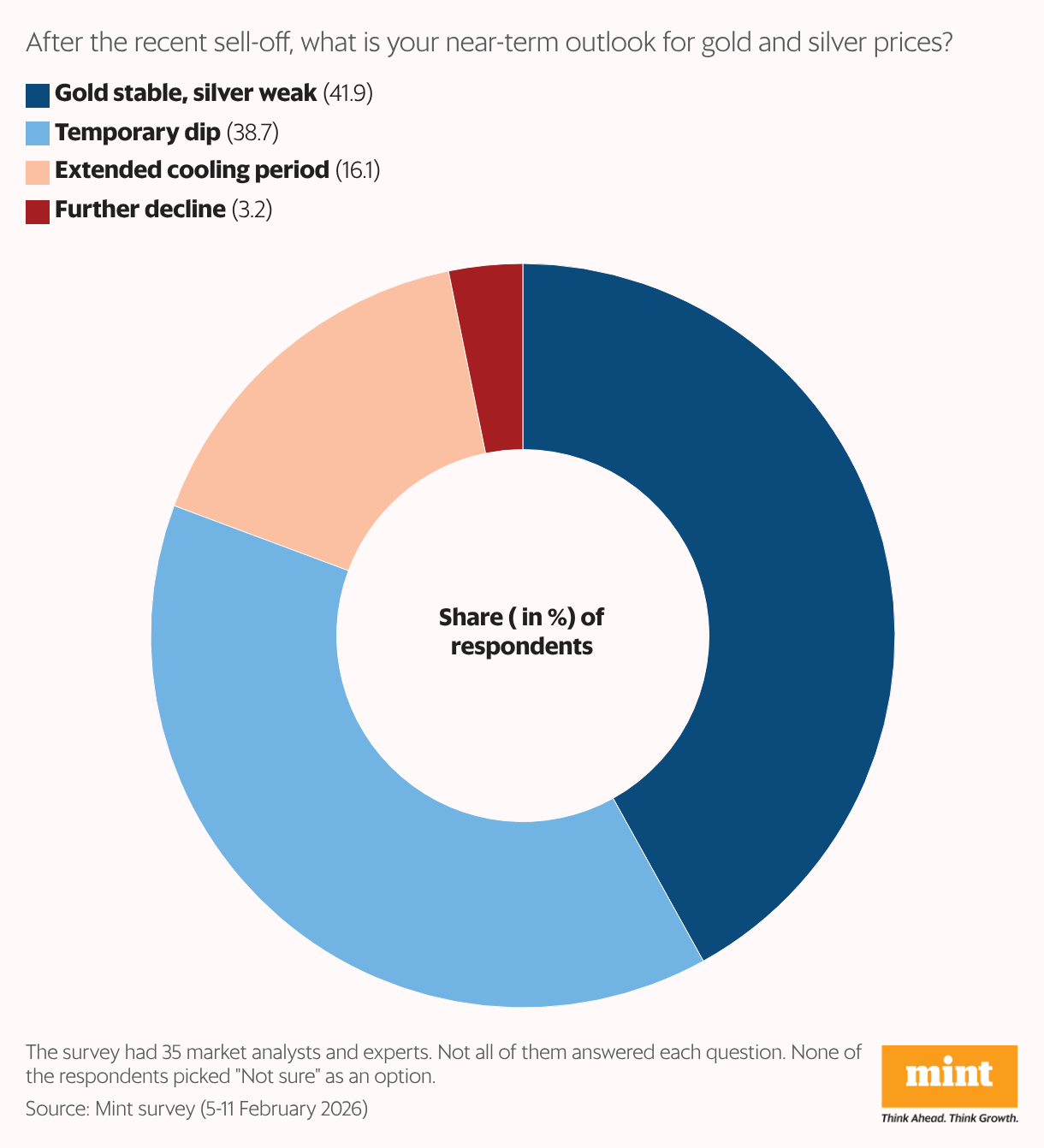
About 42% believe gold will remain relatively stable owing to its safe-haven status, while silver would stay weak. Meanwhile, 39% expect a temporary dip in both metals. According to them, this is a buying opportunity, as they see prices to recover quickly, with gold likely to head toward $6,000 as global economic uncertainty continues.
“Central banks across the globe are accumulating gold to reduce their significant exposure to the USD, which could sustain the gold rally,” said Vinit Bolinjkar, head of research at Ventura.
Whereas 16% of respondents, which includes PL Capital and Sanctum Wealth, warned of an extended cooling period and a small 3% foresee further declines in precious metals.
The dispersion reflects uncertainty in safe-haven assets even as the equity outlook cautiously improves. Yet one sentiment echoed throughout: Experts see stabilization ahead, not exuberance.