

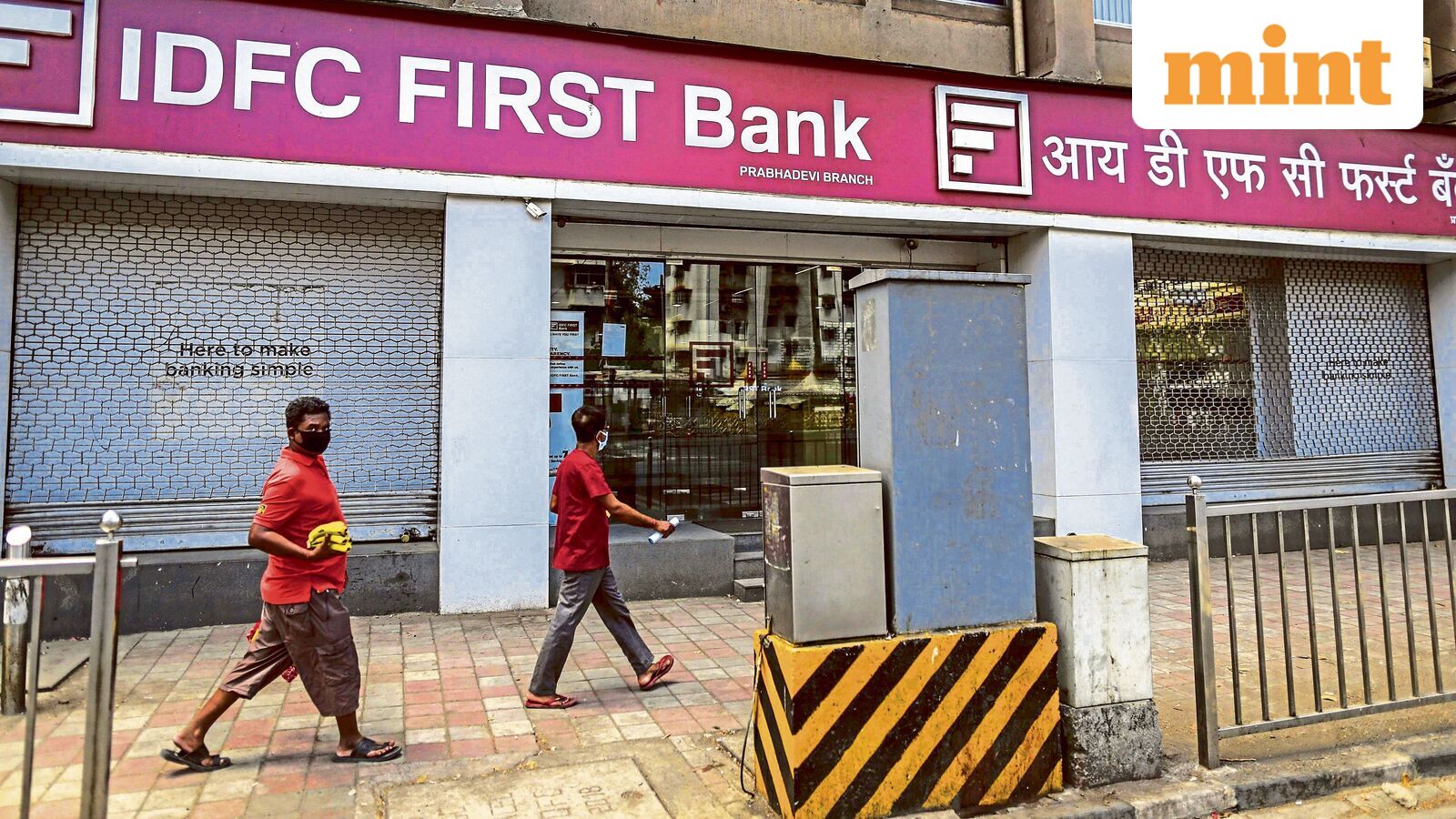
IDFC First Bank’s investors are shaken, pulling the stock down as much as 20% following reports of a fraud at the fast-growing lender.
What began as a disappointing de-empanelment of IDFC and AU Small Finance Bank by the Haryana government—affecting 0.5% of their deposits—quickly evolved into something far more unsettling.
Both banks were accused of retaining funds in low-yielding accounts despite fixed deposit instructions. AU Small Finance’s management has said there is no indication of financial impact or fraudulent activity at this stage.
At IDFC First, however, employees allegedly executed unauthorized cheque-based transactions worth ₹590 crore from government accounts. For context, the bank’s profit after tax for Q3FY26 stood at about ₹500 crores. This suggests a potential 20-25% hit to FY26 profit.
damage control
IDFC First has moved swiftly on optics and process. Four employees have been suspended, statutory auditors informed, a police complaint registered, and an independent forensic audit by KPMG has been commissioned.
The bank is also exploring temporarily freezing beneficiary accounts. As such frauds typically involve layered transactions across multiple banks and accounts, downstream freezes could help limit losses. However, even assuming recoveries over time—along with potential liabilities of other entities involved and ₹35 crore of employee dishonesty insurance-deposit-linked frauds usually require upfront provisioning, with recoveries being back-ended.
Initial investigations indicate the fraud is contained within the Chandigarh branch and limited to a set of government-linked accounts, suggesting no systemic issue for now. Yet, a fraud of this magnitude—enabled by collusion among only a few employees—points to lapses in internal controls.
“Although not a structural governance issue like IndusInd Bank’s (that led to a churn in the top management), the operational lapse may delay IDFC First’s near-term rerating story, but not derail it,” Emkay Global Financial Services said.
Governance overhang
Until further details emerge from the forensic audit, expected in 4-5 weeks, the distinct possibility weighing on investors’ minds is that it could be the first-disclosed incident, rather than an isolated one.
Even if the fraud is contained, the bank’s internal processes will need to be rewired for safety. This includes monthly balance monitoring, digital verifications of transactions and other measures to prevent collusion risks.
Management bandwidth could shift away from growth even as provisions weigh on profitability. More importantly, credibility with depositors may take a hit. Retail deposits account for 79% of customer deposits, making confidence crucial.
Ironically, the bank’s operating performance had been robust. The CASA ratio exceeded 50%, microfinance asset quality was steadily improving, and net interest margins stabilized near 5.8% in Q3FY26.
Supported by network expansion, deposit scale-up, and early signs of operating leverage promising efficiency gains, the stock had rallied over 50% in FY26—until last week.
While the bank remains adequately capitalized, sentiment is likely to remain fragile. The question nagging most investors is—did IDFC’s growth come at the cost of governance? In general, mid-sized private sector banks could face more checks of government deposits. In the interim, some deposits could move to PSU banks.
For IDFC, some bottom fishing may emerge as the stock trades at 1.2 times its FY27 consensus book-value estimates, as per Bloomberg. But for a sustained rerating, the bank needs something lenders value deeply—a clean chit.

