

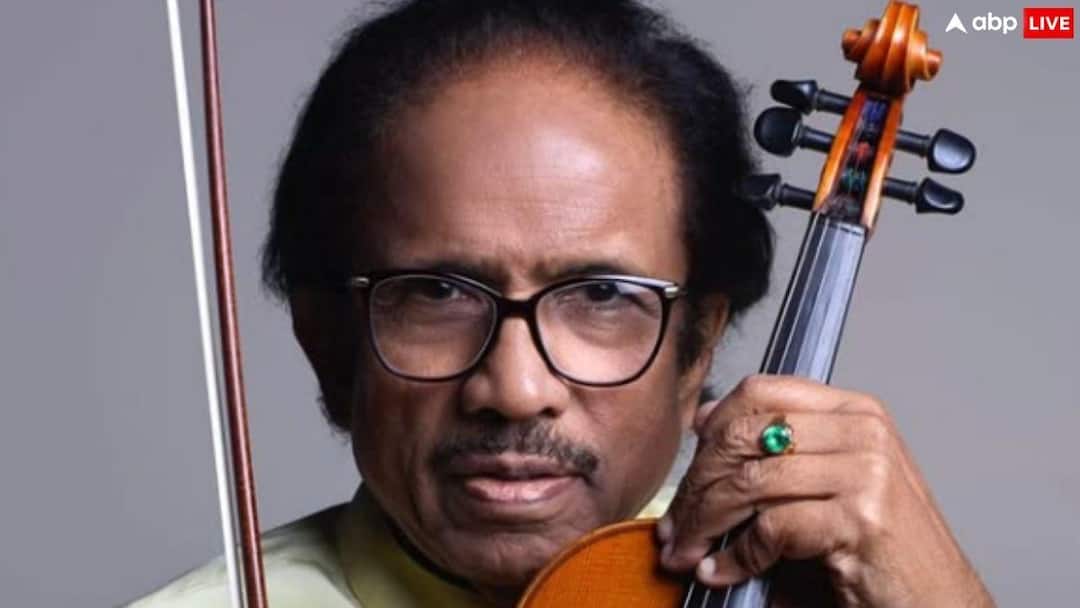
There are very few musicians who have changed the global perception of Indian classical instruments the way Dr. L. Subramaniam has changed. A prolific violinist, prolific composer, conductor and scholar, Subramaniam has spent decades taking the Indian violin beyond traditional boundaries, to symphony halls, jazz festivals and international cultural institutions on five continents. Yet, when he talks about his extraordinary journey, the conversation stops at one man: his father and mentor, Lakshminarayan Subramaniam. He says in a calm voice, “The face may be mine, but whatever is present today, technique, vision, confidence, all that is his.”
In this deeply personal and wide-ranging conversation with ABP News, Dr Subramaniam opens up about his early memories, the trauma of displacement, the discipline of classical training, his unexpected parallel life as a medical doctor and the birth of the Lakshminarayan Global Music Festival, now entering its 35th year as one of India’s most respected international music festivals.
six years the child of of the templee stage was from beginning
Dr. Subramaniam’s first public performance was not in India, but in the famous Nallur Kandaswamy Temple in Jaffna, Sri Lanka. At that time he was six years old and was very scared. In fact, he was not at all prepared for that moment which was going to be the defining moment of his life.
He recalls, “The organizers did not want me to perform, it was a big festival with thousands of people. They thought a six-year-old child could spoil it.” But his father was firm, in the middle of the performance Lakshminarayan Subramaniam announced his son’s solo performance and handed him the violin. “I was scared of the organisers, scared of failing, and scared of going back home. I don’t even remember what I played,” says Dr Subramaniam now, smiling. What he remembers is that after the performance there was thunderous applause and the temple officials said that God had actually performed through the child.” This was an auspicious beginning, which laid the foundation of a life full of faith, discipline and fearlessness.
displacement, Conflict and reconstruction
The family’s life in Sri Lanka came to a violent halt during the 1958 anti-India riots. Forced to flee overnight, they returned to India empty handed. “My father lost everything. There were eight of us, and we started from scratch,” says Subramaniam. What followed was not despair, but reconstruction. Lakshminarayana Subramaniam began to reshape the role of the violin in Carnatic music, envisioning it as a solo instrument that could command the same respect as Western classical soloists. Subramaniam explains, “This was a revolutionary step at that time. The violin was seen primarily as a supporting instrument. My father completely redesigned its technique so that it could make its own identity on the world stage.”
This vision gave birth to the famous violin trio, Dr. Subramaniam and his brothers, which attracted the attention of stalwarts like Palghat Mani Iyer and ushered in a new era for the Indian violin.
Medicine or music? choose both
Despite his talent in music, Dr. Subramaniam pursued an MBBS degree. This decision also became a topic of discussion during his medical entrance interview. He recalls, “They asked me why I wanted to waste a medical seat when I had won the President’s Award for Music.” This choice was inspired by passion as well as circumstances. He said, “We were struggling financially. I loved science, and becoming a doctor would provide stability.”
Despite receiving a scholarship to study music in Germany, his mother insisted that he complete his medical studies first. He says, “It was the best advice of my life. Without that MBBS degree, I would not have been able to pursue a PhD and doctoral degree in music later.”
broke the barriers
Dr. Subramaniam gained recognition at the international level when he started mixing Indian classical music with Western orchestration. This was at a time when such experiments were viewed with suspicion in their country. His albums Fantasy Without Limits and Conversations (the latter with jazz legend Stéphane Grappelli) achieved international popularity and placed him in the same league as Herbie Hancock and Miles Davis. He says, “If you write music, you have to write every note. This is the discipline I learned from my training in Western classical music.”
He also got a call from the cinema world, the most memorable of which was the film ‘Salaam Bombay!’ which even received praise from Satyajit Ray. He says, “He told me that the music was perfect, not a single note too much, not a single note less.”
Importance of Laxminarayan Global Music Festival
After his father’s death, Dr. Subramaniam admits that he found it difficult to even touch the violin. “Every time I saw it, I was reminded of him,” he says. The Lakshminarayan Global Music Festival, launched in 1992 on his father’s birth anniversary, became both a tribute and a source of inspiration for him. The event, which started in Chennai, soon spread across India and the world, and became a platform where Indian classical music, jazz, folk traditions, orchestras and global music interacted. “The Jugalbandi culture we know today has evolved from collaborations that started decades ago,” he says.
This year’s event is special. In fact, for the first time in India, the festival will present orchestra, choir and ballet simultaneously. At its center is the Navagraha Symphony, a 45-minute symphonic composition based on ancient Sanskrit verses dedicated to the deities of the nine planets. The involvement of three generations of his family gives this presentation emotional depth, making it both personal and historic.

