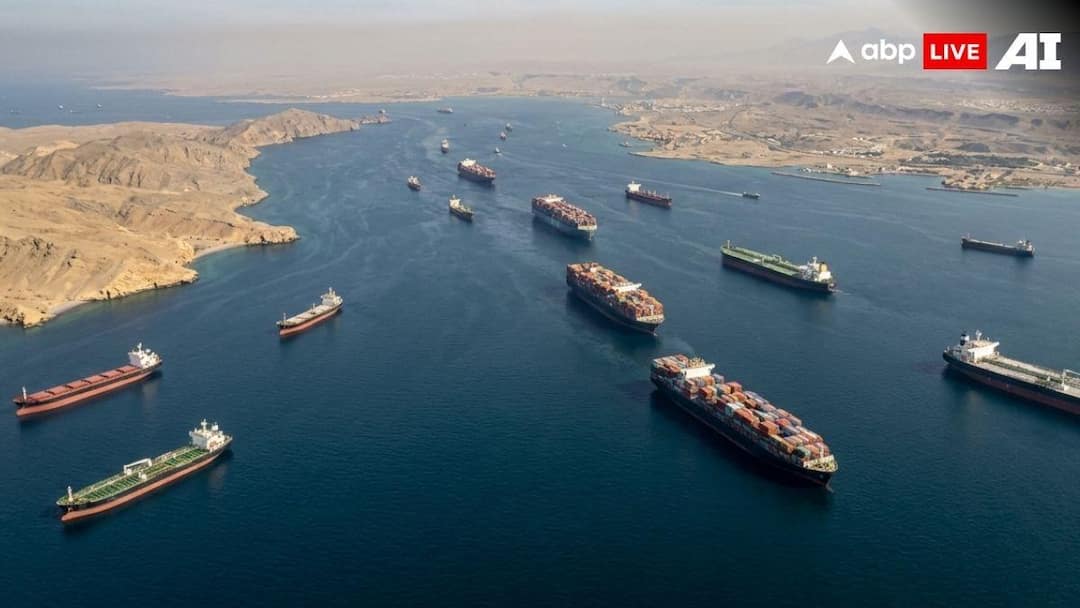
17 days after the war between America, Israel and Iran, today the world is standing at the brink of an energy crisis that has never happened before. The main route for oil and LPG supply was the Strait of Hormuz; tanker traffic on it has almost reduced to zero. About 400 ships are anchored outside the Gulf of Oman and do not have the courage to go further.
Iran has kept this as its biggest weapon, but its strategy with this weapon is even more advanced. Do you understand how Iran has planned to close, one by one, every route through which oil reaches the world?
The first route closed – Hormuz, it is just a 33 kilometer wide route between Iran and Oman and 20 million barrels of oil passes through it every day, which is 20 percent of the world’s total oil consumption. The oil of Saudi Arabia, United Arab Emirates, Iraq, Kuwait and Qatar goes through this route.
The Islamic Revolutionary Guard Corps (IRGC) officially announced on March 2 that Hormuz is closed to the US and its allies. Any ship that tries to pass will be attacked and this happened – according to UKMTO, 17 civilian ships have been attacked since 28 February.
After the closure of Hormuz, everyone thought that there are bypass routes and they will use them, but Iran has planned that too. Second route – Fujairah… Sensing the dangers of such a war, the UAE spent 4.2 billion dollars in 2012 and built a pipeline, ADCOP (from Habshan to Fujairah), 380 kilometers long.
It was the insurance policy of UAE that if Hormuz is closed, oil will come out from Fujairah which is directly connected to the Indian Ocean. Its capacity is 1.5 million barrels per day and Iran has also closed that exit. Iranian drones attacked Fujairah’s oil terminal and caused a massive fire, smoke billowing, oil loading halted and shipping company Maersk shutting down all operations in Fujairah. In this way the second option is also closed.
Third route- After Hormuz and Fujairah, Yanbu and Bab-al-Mandab are left. Saudi Arabia had another route for the East-West Pipeline. This is a 1,200 kilometer long pipeline from Abqaiq to Yanbu. Its design capacity is 7 million barrels per day. As soon as Hormuz was closed, Saudi Arabia activated this route. Started sending oil from Yanbu to the Red Sea but to get out of the Red Sea one has to pass through Bab-al-Mandab and this is where the Houthis are sitting.
Announcement of ‘Hour Zero’ at Bab-al-Mandab
Just 30 kilometers wide, the Bab al-Mandab between Yemen and Djibouti connects Red Sea to the Gulf of Aden, the only entrance to the Suez Canal. This is the route for 10 to 12 percent of the world’s international maritime trade. Due to Houthi attacks, the oil flow from here had fallen from 8.7 million barrels per day in 2023 to 4.2 million barrels per day in 2025. This road was already half closed.
On March 14, 2026, Houthi officials announced military alignment with Iran and declared ‘Hour Zero’. The Houthis clearly said that closing Bab-al-Mandab is their priority. Experts say that as soon as Saudi Arabia started deliveries from the Red Sea, the Houthis were ready to close that route too. This is part of Iran’s three-step strategy.
If both the Straits of Hormuz and Bab-al-Mandab are completely closed simultaneously, 30 percent of the world’s maritime oil trade could come to a halt in one fell swoop. Goldman Sachs has warned that due to Houthi capture of Bab-el-Mandab, the price of oil could go up to $ 120 per barrel, whereas currently oil has crossed $ 110 and WTI, which was $ 57 at the beginning of 2025, has reached $ 119.
Ships that cannot pass will have to round the Cape of Good Hope in Africa. To go from here, additional fuel of 12 to 15 days is required. Shipping companies have left the field. Companies such as CMA CGM, Maersk and Hapag-Lloyd have stopped all trans-Suez services from Bab-el-Mandab. Insurance companies have either stopped war risk cover or have made it so expensive that no commercial operator is daring to go on these routes.
What is its impact on India?
India imports 88-89 percent of its crude oil needs. This is the highest level ever. 84 percent of the oil passing through Hormuz goes towards the Asian market of China, India, Japan, South Korea. If both Hormuz and Bab-al-Mandab remain closed for a long time, then petrol, diesel, LPG, air fares all will directly affect your pocket.
Also read:-
Israel-Iran War: Do America and Iran want to end the war? Araghchi and Trump’s envoy talked for the first time amid the attacks