

Legend has it that one crisp morning early in 1848, some customers walked into a store operated by Brannan in Sacramento, California. After making their purchases, they stunned Brannan and the store employees by paying for the goods in gold! Upon enquiries, Brannan learnt that the customers worked for a landowner and they had stumbled upon gold deposits at a small settlement about 36 miles northeast of Sacramento.
Ever the sceptic, the 28-year-old Brannan decided to go to the spot himself and verify the claims. Once there, he found the news to be true and learned that “there was more gold than all the people in California could take out in 50 years.”
Brannan was, quite literally, standing on a huge gold mine. But what he did next ranks among the most counterintuitive moves in modern financial history. Instead of plunging into the nascent gold rush himself, he hurriedly set up a store selling picks, shovels, pans and other supplies. To stoke the frenzy, he famously paraded through San Francisco streets waving a vial of gold, shouting, “Gold! Gold! Gold! Gold from the American river!”
Very soon, a tide of hopefuls began streaming towards California in search of fortune. By the middle of the year, around three-quarters of the male population had left San Francisco for the mines. Tens of thousands more from across the country were to follow. As the rush gathered momentum, Brannan’s store did roaring business. He was selling goods worth a whopping $5,000 per day to miners (about $200,000 in today’s dollars). Before long, he became California’s first millionaire.
View Full Image
The episode is worth lingering over. The richest man of the California gold rush was not the one panning rivers or digging vast tracts of land or buying and selling the yellow metal. The biggest winner turned out to be the one who sold picks and shovels to thousands of eager dreamers flocking to get a piece of the action.
Historical parallels are often faulted for flattening nuance, yet it is tempting to ask—is a similar dynamic now playing out on Dalal Street?
Wealth machine
Here’s a quick quiz for you. Which Indian stock has been the fastest wealth creator in the post-covid era? Is it an auto major, buoyed by consumers’ seemingly insatiable appetite for sports utility vehicles? Or perhaps a company in the information technology (IT) services sector, which is currently battling headwinds but enjoyed explosive growth during the lockdown years? How about a mid-cap defence player?
The answer may come as a surprise: it is BSE.
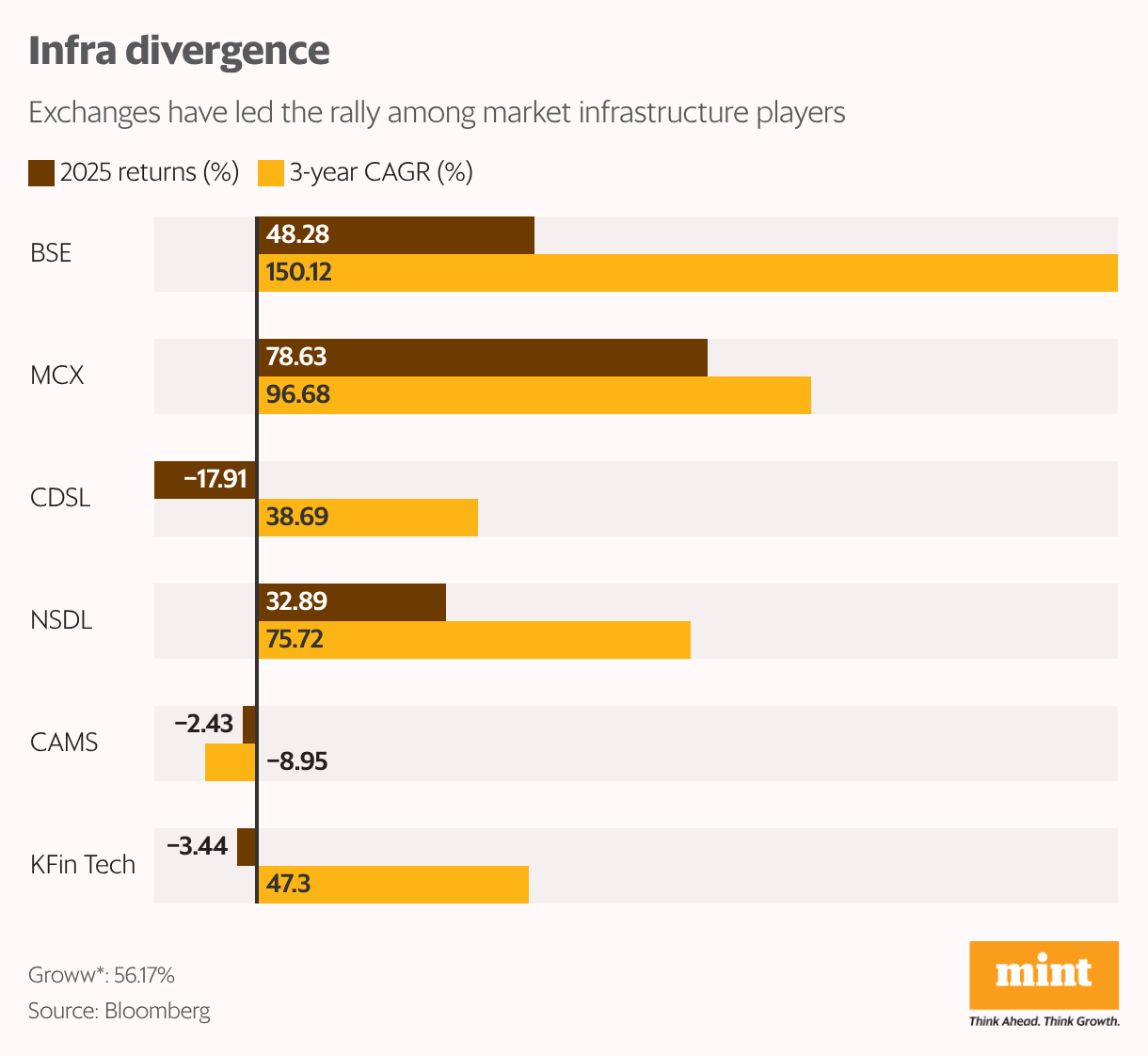
The BSE stock has posted a five-year total return CAGR (compound annual growth rate) of an astonishing 124% during 2020-2025, as highlighted by Motilal Oswal’s 30th Annual Wealth Creation Study published last month. In fact, every segment of the domestic capital market infrastructure is a story of head-spinning numbers.
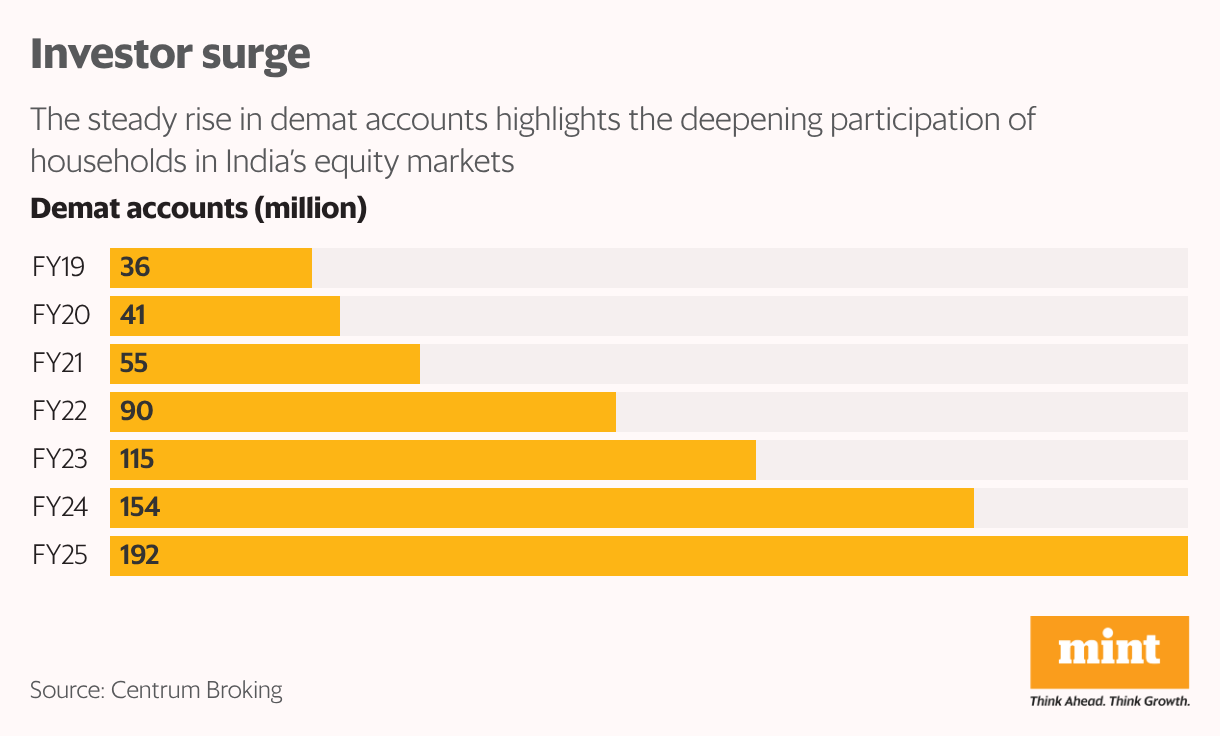
The Indian mutual fund industry’s assets under management (AUM) has expanded from about ₹12.75 trillion in December 2015 to more than ₹80 trillion by December 2025, a more than sixfold increase in a decade. Demat accounts have also grown around fivefold from 41 million in fiscal year 2020 (FY20) to over 216 million today, while systematic investment plan (SIP) inflows have risen from sub- ₹10,000 crore levels a few years ago to around ₹31,000 crore per month as of December, indicating a tectonic shift in India’s financial landscape.
“Capital market infrastructure players offer a compelling long-term growth story, driven by the deepening equity culture and financialization of household savings,” Sneha Poddar, vice president of research, wealth management, Motilal Oswal Financial Services, told Mint.
These numbers point to a robust system at work, yet the mechanics of the ecosystem remain opaque to many, investors included.
India’s capital market infrastructure comprises brokers, exchanges, depositories and registrar and transfer agents (RTAs). These players generated ₹70,000 crore in revenues in FY25, led by brokers and exchanges.
Brokers form the front end of India’s capital markets. They are registered with the Securities and Exchange Board of India (Sebi) and are authorized members of stock exchanges to execute buy and sell orders on behalf of individual or institutional investors in various segments, including equities, derivatives and commodities. Brokers facilitate access to trading platforms, provide real-time market data and may offer additional services such as research, advisory support and account opening assistance. They earn income through brokerage fees and commissions charged on executed trades.
Large full-service brokers include ICICI Securities, HDFC Securities, Axis Securities, Kotak Securities and Motilal Oswal Financial Services, among others. However, the post-covid boom in equity culture—from around 30 million individual investors in 2019 to over 120 million in 2025—has been largely led by discount/online brokers like Zerodha, Groww, Upstox, 5paisa and others, which account for over 60% of the active demat accounts.
Stock exchanges serve as the organized platforms where securities are listed, traded and priced. Exchanges provide a transparent, regulated marketplace that matches buy and sell orders from brokers and thus are instrumental in price discovery, market liquidity and investor confidence.
India has some serious pedigree in this department. The National Stock Exchange of India (NSE) is the third-largest equity exchange in the world by number of trades and the largest derivatives exchange by contracts traded, while the BSE, formerly the Bombay Stock Exchange, founded in 1875, is Asia’s oldest bourse. The NSE has consistently commanded 90% share in the cash segment and holds a virtual monopoly in futures trading (both stock and index), though the BSE has started making some inroads. The segment also includes commodity exchanges such as the Multi Commodity Exchange of India (MCX) and the National Commodity and Derivatives Exchange (NCDEX).
The NSE has consistently commanded 90% share in the cash segment and holds a virtual monopoly in futures trading (both stock and index), though the BSE has started making some inroads.
Depositories are institutions that provide paperless, electronic custody of securities on behalf of investors. Instead of physical share certificates, investors hold securities in dematerialized form through a depository, which maintains records of ownership and facilitates the seamless transfer of securities when trades settle.
India has a duopoly in the depository market in the form of National Securities Depository Ltd (NSDL) and Central Depository Services Ltd (CDSL).
They also oversee the processing of corporate actions such as dividends, bonuses and stock splits so that changes are accurately and promptly recorded in investors’ holdings.
The last piece of the market infrastructure ecosystem are the RTAs, which are specialized service providers engaged by companies and mutual funds to maintain accurate and up-to-date records of investors. They are the administrative backbone who handle tasks such as maintaining shareholder registers, processing transfers of securities, managing dividend payments and executing corporate actions like bonus or rights issues. CAMS is the leader in the RTA segment, followed by players like KFin Technologies, Alankit and others.
Once seen purely as ‘market plumbing’ enablers, capital market infrastructure players are now becoming a distinct and compelling investment theme, thanks to structural tailwinds like rising retail participation, reallocation of household savings toward financial assets and rapid spread of low-cost digital platforms.
Infra play
India’s equity culture is clearly moving from “trend” to “structure,” and that makes capital market infrastructure players an attractive investible segment over the medium-to-long term, Asutosh Mishra, head, institutional equities research, Ashika Stock Broking, said.
The ecosystem is witnessing a durable financialization wave. In this backdrop, exchanges, depositories and RTAs benefit from asset-light, scalable ‘toll-booth’ business models with strong moats (regulatory barriers, network effects, annuity-like revenue streams) and typically high return on equity (ROE) with limited balance-sheet risk, he added.
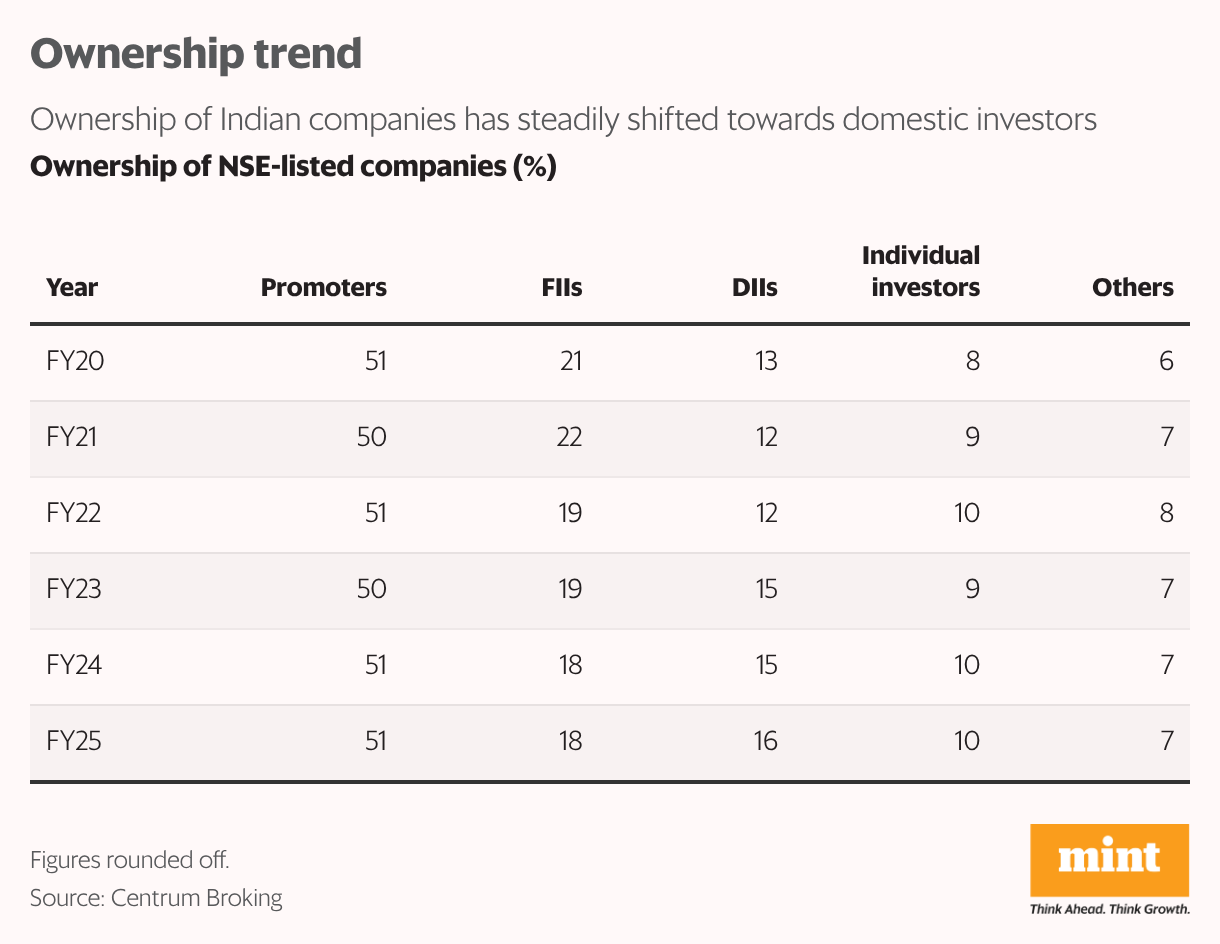
“Within the space, our preference tilts towards depositories and RTAs as relatively defensive compounders—growth here is driven by account proliferation and AUM expansion rather than day-to-day trading volatility—while exchanges remain structurally strong but carry higher regulatory/product concentration risk given the dominance of derivatives in industry economics,” Mishra further said.
Brokers offer the highest operating leverage to market activity but are also the most cyclical and competitive, he pointed out, making them more tactical unless supported by strong non-broking monetization (wealth, lending, distribution).
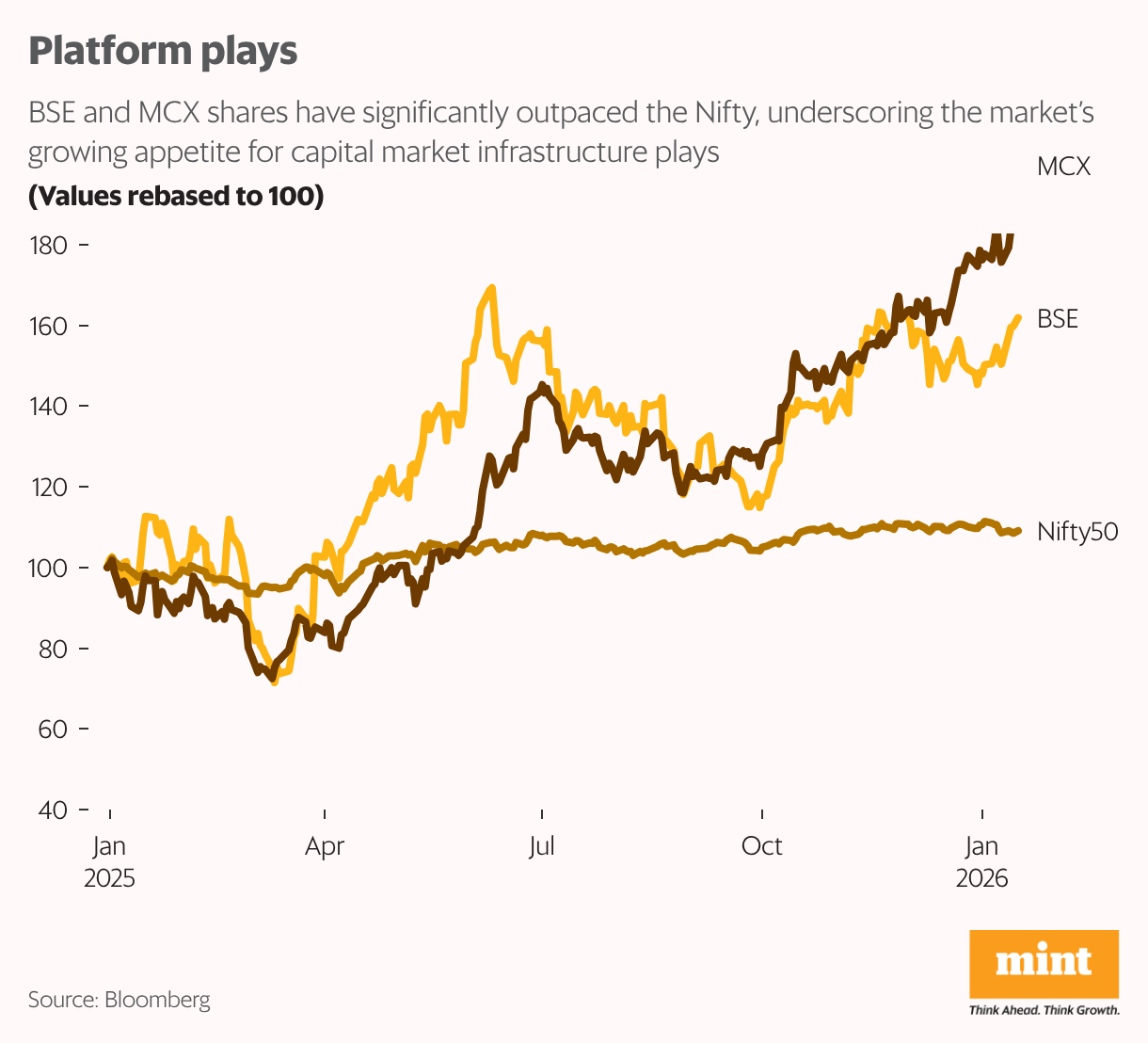
As noted earlier, one segment enjoying a dream run on Dalal Street is stock exchanges. Even after a sharp rally over the past few years, the BSE’s shares jumped another 50% in 2025 during a largely sideways market. The MCX performed even more strongly, with the stock soaring nearly 80% over the same period. And one of the most anticipated market events of this year will be the long-awaited public offering (IPO) of the NSE, which the Street is tracking closely.
Just what is it about exchanges that make them such a hot bet?
“The BSE’s spectacular run and the strong build-up to the NSE’s much-awaited IPO are essentially a reflection of how stock exchanges have become the toll booths of India’s financialization story. The biggest driver is the explosion in derivatives activity, where India is now among the largest global markets by contract volumes—every incremental trade directly lifts exchange revenue, while costs remain largely fixed, creating powerful operating leverage and margin expansion,” Mishra explained.
The BSE has also benefited from a clear turnaround narrative, moving from being a marginal player in derivatives to steadily gaining traction. In fact, analysts say there could be a lot more in store.
“The anticipated NSE IPO could act as a meaningful re-rating trigger for the BSE, as the NSE’s mandatory listing on the BSE is likely to increase volumes, institutional participation and investor attention, prompting a reassessment of relative valuations,” Motilal Oswal’s Poddar said.
The NSE cannot list on its own platform, and therefore its shares will be listed on the BSE post its IPO.

View Full Image
That said, exchanges are not risk-free compounders—regulatory risk (especially around derivatives) remains the biggest swing factor, and after a sharp rally, valuations demand continued execution and volume momentum.
The sharp rise of the MCX stock has attracted the Street’s attention, with many participants considering it to be a proxy for the commodities supercycle underway currently. However, analysts recommend a cautious approach.
“The MCX’s rally reflects normalization after regulatory overhangs, a revival in commodity participation, and improved operating metrics. However, treating the MCX as a clean proxy for the commodity supercycle is a stretch,” Sonam Srivastava, founder and fund manager at Wright Research PMS, said.
The MCX is a proxy for volatility, participation and hedging demand in commodities, not for commodity prices themselves. Volumes rise when prices move sharply in either direction.
“If the commodity theme plays out through stable, grinding uptrends, producers and asset owners benefit more than exchanges. MCX works best as a volatility and financialization play on commodities, not as a direct beta substitute,” she added.
Twists and turns
If rising retail participation is the biggest tailwind for capital markets, the natural question is whether a prolonged market slowdown could blunt that momentum.
Protracted equity drawdowns do affect cash market volumes, IPO activity and retail sentiment, which can compress near-term earnings for capital market infrastructure players, but analysts say today’s environment is structurally different from past cycles.

View Full Image
“The SIP book crossing ₹31,000 crore is not just a flow number; it reflects a behavioural shift from episodic investing to rule-based participation. Even during weak small- and mid-cap phases, SIPs tend to be sticky, derivatives volumes often remain elevated, and hedging activity increases. That cushions the downside for exchanges and depositories. Earnings may de-grow temporarily, but the franchise value is not impaired,” Srivastava said.
Investors should also note the impact of a prolonged slowdown will vary across segments.
“Exchanges and brokers are the most cyclical, because their revenue is heavily linked to cash and derivatives volumes—so if market participation cools, earnings can correct meaningfully and valuations can de-rate quickly. RTAs are relatively more defensive, but even here, a prolonged downturn can slow new SIP registrations, reduce incremental AUM additions, and compress growth rates.
“Depositories remain the most insulated, supported by annuity-like revenues (account maintenance and transaction-linked fees) and the stickiness of demat infrastructure, though new account opening momentum can slow in weak markets,” Ashika Stock Broking’s Mishra said.
Most analysts maintain the key risk to capital market infra stocks is not a market downturn per se, but factors like regulatory intervention.
Regulator Sebi has taken a series of measures in recent times to cool the speculative excess in derivatives trading by retail investors. These include significant changes such as increasing the minimum contract size for index futures and options, requiring upfront payment of option premiums, and limiting the number of weekly expiry contracts offered by exchanges.
According to global brokerage firm Jefferies, follow-up regulations on weekly index options pose a key risk for exchanges and brokers, as this product accounts for 70-80% of their revenue.
“We estimate a 10% fall in options revenue could adversely impact earnings by 7-8%. A shift of weekly index option expiries to fortnightly or monthly can adversely impact earnings by 20-50%. Divestment of clearing corporations could be another key risk for exchanges adversely impacting BSE’s earnings by 8-10%. We see RTAs at significantly lower regulatory risk considering their nil exposure to options,” it said in a recent note.
That said, the consensus view is that the longer-term structural drivers of the equity market story are firmly in place. And as history shows, it is often the picks-and-shovels businesses that emerge as the biggest beneficiaries of a gold rush.