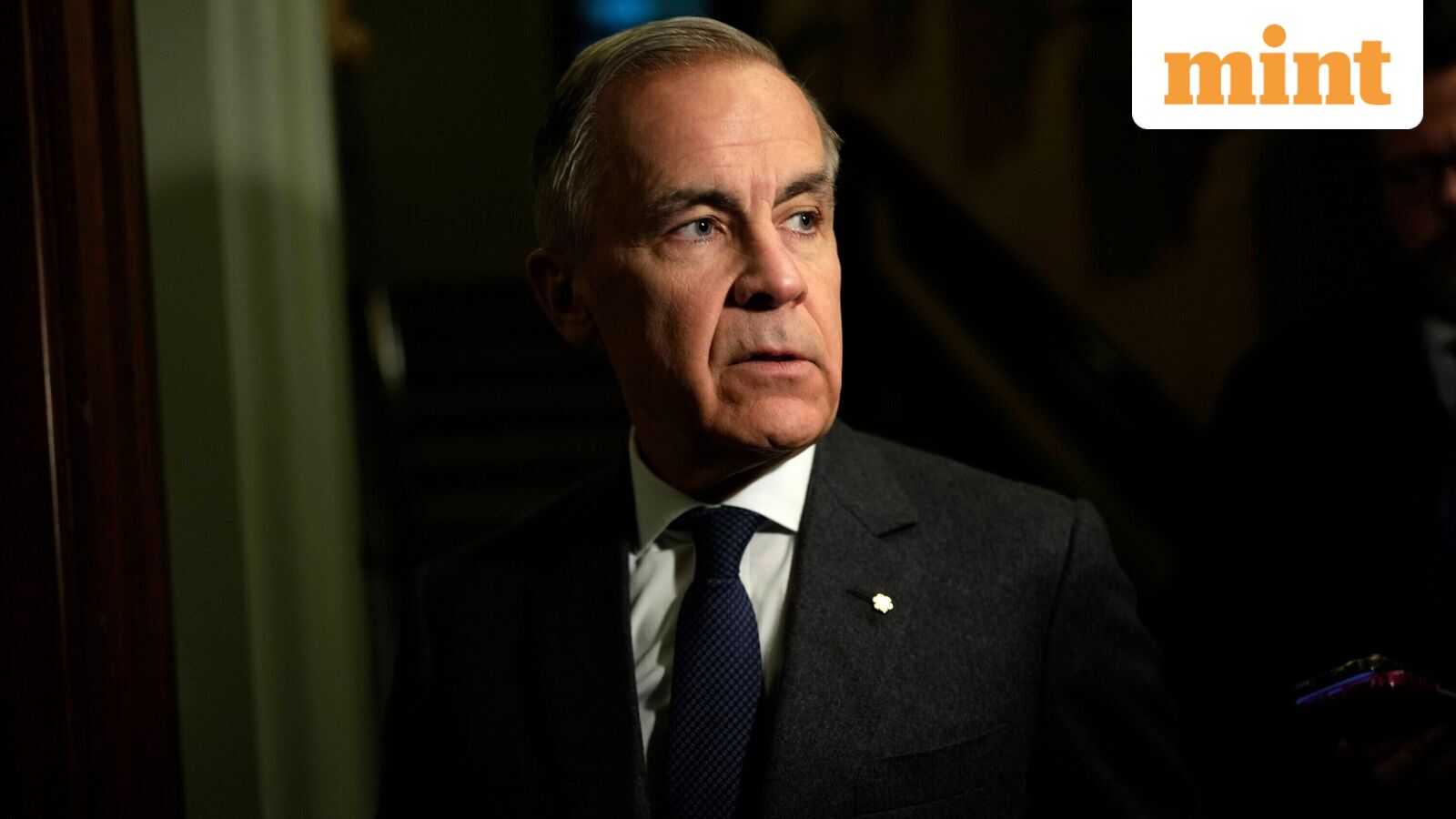
Canada Prime Minister Mark Carney’s visit to India from today will mark a diplomatic reset and give rise to a host of new trade opportunities, India’s High Commissioner in Canada said. These include in nuclear power, oil and critical minerals as per the top diplomat.
The trip will cover an “immense” agenda that is likely to be formalized in cooperation agreements across vast sectors, including research, artificial intelligence, quantum computing and education.
Carney’s visit is also expected to include a deal that will expand the uranium shipments from Canada to India, India’s high commissioner Dinesh Patnaik said. New Delhi has also expressed an eagerness to buy heavy crude and other energy products from Canada, and is looking at potential investments in pipelines, terminals and other infrastructure.
The trip marks a major shift in a relationship that was badly strained just a year ago. In 2024, Canada moved to expel six Indian officials, alleging that agents linked to the government were conducting a campaign of violence, intimidation and extortion against Canadian citizens. That was about a year after then-Prime Minister Justin Trudeau shocked Canadians by saying there were credible allegations that India was behind the murder of a Sikh activist in British Columbia.
Since Carney replaced Trudeau, everything has changed. “We are looking at a total reset of the relationship,” Patnaik said in an interview, according to Bloomberg.
“We are not school children with a single issue — you took my bag, you took my lunch box,” he said. “You are the largest democracy in size, we are the largest in population. And so it’s inevitable and natural for us to work together, and so this visit will put the stamp on that.”
Mike Carney’s visit to India
Mike Carney departs for India on Thursday before continuing on to Australia and Japan. The trip underscores his trade-driven foreign policy and is central to his push to move past the diplomatic rupture.
Carney and Indian Prime Minister Narendra Modi agreed in November to resume talks toward a free-trade deal, and that agreement could be signed within a year, Patnaik said. Although the two countries have spent years trying — and failing — to clinch an agreement, Patnaik said both economies have evolved and momentum is now building.
He pointed to India’s recent massive pact with the European Union as evidence of that shift. “Political intent overshadows everything,” he said. US tariffs, of course, have changed the incentives for both countries to deal with other trading partners.
The visit caps almost a year of effort from Carney to thaw relations with Modi. The diplomatic row broke out into the open in September 2023, when Trudeau accused the Indian government of orchestrating the murder of Hardeep Singh Nijjar — a claim Modi’s government furiously denied.
Near the end of Trudeau’s tenure, the two sides gradually began patching things up. The murder case has largely become a matter for Canada’s courts, where four Indian nationals are awaiting trial.
Some Sikh separatists in Canada say India is still targeting them. The World Sikh Organization said this week that a prominent activist and his family were warned by police about threats allegedly emanating from Indian government agents.
But a Canadian official, speaking in a background briefing, said the government is confident such activity is not continuing. He said the two countries have robust mechanisms to address transnational repression — and that Carney would not be making the trip if officials believed the threats were ongoing.
Carney will travel to Mumbai and New Delhi, avoiding Punjab, where a large share of Canada’s Sikh diaspora traces its roots and where separatist tensions originate. He’ll meet with leaders in business and education, and renew the Canada-India CEO Forum alongside Modi, the Canadian official said.
In Australia, Carney will see Prime Minister Anthony Albanese and address Parliament. Chief executives from some of Canada’s largest pension funds will join this leg of the trip, and an announcement on expanded defence-research collaboration is expected.
Carney will close out his trip in Tokyo, where he’ll meet Prime Minister Sanae Takaichi for the first time since her landslide election win. Japan is Canada’s second-largest trading partner in the region after China.
Patnaik said he sees a different Canadian attitude under Carney’s leadership.
“He’s realized that Canada has to behave like a global power, which is that a global power has multidimensional relationships with all countries,” Patnaik said.
He said India welcomed Carney’s speech at the Davos summit that described a new era of great power rivalry and outlined a strategy of “variable geometry” for middle powers — creating shifting alliances to prevent larger powers from dominating them.
But Patnaik added that it was also nothing new for people living in India. “What Prime Minister Carney said in Davos is what we’ve been saying for the last 50 years,” he said with a laugh. “In a way, he’s getting us to see ourselves more clearly in the mirror as to what we are.”
Key Takeaways
- The visit marks a pivotal moment in Canada-India relations, focusing on diverse sectors like nuclear power and AI.
- Historical tensions are being addressed through renewed diplomatic efforts and cooperation agreements.
- Economic shifts, such as India’s pact with the EU, indicate evolving trade dynamics that both countries are keen to explore.