

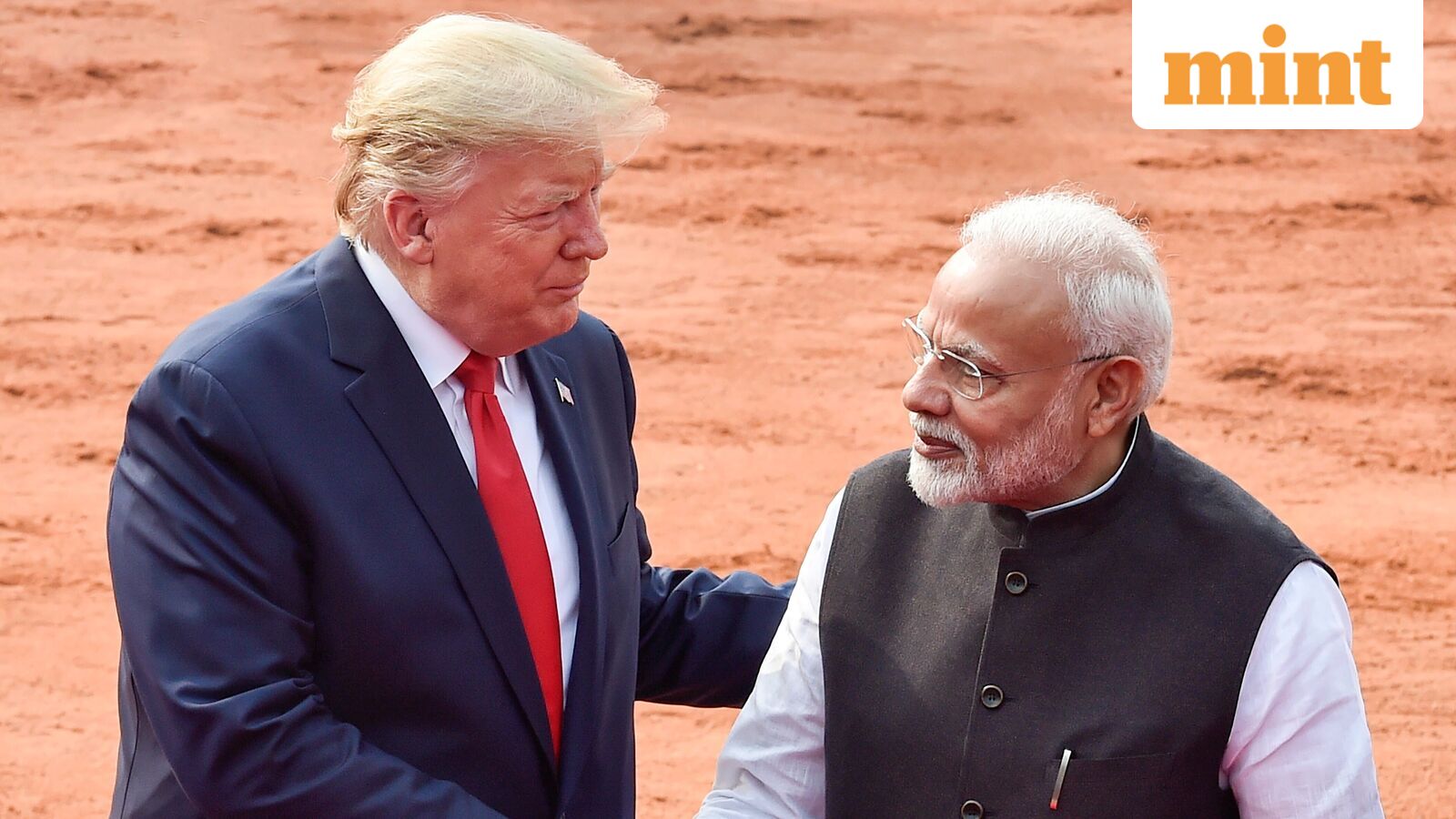
India-US trade deal: After months of uncertainty, the trade deal has finally lifted. Along anticipated lines, the deal has been received with much cheer by the Indian stock market as benchmark indices, Sensex and Nifty, recorded a 3% rally on Tuesday.
On Monday evening, US President Donald Trump slashed tariffs from 25% to 18%. Media reports suggest that 25% additional tariff imposed for the purchase of Russian crude oil has also been removed, taking away a major overhang for the stock market investors.
While the India-US trade deal is seen providing an impetus to the export-oriented sectors, analysts see multiple positives accruing for the market, including the reversal of relentless foreign portfolio investor (FPIs) outflows and the strength in the Indian rupee.
FPIs have largely avoided the Indian stock market over the last one year, turning net sellers in eight out of 12 months and offloading a record ₹166,286 crore amid the elusive trade deal, earnings slowdown and lack of AI-themed stocks.
The selling extended into 2026 as well, with net outflows of ₹35,962 crore in January. However, the first two sessions of this month saw buying worth. ₹1906 crores.
Consequently, India has significantly underperformed its peers by ~40% over the past year. Additionally, the rupee depreciated by ~6% against the USD, despite the slide in the dollar index. Domestic brokerage Motilal Oswal Financial Services (MOSL) believes many of these adverse trends are now likely to reverse.
“A large chunk of US FII capital will likely shift here, viewing India as the premier strategic play among emerging markets. The current high pessimism? It’ll get trapped in a sharp rally fueled by short covering. DIIs and retail will pile in, amplifying flows from all sides—get ready for the upside!,” opined Divam Sharma, Co-Founder and Fund Manager at Green Portfolio PMS.
Domestic investors cushion FPI blow!
Over all these months, Domestic institutional investors (DIIs) have provided uninterrupted net buying across all months, consistently countering selling pressure. The steady SIP inflows by retail investors helped cut India’s losses. Nifty rose 10% last year. In the absence of supportive retail inflows, the underperformance could have been sharper.
For a strong, secular bull market, both FIIs and DIIs are required. You can’t clap with one hand, said Kranthi Bathini of Wealthmills Securities.
“That’s what we’ve seen over the last one-and-a-half years — DIIs have been buying, but the market has largely remained range-bound. There is some exhaustion now. Markets move meaningfully only when both FIIs and DIIs participate together. That’s when you get a strong, sustainable bull market,” he said.
Bathini believes the trade deal has provided a very positive signal for foreign portfolio investors and acts as a sentiment booster for the overall market.
Relief for retail investors, but not immediately
But now the key question remains: With the FPIs expected to come back with a bang, will retail investors’ patience finally pay off? The answer is yes, but this impact will likely come with a lag, according to experts.
Retail investors tend to allocate a higher share of their investments to mid- and small-cap stocks compared with large-caps. The pain remains deeper in the broader market space, and now with the FPIs expected to return to Dalal Street, analysts expect a revival, but over 1-3 years.
Market veteran Sunil Subramaniam said while inflows into mid-caps and small-caps have been steady, fund managers have been deploying a significant portion of inflows into large-cap stocks for the schemes catering to the broader market — nearly 30–35%, as permitted by Sebi — seeking relative stability and better risk-adjusted returns.
This trend, however, is expected to reverse over the next two to three years, with mid- and small-cap stocks likely to significantly outperform large-caps, he opined.
The trade deal is seen as incrementally positive for MSME-linked sectors such as textiles, leather, chemicals and auto ancillaries, which form a large part of the broader market universe. Once FIIs return meaningfully, they are expected to channel funds into IT and pharma stocks—segments dominated by large-cap companies—while DIIs are likely to rotate to mid- and small-cap names. This rotation, however, is expected to play out gradually, taking five to six months, with returns potentially becoming visible only after a year or more, Subramaniam explained.
Today’s market rally is largely a catch-up move, and gains are likely to be more moderate going forward, he said. “Patience, therefore, remains key. Over a two- to three-year horizon, mid- and small-cap stocks are expected to deliver a CAGR of 15–18%, compared with 12–15% for large-caps,” he opined, which bodes well for retail investors.
Another major factor that needs to align is earnings recovery. Trade agreements create opportunity, not guaranteed outcomes, said Nikunj Saraf, CEO of Choice Wealth. If earnings growth doesn’t follow in the next few quarters, markets will move on from the narrative, he said, expecting retail patience.
Nikunj Saraf, CEO of Choice Wealth, also said retail patience will pay off but not instantly. Trade agreements create opportunity, not guaranteed outcomes. If earnings growth doesn’t follow in the next few quarters, markets will move on from the narrative, Saraf said.
“For retail investors who stayed invested despite volatility, this improves the backdrop. Markets often reward patience when risks reduce. That said, patience pays off fully only when companies convert this improved environment into higher revenues and profits. Sentiment can lift prices for a while, but sustainability comes from earnings,” he noted.
In the current phase, he said investors should be sensible and not aggressive by picking fundamentally strong companies rather than chasing momentum.
Disclaimer: This story is for educational purposes only. The views and recommendations expressed are those of individual analysts or broking firms, not Mint. We advise investors to consult with certified experts before making any investment decisions.

