

India’s first foundational artificial intelligence models launched on Wednesday, marking a leap for the country targeting a leadership role in the transformative technology sweeping the world.
Bengaluru-based Sarvam AI, backed by investors such as Peak XV and Vinod Khosla, unveiled three foundational AI models with 3-billion, 30-billion and 105-billion parameters. The company, the first to be funded by the India AI Mission in April last year, said its models can be used through voice commands and are accessible through 22 Indian languages. It also offers agentic AI applications that can execute a range of tasks with minimal human intervention.
Besides, BharatGen, an IIT Bombay-incubated, government-funded consortium, also unveiled a 17-billion parameter AI model as an early build. Launched in October 2024, BharatGen is a government project to develop a sovereign AI model, and is available in a variety of languages.
Foundational AI models are trained on mountains of data and can understand and generate text, images, or other content, powering many modern AI applications. India has invested in developing sovereign AI models to ensure the country has systems primarily trained on Indian data, Union IT secretary S. Krishnan had said a day earlier.
AGI still far
However, the arrival of artificial general intelligence (AGI) will take five to eight years, said Demis Hassabis, who heads Google’s AI research lab DeepMind. “We are not there yet,” he said, referring to technological intelligence that matches human intelligence.
“There are still things that systems can’t do—things like continued learning still needs to happen,” Hassabis said at a session at the event.
Separately, Google made a pitch to bring its cutting-edge AI models and products to applications in the Indian government agencies. At an event, chief executive Sundar Pichai underlined the use of DeepMind’s AI in public services in the country.
“I believe India is going to have an extraordinary trajectory with AI, and we want to be a partner,” Pichai said at an event on the sidelines of the summit.
New Phase
India leapfrogged in mobile internet, pivoted smartphone revolution, and the same is going to be the case with AI, Qualcomm CEO and president Cristiano Amon said. Qualcomm Inc has set aside $150 million for a dedicated venture capital fund targeting AI startups in India.
“AI is entering a new phase, where intelligence is directly built into devices and systems that people depend on everyday—smartphones and PCs to cars, machines and robots. It delivers richer and meaningful experiences, and the shift to AI will reshape industries. India’s startup ecosystem has a critical role to play in it, as AI drives innovation across sectors,” Amon said in a statement.
AI marketplace
Meanwhile, India’s next AI Mission is building.
AI Mission 2.0 will change course to create a marketplace to sell models and applications that the first tranche funded, said Abhishek Singh, additional secretary at IT ministry and chief executive of India AI Mission. Singh said the ministry will actively seek feedback on India AI Impact Summit.
“The expo is also giving us some ideas on identifying, procuring and deploying solutions, and state governments are also being consulted; so, AI Mission 2.0 will be after thorough discussions, consultations with all the government departments and state governments. We need to ensure that use cases that have been developed, which run on Indian foundation models, are scaled up and deployed at population scale,” Singh said in an interview.
Expo
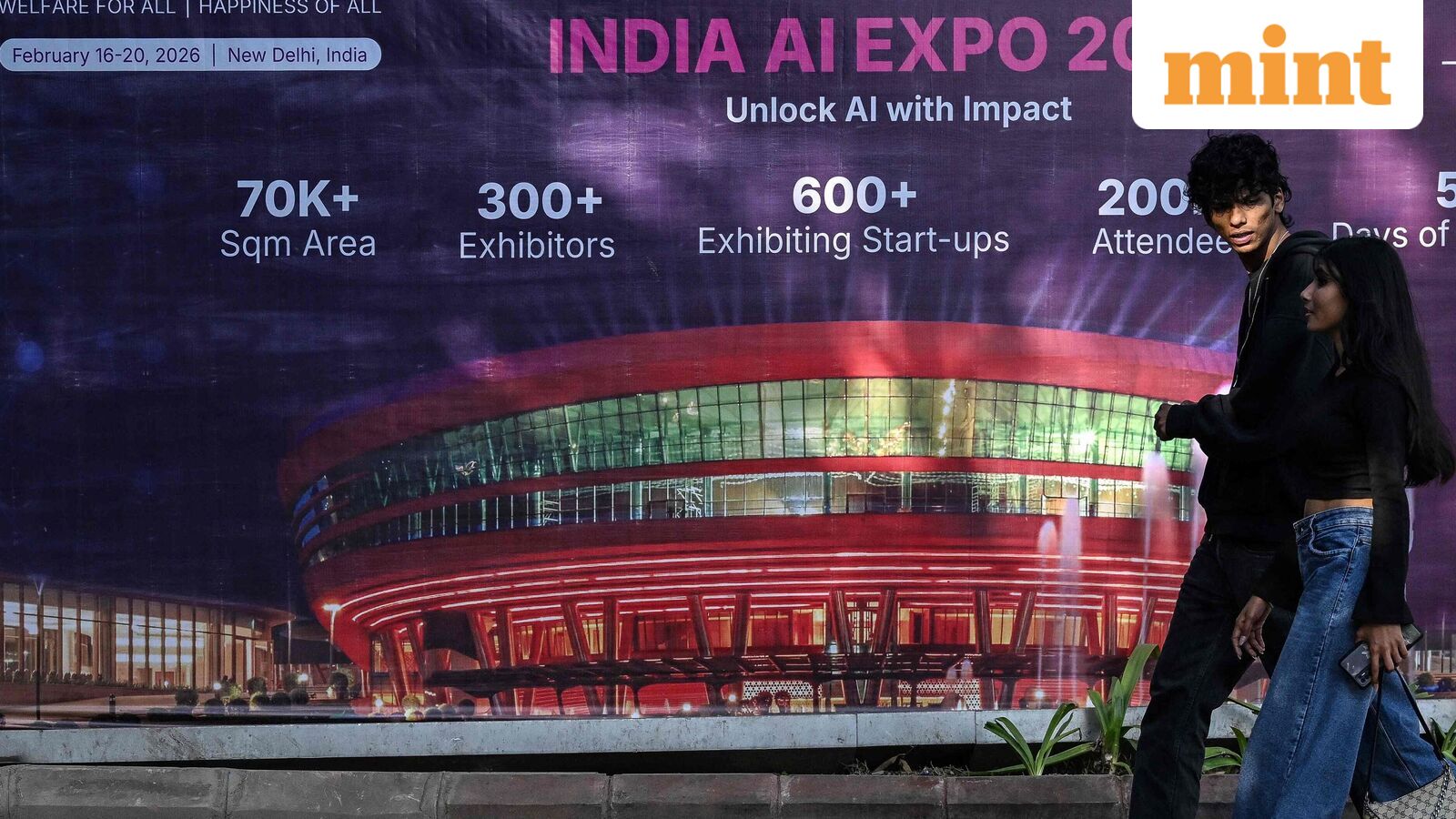
The summit’s expo features 600 startups and more than 300 exhibitors, spread across a 70,000 sq. m space at Bharat Mandapam—the same venue that hosted Startup Mahakumbh last year in April, which drew 3,000 startups.
Singh of India AI Mission, said the Center considered the event a success.
“We saw footfalls of over 250,000 people until yesterday, and the show floor saw massive crowds. We saw so much demand that we even had to extend the expo by one day, and many private investors have announced deals on the sidelines already. We will, however, take the learnings we get from this year’s event, and address key points to improve next year’s summit by perhaps seeking even larger meeting rooms, alongside other factors,” Singh said in an interview.
Robot dog controversy
While AI models and announcements evoked excitement, the other end of the summit was marred by controversy as Greater Noida’s Galgotias University was asked to leave the premises after it exhibited a Chinese robot dog. However, S. Krishnan, secretary at Meity, said that “what happened should not affect the way people present or exhibit their work at such events.”
“The idea is not to use an opportunity like this to become something else or create unnecessary noise. It is essential that a proper code of conduct is followed, as there are other countries and other participants involved as well. Controversies around one issue should not overshadow the tremendous effort put in by others,” Krishnan said in an interview.
Galgotias University later issued a statement, claiming the professor on ground “was ill-informed… and not authorized to speak with the press.”
Questions
However, exhibitors had to face skeptical questions.
Srikanth Vidapanakal, founder and chief executive of startup Species AI, said that its robots were assembled in Bengaluru, with “some of it being made in China.” The startup was exhibiting robots for warehousing and logistics in e-commerce, with each robot costing ₹10-15 lakh.
“It (the controversy) dampened the visual lens of looking at robotics, but I think we are pretty solid with what we do,” he added.
Several exhibitors were disappointed as the summit’s expo closed after mid-day on Wednesday, after losing half a day on the inaugural day. The same is expected to repeat on Thursday, with the expo being shut for access to the general public. The IT ministry sought to salvage the situation by extending the summit by a day, while many exhibitors said extending their stay may not be worth the money.
With stalls costing up to ₹15-50 lakh for a week and the first day a near-wipeout, exhibitors remain concerned about their returns from the five-day India AI Impact Summit. Compounding concerns are more restrictions expected in the coming days due to VIP visits, and what exhibitors said was the lack of a “target crowd” that could have let them showcase their businesses to investors.
The founder of a Bengaluru-based robotics startup exhibiting at the venue said the quality of visitors at the expo floor was underwhelming from the standpoint of returns on investments. “You want decision-makers, investors, and serious buyers walking up to your stall, not just curious students or crowds,” he said, requesting anonymity.
Entry closure
Prime Minister Narendra Modi is set to deliver his keynote address on Thursday, for which all entries to the venue will remain closed until at least 11am, except for those with a special invite. The closure promises to be another sore point for exhibitors who have paid ₹25,000-50 lakh for the five-day exhibition, where they hoped to meet a steady stream of foreign participants to collaborate with, or even interested early-stage investors.
At the expo, a startup pod at just 1 sq. m costs ₹25,000, while a standard stall of around 55 sq. m comes to roughly ₹15 lakh. A country pavilion at 200 sq. m cost companies ₹50 lakh just for the floor space—costs of booth construction, audio-visuals, staffing, logistics, flights and accommodation are extra. The total cost for exhibitors could easily double or triple their final bills.
Ticketing?
“The event should have been ticketed, which would have led to the influx of serious attendees. This is a structural flaw, and this open-entry format dilutes the quality of attendees. The audience composition simply didn’t give us anything to return with,” the representative of an automation startup said.
Meity’s Singh, however, said restricting expo entry in favor of investors was never on the cards. “Our goal was always to increase the footfall and allow as many people to see AI in action, and not restrict them in any way. That is one of the reasons why we expanded the expo by one day,” he added.
Behind the buzz, founders are chasing attention, not just capital. Many have stayed away from stalls altogether, opting to enter as general visitors rather than exhibitors, circulating through the halls in search of an impromptu pitch or a conversation that might lead somewhere. “In a room this size, sometimes the most valuable real estate isn’t a booth. It’s just being there,” said a founder from Gujarat.
Some, however, said the proceedings exceeded expectations. “The optics of having the country’s top leadership walk through an AI expo, cameras rolling, coverage guaranteed is worth the inconvenience. It’s a pragmatic read, being part of an event that commands national attention has value that doesn’t always show up immediately in booth footfall,” said an AI startup founder from Delhi.
Analysts said that such optics could help. Madhur Singhal, managing partner and chief executive at Praxis Global Alliance, a management consulting firm, said that being seen in event photos could “help with fundraising and have potential ecosystem benefits.”
“But, per se, that is not a quantifiable return on investment,” Singhal added.

