

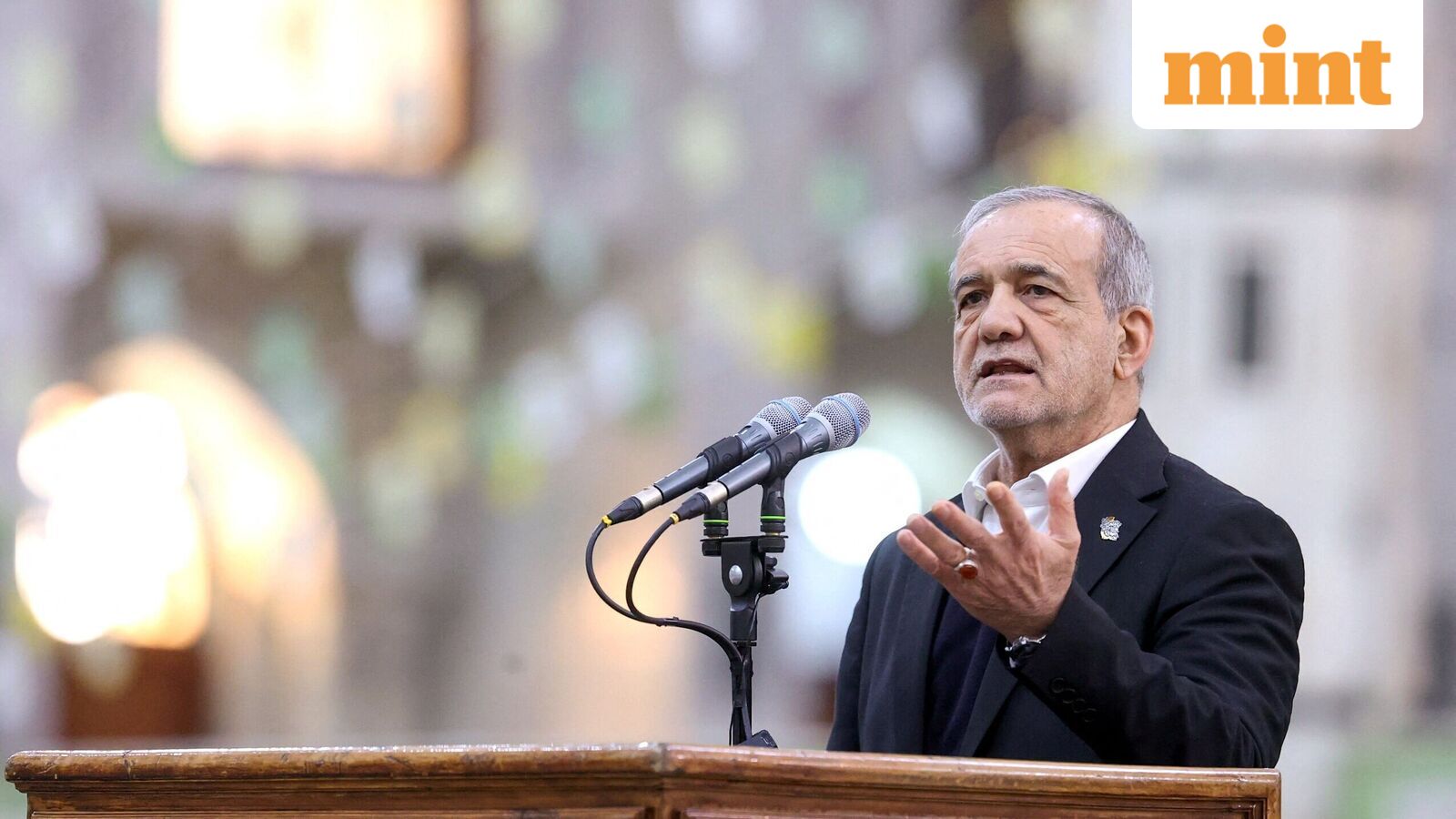
Iranian President Masoud Pezeshkian has signaled a conditional willingness to engage in negotiations with the United States, indicating a potential diplomatic opening while stressing that any talks must take place in an environment free from threats and what he described as “unreasonable expectations”.
Pezeshkian Sets Conditions for Possible US Negotiations
In a formal statement, President Pezeshkian said he had acted in response to requests from “friendly governments in the region” urging Tehran to reply to a proposal by the US President for negotiations. He said he had instructed Iran’s foreign minister to explore the groundwork for talks, provided key conditions were met.
“I have instructed my Minister of Foreign Affairs, provided that a suitable environment exists — one free from threats and unreasonable expectations — to pursue fair and equitable negotiations,” Pezeshkian said in a post on X.
He added that any discussions would be held “within the framework of our national interests”.
Emphasis on Dignity and National Interests
The Iranian president underlined that any prospective engagement must be guided by the principles of dignity, wisdom and expediency, and remain firmly rooted in Iran’s national interests.
The remarks suggest Tehran is seeking to demonstrate openness to dialogue without appearing to yield to external pressure, reinforcing its long-standing position that negotiations must be fair and equitable.
Rising Tensions in the Region
Pezeshkian’s comments come amid heightened regional tensions, after Washington dispatched an aircraft carrier strike group to the Middle East following Iran’s deadly response to anti-government protests that peaked last month.
US President Donald Trump has said he remains hopeful that Washington will “work something out” with Tehran, while warning that “bad things would happen” if no agreement is reached. Iranian authorities have maintained that they favor diplomacy but have also vowed an unrestrained response to any act of aggression.
Nuclear Talks Only, Tehran Insists
Iran has repeatedly stressed that any negotiations must remain strictly focused on the nuclear issue, rejecting discussions on its missile program or broader defense capabilities.
In an interview with cnn broadcast on Monday, Iran’s foreign minister Abbas Araghchi said a nuclear agreement with the United States was achievable if Washington adhered to its stated aim of fairness.
“So I see the possibility of another talk if the US negotiation team follows what President Trump said: to come to a fair and equitable deal to ensure that there is no nuclear weapons,” he said. “So if that is the case, I am confident that we can achieve a deal.”
Khamenei Warns of ‘regional war’
Despite the signals of possible engagement, Iran’s supreme leader Ali Khamenei has warned that any US attack on Iran could trigger a “regional war”, highlighting the high stakes surrounding renewed diplomacy.
The latest remarks mark a notable moment for the reformist Pezeshkian, who in recent weeks had warned Iranians that the unrest in the country had moved beyond his control. The statement also appears to indicate backing from Khamenei for talks that the 86-year-old cleric had previously dismissed.
Behind-the-Scenes Diplomacy and Unanswered Questions
Turkey has reportedly been working behind the scenes to facilitate talks later this week, as US Middle East envoy Steve Witkoff travels in the region. However, it remains unclear whether Tehran and Washington can reach an agreement, particularly as President Trump has included Iran’s nuclear program among a broader set of demands.
Trump ordered the bombing of three Iranian nuclear sites during the 12-day war launched by Israel against Iran in June, further complicating the diplomatic landscape.
Signals From Tehran’s Power Centers
Writing again on
“I have instructed my Minister of Foreign Affairs, provided that a suitable environment exists — one free from threats and unreasonable expectations — to pursue fair and equitable negotiations, guided by the principles of dignity, prudence, and expediency,” he said.
The United States has yet to publicly acknowledge that talks will take place. A semi-official Iranian news agency reported on Monday—before later deleting the report without explanation—that Pezeshkian had issued such instructions to Araghchi, who held multiple rounds of talks with Witkoff before the June conflict.
Nuclear Red Lines Reiterated
Late on Monday, the pan-Arab channel Al Mayadeen aired an interview with Ali Shamkhani, a senior adviser to Khamenei on security affairs and a member of Iran’s Supreme National Security Council.
Shamkhani suggested that any talks would begin indirectly before potentially moving to direct negotiations if an agreement appeared attainable. He said discussions would focus solely on nuclear issues.
Asked whether Russia could take custody of Iran’s enriched uranium, as it did under the 2015 nuclear deal, Shamkhani dismissed the idea. “Iran does not seek nuclear weapons, will not seek a nuclear weapon and will never stockpile nuclear weapons, but the other side must pay a price in return for this,” he said.
Uncertainty Ahead
Iran has been enriching uranium up to 60 per cent purity, a short technical step from weapons-grade levels, and has refused requests by the International Atomic Energy Agency to inspect sites bombed during the June war.
Meanwhile, Witkoff is expected to meet Israeli Prime Minister Benjamin Netanyahu and other senior officials before traveling on to Abu Dhabi for Russia–Ukraine talks.
“We have talks going on with Iran, we’ll see how it all works out,” Trump said in the Oval Office on Monday. “I’d like to see a deal negotiated… and if we can’t, probably bad things would happen.”

