

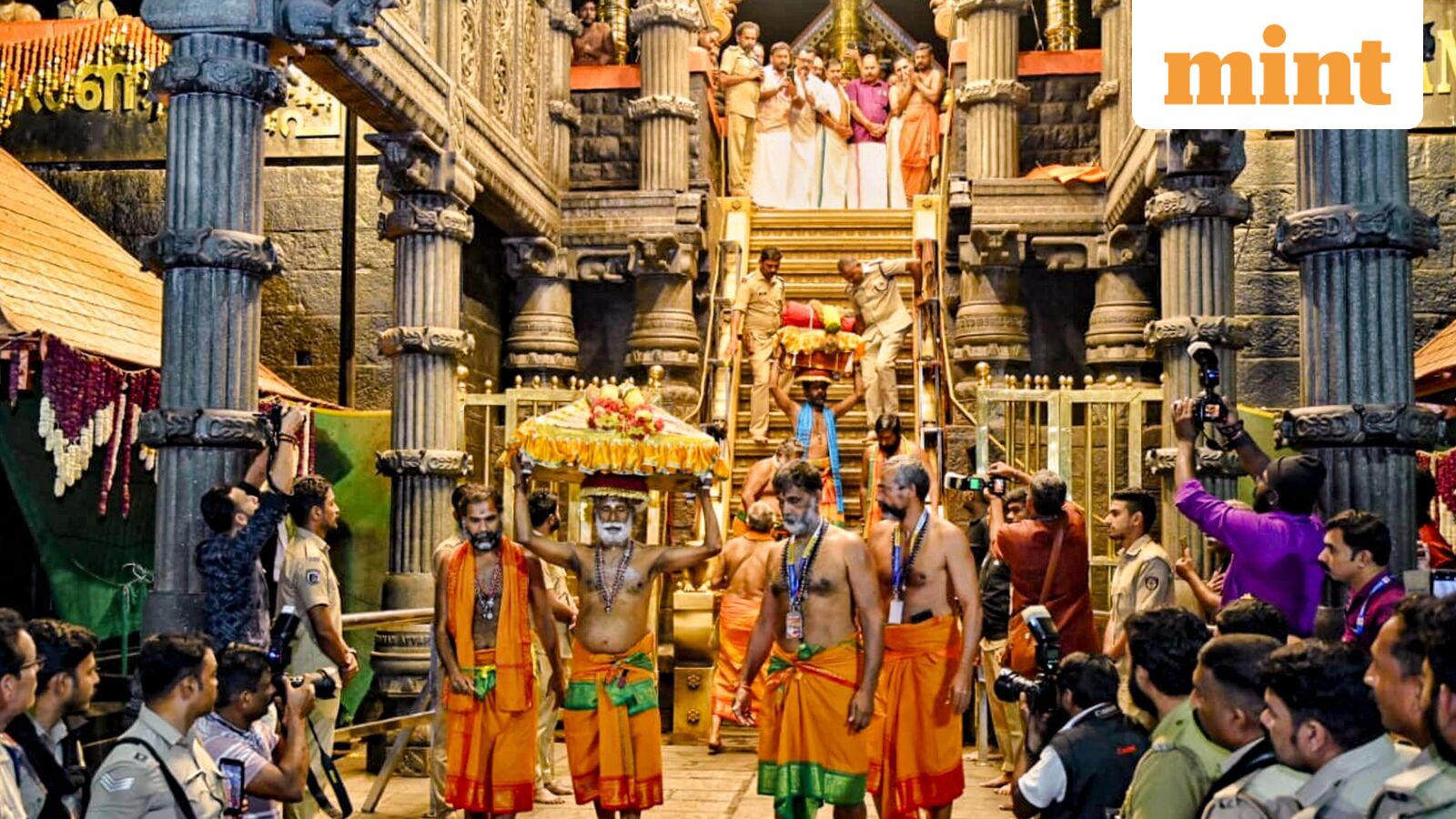
Kerala Assembly Elections: As Kerala heads into Assembly polls later this year, the Sabarimala women’s entry issue has re-emerged as a potent political plank in the only state in the country currently governed by the Left. Opposition parties on Monday questioned the ruling Left government over its earlier support for the move that had led to widespread unrest.
The issue gained fresh attention after the Supreme Court on Monday reopened the case, announcing that a nine-judge bench would begin final hearings on a batch of petitions on discrimination against women in religions and places of worship, including the Sabarimala temple, news agency PTI reported.
Under pressure from prominent Hindu caste organizations and the opposition Congress and BJP, the Left government said the Sabarimala women’s entry issue involved several constitutional complications and that an appropriate stand would be taken after discussions.
The opposition urged the Pinarayi Vijayan-led dispensation to immediately submit a revised affidavit to the Supreme Court.
Clarifying the government’s stand, the state’s Law Minister P Rajeev said it was not a matter to be reduced to a “yes or no” answer, and even the Apex Court made it clear that it would take the review petitions only after addressing seven constitutional questions.
“This is not a situation where a simple ‘yes or no’ can be stated. Several constitutional complications are involved in it. All aspects need to be considered,” he told reporters, adding that the state government has enough time to inform its stand.
He, however, said the government is here to protect the faith of believers, and it would stand by them, cutting across belief. He said faith and social reform must go hand in hand and reiterated that this had been the government’s position in its affidavit before the court.
Rajeev said the state government, in its earlier affidavit, had suggested constituting a commission of scholars having deep knowledge of Hindu beliefs and having a record in social reformation to study the women’s entry issue, but the apex court didn’t consider it.
However, the government stands by its suggestions, he added.
The minister maintained that the government had earlier acted in accordance with the SC verdict on the issue.
“It was not a government order but the supreme court verdict. The apex court verdict is naturally binding. The same supreme court had later decided to review it. Even then, the earlier verdict has not been stayed,” Rajeev said.
The government did not take any adamant stand after that, the minister said, referring to the issue that triggered massive protests by Hindu outfits and opposition parties in 2018 after the Left government attempted to implement the Supreme Court verdict allowing the entry of women of menstrual age into the revered Lord Ayyappa shrine at Sabarimala.
“We will present a good stand before the supreme court after examining the constitutional aspects. We have ample time,” he said, adding that a stand would be taken after examining all aspects in detail.
‘CPI (M) urged to make its stand clear’
However, the major opposition parties—the Congress and BJP urged the CPI(M)-led government to make its stand clear on the matter, with the grand old party calling on it to file a revised affidavit in the top court on the matter.
Seeking to corner the Left government, senior Congress leader VD Satheesan said the Pinarayi Vijayan-led dispensation should be prepared to “correct” the affidavit it had filed earlier in connection with the matter.
The Leader of Opposition in the assembly alleged that several organizations were invited to the Global Ayyappa Sangamam after being misled with assurances that the government would change its stand on the women’s entry into Sabarimala temple.
Addressing reporters in Palakkad, he said if the affidavit was not revised, the government’s duplicity would be exposed.
Satheesan accused the government of adopting a “confused approach” and lacking a clear or firm stand on the issue, while simultaneously seeking the votes of Ayyappa devotees.
How many hours of discussion are required to state that the earlier stand is being changed in view of changed social circumstances? Just 10 minutes are needed to file an affidavit, he said.
‘U-turns on several issues’
BJP state president Rajeev Chandrasekhar alleged that the state government had taken U-turns on several issues in the past and might do the same on the women’s entry issue also.
The government can do anything, he alleged, keeping the elections in mind.
Chandrasekhar also said there is no change in the party’s earlier stand on the issue.
‘Women of menstruating age should not be allowed’
The state’s two major Hindu caste outfits – the NSS and the SNDP Yogam – on Monday reiterated that women of menstruating age should not be allowed entry into the Sabarimala temple, as the Supreme Court considered review petitions in the matter.
Nair Service Society (NSS) general secretary G Sukumaran Nair said the organization has not changed its stand against the entry of women of menstruating age at Sabarimala.
Nair said he expects the state government to change its position.
Sree Narayana Dharma Paripalana (SNDP) Yogam general secretary Vellappally Natesan said it was not appropriate to allow an entry practice that did not exist at the Sabarimala temple earlier.
Natesan recalled that widespread protests had erupted in the state following the earlier Supreme Court verdict.
“We should also remember that those who supported the judgment earlier are now against it. The court has now given the government an opportunity to express its opinion. Let the court make a decision,” he said.
What is the Sabarimala Women’s entry row?
The Sabarimala women’s entry issue is a long-standing legal and social conflict in Kerala, centered on whether women of menstruating age (10–50 years) should be allowed into the Lord Ayyappa Temple.
In 2018, a 5-judge bench originally lifted the ban in a 4:1 majority, ruling that the exclusion was unconstitutional and violated the right to equality.
On January 2, 2019, two women, Bindu Ammini and Kanakadurga, became the first in the restricted age group to successfully enter the shrine under police protection, which led to widespread protests and a temporary closure of the temple for “purification” rituals.
Now, as per Monday’s decision, the Supreme Court of India has scheduled a 9-judge Constitution Bench to begin final hearings on April 7, 2026.
The court will hear petitioners supporting the review from April 7–9, those opposing it from April 14–16, and is expected to conclude the process by April 22, 2026.
This is not a situation where a simple ‘yes or no’ can be stated. Several constitutional complications are involved in it.
The 2026 Kerala Legislative Assembly elections are expected to be held in April or May 2026, as the current assembly’s five-year term ends on May 23, 2026. An official announcement of the dates is expected by the end of February or the beginning of March.
Key Takeaways
- The Sabarimala women’s entry issue highlights ongoing tensions between religious beliefs and constitutional rights.
- Political parties are leveraging the controversy to gain electoral advantage ahead of the upcoming assembly elections.
- The Supreme Court’s involvement underscores the complexity of addressing gender discrimination within religious contexts.

