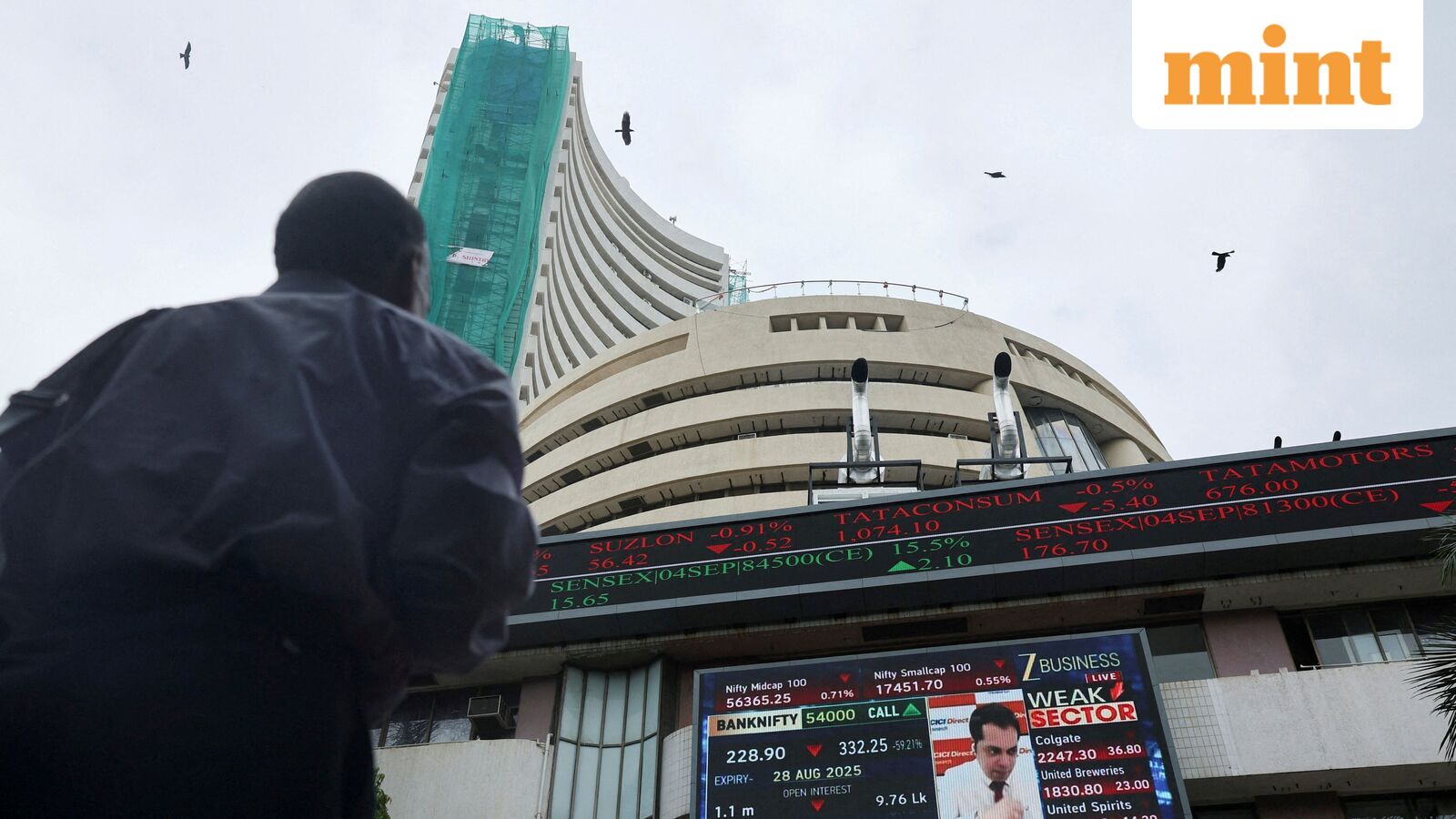
The stock market is facing strong headwinds at the current juncture. Geopolitical risks remain elevated amid the ongoing US–Iran war, while the Russia–Ukraine conflict has stretched beyond four years. Crude oil prices have spiked, adding to inflationary pressures. There are also visible signs of a slowdown in global growth.
At the same time, artificial intelligence (AI) is poised to disrupt multiple sectors, with the IT industry at the forefront. Clearly, the market has no shortage of concerns. Is it time to stay on the sidelines?
Bulls licking wounds
On a monthly scale, market benchmarks have been in the red since last December, even as they hit their record highs, indicating they lack durable triggers to sustain gains.
The Sensex hit its all-time high of 86159 on December 1, while the Nifty 50 scaled its fresh peak of 26,373 on January 5 this year. At the current juncture, they are down more than 6% from their record highs.
The December quarter earnings remained largely stable and on expected lines, but they have been insufficient to keep the bulls in top gear.
Strong bouts of volatility have wounded bulls, reinforcing the fear that investors should brace for muted returns this year.
Is it time to stay on the sidelines?
Historically, a selloff is followed by a bull run. So, the market is bound to rise in the coming months. But the real question is, has it hit the bottom, or will it fall more?
The answer is, no one knows. It is always difficult to predict the course of the market precisely. There are guesses only. And at this juncture, many experts believe investors should wait for a few days and start buying quality stocks.
“Our sense is that the key variable to watch is the geopolitical conflict. If it gets prolonged, it could pose a meaningful challenge for markets. However, given that the US and Israel appear to have air supremacy, it does not seem likely that the conflict will extend for a long period,” said Pankaj Pandey, the head of research at ICICI Securities.
“While we may see knee-jerk reactions in the near term, we expect the situation to stabilize over time. From our perspective, this is primarily a short-term challenge rather than a structural concern for the markets,” Pandey added.
Pandey has not made any changes to his Nifty target for the end of this year. He expects the Nifty 50 to be near 29,500 by the end of the calendar year 2026.
“We are maintaining our year-end target. We believe investors should wait for a few more days to allow volatility to settle. However, we think markets are approaching levels where staggered buying could be considered. Broadly, we would look at areas that see sharper corrections. That said, we currently prefer BFSI and capital goods,” said Pandey.
Rajesh Kothari, the founder and CIO of ALFAccurate Advisors, highlighted that historically, during such geopolitical conflicts, the Sensex has corrected by around 10%. However, past data indicate that such corrections have generally been temporary, with markets recovering on average within approximately 38 trading days once uncertainty begins to ease.
Kothari, like many other experts, also believes that the overall impact of the turmoil in the Middle East will depend on the duration of the conflict, which currently appears likely to remain limited to 1–3 weeks, given the low public support for escalation in the US and the approaching mid-term elections.
Kothari underlined that markets may react to fear initially, but will likely recover on fundamentals, creating opportunities in domestic sectors like banking, auto, consumer discretionary, hospitals, and select capital goods.
“This phase offers an opportunity to position clients in quality portfolios focused on structural alpha generation,” said Kothari.
VK Vijayakumar, Chief Investment Strategist at Geojit Investments, said while the headwinds for the economy and markets are strong now, there are tailwinds, too, like India’s robust GDP growth rate, financial stability and improving corporate earnings.
Vijayakumar believes that if the Iranian conflict subsides, the tailwinds will emerge, impacting stronger.
“The market dip will provide buying opportunities for long-term investors with a time horizon of more than three years. However, expect only modest returns in calendar year 2026. The prospects for the long-term look bright,” said Vijayakumar.
G Chokkalingam, the founder and head of research at Eeconomics Research Private, believes prolonged weakness in the Indian market is most unlikely.
He highlighted that global equity markets learned to live with wars, which is amply evident. Crude oil has remained far below $100 a barrel despite several wars in the last five years. Oil intensity in economic growth has been going down over the last 15 years. Renewable energy has really taken off.
So, Chokkalingam added that if oil demand otherwise remains muted and oil price does not rise over $100 a barrel, the global economy and markets may not be affected badly.
AI could be a threat to Indian technology stocks. However, other sectors may rescue the whole market, Chokkalingam believes.
The technical projection for Nifty
According to Aditya Thukral, a SEBI-registered research analyst and the founder of AT Research and Risk Managers, the short-term trend for Nifty 50 remains negative with the formations of lower highs and lower lows.
Thukral highlighted that the index is below all the major exponential moving averages, i.e. 20-day, 50-day, 100-day and 200-day, which are sloping downwards as well. The market breadth continued to deteriorate in the past few days, where only 20% of stocks are now above the 200-day EMA. All these are bearish signals and worrisome for bulls.
At the same time, Thukral added that the 14-period RSI, which is trending lower, reads near 40 on daily charts and around 47 on weekly charts. These are clearly positioned well above the oversold zone, and continuation of the short-term downtrend is expected to take place in the days to come.
“The medium-term trend for Nifty 50 is sideways as no clear sequence of highs and lows is visible. The index is also exhibiting a three-legged zig-zag structure on higher time frames, where wave C of the ABC pattern is underway, and this could extend the fall towards 24,350 levels by the end of March 2026. Also, the index holds key supports around 24,300, the levels which have not been seen. since August 2025,” Thukral said.
“During these pattern formations and based on the readings of 20-day, 50-day and 100-day EMAs, multiple resistances have been formed between 25,400 and 25,650 levels for the index, and a decisive close above 25,650 will change the trend for the benchmark index. We expect the index to test 24,350 by the end of March 2026 by staying below. 25,650. Key supports are near 24,850, 24,570 and 24,330, while key resistances for the index are 25,400 and 25,650,” said Thukral.
Read all market-related news here
Read more stories by Nishant Kumar
Disclaimer: This story is for educational purposes only. The views and recommendations expressed are those of individual analysts or broking firms, not Mint. We advise investors to consult with certified experts before making any investment decisions, as market conditions can change rapidly and circumstances may vary.