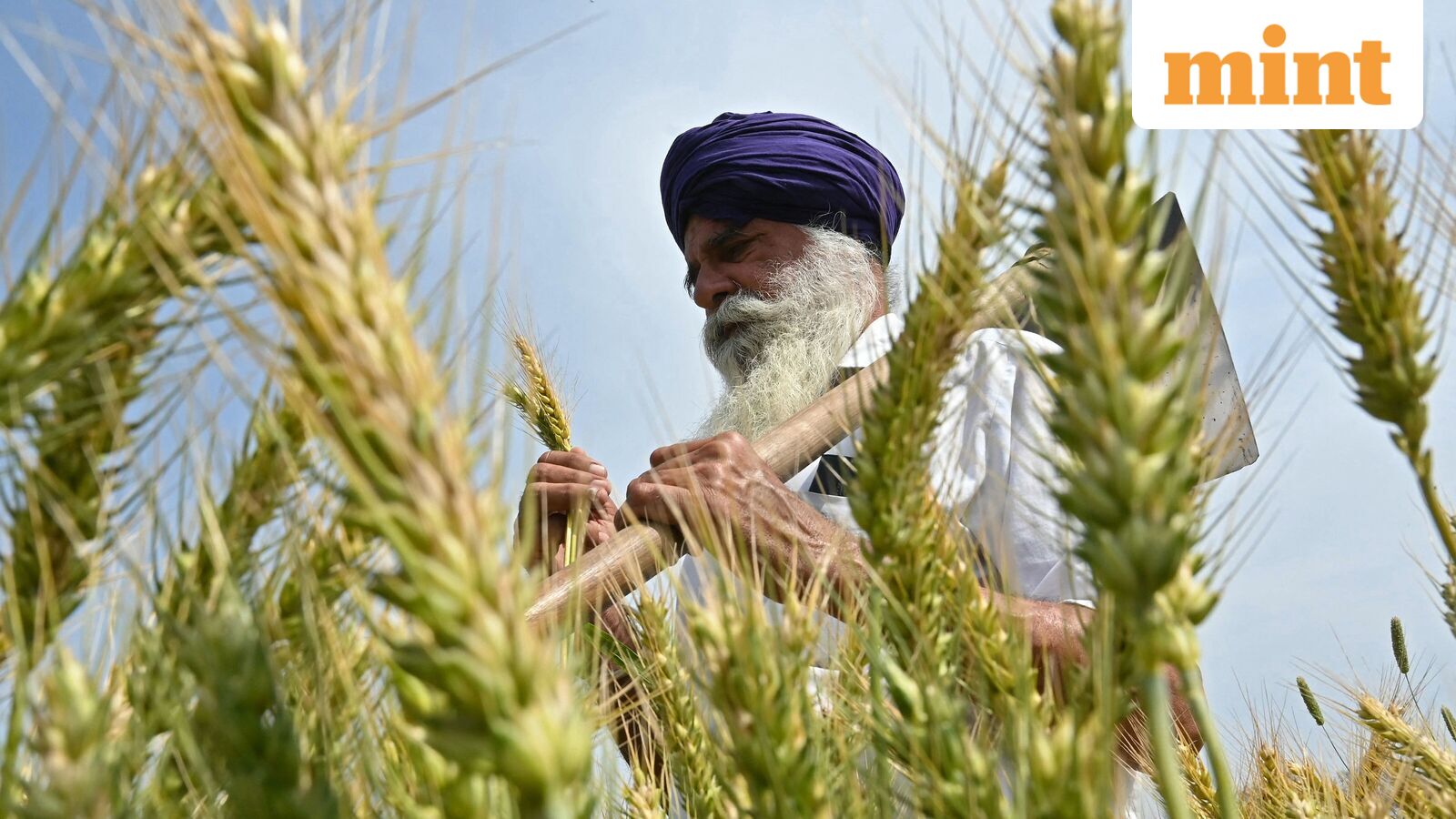
A looming record harvest and the war in West Asia are likely to spur more wheat farmers to seek higher support prices via government procurement as the staple fetches 15% lower than last year in the open market, according to farmers and sector experts.
The minimum support price (MSP) of ₹2,585 per quintal announced for the current rabi marketing season 2026-27 is ₹290 per quintal higher than the average wheat price in the open market is around ₹2,294.82 per quintal as on 7 March.
Lower prices in the open market this year reflect forecasts of up to 120 million tonnes output for the current year, driven by higher acreage, favorable conditions and state incentives. At that level, it would surpass the previous record of 117.94 million tonnes set in the 2024-25 crop year (rabi season). The government usually begins wheat procurement in April, but it may start earlier at the request of states.
The current situation marks a sharp reversal from the previous marketing season 2025-26, when open market prices exceeded the MSP.
Farmers’ inclination to sell more to the government this year also comes amid concerns that the war in West Asia may hit wheat exporters even as the world’s second-largest producer of the staple decided to reopen overseas shipments after nearly four years of restrictions.
“With open market prices ruling below the MSP, it is important that government agencies ensure procurement of all wheat brought by farmers to mandis in major producing states,” said Devinder Sharma, an agricultural policy expert. “This will help farmers secure remunerative prices for their produce and stabilize market sentiment.”
Lower open market prices
The area under wheat cultivation for the 2025-26 crop year has increased by around 6.13% over the previous year to around 33.4 million hectares as of 30 January, according to official data. The increase in sowing has been supported by adequate soil moisture, favorable climatic conditions in key producing states and improved price incentives.
Madhya Pradesh and Rajasthan have announced a bonus on wheat procurement ranging from ₹40 per quintal to ₹150 per quintal over and above the MSP, taking the price to ₹2,625 and ₹2,735 per quintal, respectively. The wholesale price of wheat in Delhi is hovering around ₹2480-2500 per quintal.
In the last season, wheat was sold at an average price of ₹2,689.45 per quintal in the open market compared with an MSP of ₹Rs 2,425 per quintal.
“Procurement arrangements are being strengthened to handle the expected increase in arrivals at mandis. The government is planning to expand procurement facilities and ensure adequate infrastructure at designated centers so that farmers are able to sell their produce at the MSP without facing logistical bottlenecks,” said a government official requesting anonymity.
Agriculture and allied sectors account for around 16% of India’s gross domestic product (GDP), with nearly 46% of the country’s workforce dependent on agriculture.
“This is the best time for farmers to take advantage of the MSP. When market prices fall, the government’s MSP support becomes even more important,” said Rakesh Arrawatia, professor at the Institute of Rural Management Anand (IRMA) and Dean, School of Cooperative Banking and Finance and agricultural economist. “Since open market prices are currently lower, farmers can benefit by selling their produce through MSP procurement.”
Queries emailed to the ministries of consumer affairs & food distribution and agriculture on 9 March remained unanswered till press time.
Foreseeing challenges
“It is certain that farmers will opt for government mandis to sell their wheat crop as the MSP rates are higher than the prevailing market price,” said Rattan Randhawa, a farmer from Deo village in Punjab’s Taran Tarn district.
Farmers’ unions say they may face challenges in accessing procurement centers and selling their produce at the MSP as infrastructure is limited and inefficient.
“Farmers will naturally prefer to sell their produce at government mandis where procurement infrastructure and facilities are well established, as it ensures they receive the MSP. However, in several states, the mandi infrastructure and procurement arrangements are still limited,” said Balbir Singh Rajewal, president, Bharatiya Kisan Union (Rajewal), a farmers’ organization in India that represents the interests of producers in northern states such as Uttar Pradesh, Punjab, Haryana and Rajasthan.
“In such regions, farmers may face difficulties in transporting and selling their wheat at procurement centres. Unless adequate procurement infrastructure and logistics are strengthened, many farmers may not be able to fully benefit from the MSP mechanism,” said Rajewal.