Nepal Elections 2026: Nepal will vote to elect a new government on 5 March. The voting will be the first election in the Himalayan nation since the deadly youth-led anti-corruption protests toppled the government of then-Prime Minister KP Sharma Oli in September 2025.
The ‘Gen Z’ protests last year killed 77 people and injured more than 2,000. Nepal has since been governed by an interim government led by former chief justice Sushila Karki, which promised to hold fresh elections and hand over power within six months.
For decades, Nepal’s political landscape has been dominated by veteran leaders — many of them former Maoist insurgents — who have taken turns in power since the end of the 10-year civil war in 2006.
Key figures contesting this time include a former prime minister seeking a return to power, a rapper-turned-mayor bidding for the youth vote, and the newly elected leader of the Nepali Congress party.
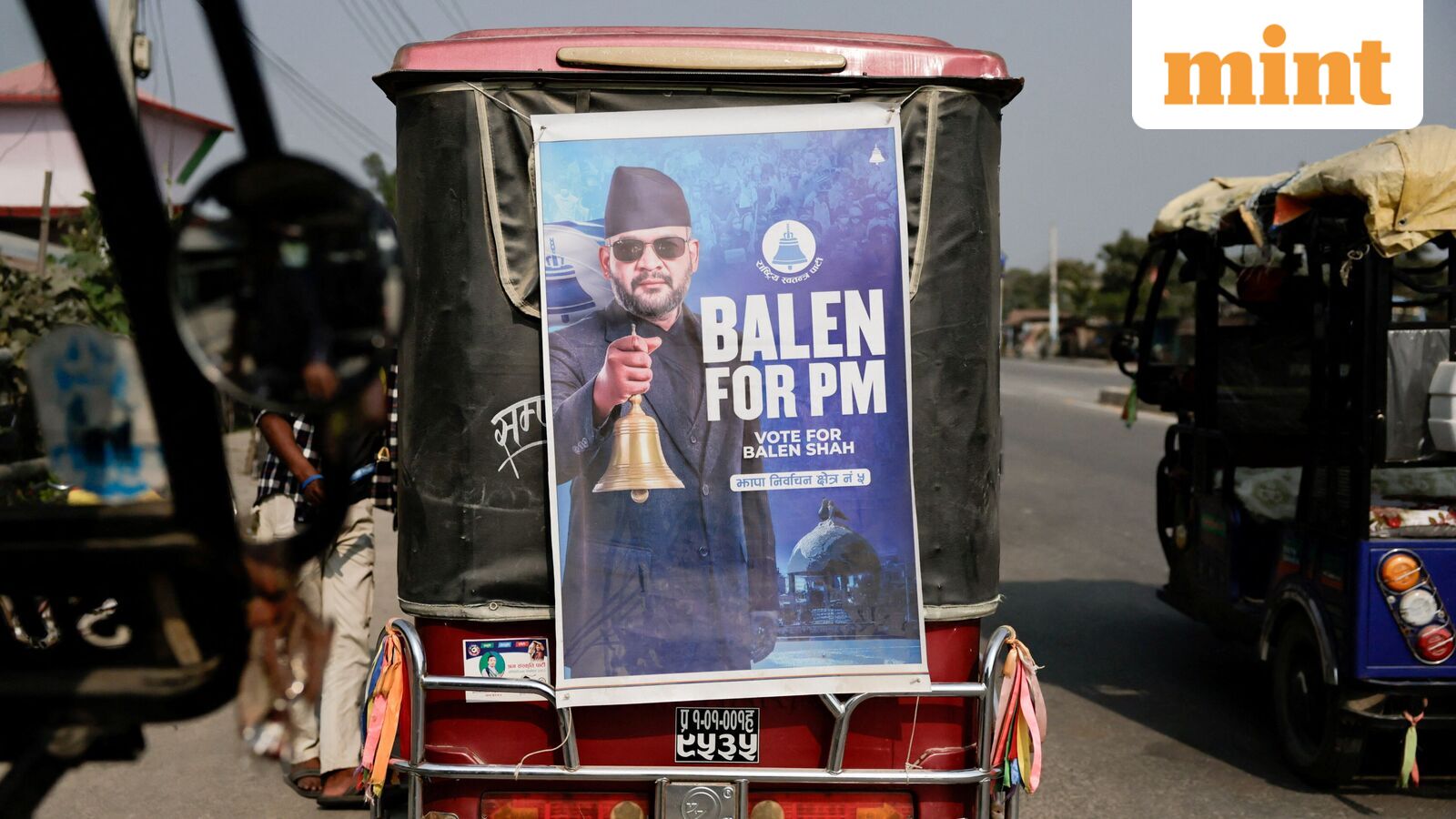
Among the frontrunners for prime minister is Rapper-turned-politician and former Kathmandu mayor Balendra Shah, 35, of the centrist Rastriya Swatantra Party.
Facing him in the Jhapa 5 constituency is four-time prime minister Oli, 74, of the Communist Party of Nepal (Unified Marxist–Leninist), vying for the top post again.
Oli is facing an uphill battle to win back ‘Gen Z’ voters who ousted him barely six months ago.
Other contenders include the centrist Nepali Congress party’s 49-year-old Gagan Thapa and three-time prime minister Pushpa Kamal Dahal, 71, who now leads the Nepali Communist Party.
Oli has been a liberal communist since the 1990s, while Dahal led a bloody Maoist insurgency for a decade before joining mainstream politics in 2006.
Here are the most closely watched candidates in the 5 March parliamentary polls in Nepal:
Balendra Shah, 35
Shah, widely known as “Balen”, has emerged as a symbol of youth-driven political change, after backing the protests that forced the government from power, news agency AFP said.
Born in Kathmandu in 1990, Shah was a schoolboy during Nepal’s decade-long Maoist civil war. A former underground hip-hop artist whose songs railed against corruption and inequality, the 35-year-old civil engineer shot to national prominence through music.
Shah tasted his first political victory in 2022, when he was elected Kathmandu’s first independent mayor. Over the years, Shah has cultivated an image of a young reformer who launched campaigns against tax evasion, traffic congestion and waste mismanagement in the country.
In December 2025, Shah joined the centrist Rastriya Swatantra Party (RSP), positioning himself for national leadership.
Shah is challenging former prime minister Oli in his home constituency. Shah told AFP that it shows he is “not taking the easy way out”.
Advocating a liberal economic system with social justice, including free education and healthcare for the poor, Shah says Gen Z’s core demand is good governance – and insists music will remain part of his identity, even if he becomes prime minister, news agency AFP said.
KP Sharma Oli, 73
KP Sharma Oli, 73, was ousted as prime minister by the uprising but retained enough support to be reelected leader of the Communist Party of India. Nepal-UML (Unified Marxist Leninist).
Oli is one of Nepal’s most seasoned and polarizing political figures and a veteran Marxist leader who has served four times as prime minister.
Oli was drawn into underground communist activism as a teenager and was arrested in 1973 for campaigning against the monarchy. He spent 14 years in prison, including four in solitary confinement.
In later years, Oli rose through the party ranks to become prime minister in 2015, returning to office multiple times before he was ousted in the ‘Gen Z’ uprising last year.
Oli is often accused of authoritarian streak and intolerance of dissent. But those who support him credit him with strong leadership and nationalist resolve, particularly in navigating relations with India and China.
Oli is accused of ordering security forces to fire on protesters during last year’s unrest, in which at least 77 people were killed, and crowds torched parliament. Oli has denied the charges and instead blamed what he called “infiltrators” for the violence, in an interview with AFP
Gagan Thapa, 49
Gagan Thapa emerged as a key player after he led an internal revolt in January to be elected as head of the Nepali Congress, the country’s oldest and historically dominant party.
Born in 1976, Thapa was drawn into politics as a teenager during the 1990 pro-democracy movement against the then absolute monarchy. Thapa rose through student activism, linked to the Nepali Congress, and became a prominent figure in the 2006 mass uprising that forced the king to abdicate.
Thapa has been jailed several times for street protests. He eventually entered the Parliament of Nepal as one of its youngest members and has since served multiple terms. Thapa has also been Nepal’s health minister.
“I am the right mix of energy and experience — the right mix which can deliver,” Thapa told AFP, pledging governance reform and job creation, while promising to work across party lines.
Nepal Elections 2026 in numbers
Nearly 19 million of Nepal’s 30 million people are eligible to vote in the 5 March election for the 275-member Parliament.
There are about 800,000 first-time voters in Nepal. As many as 65 political parties are in the fray for the 5 March polls.
The voters will elect 275 members of parliament through a mixture of first-past-the-post voting and proportional representation. From 275 House of Representatives (HoR) seats, 40 per cent, or 110 members, are elected through a proportional voting system. Elections are conducted for 165 seats under the First Past the Post (FPTP) or direct voting system.
More than 3,400 candidates are in the fray. These include more than 1,000 people under 40, according to a BBC report.
Voting will start at 07:00 local time and continue until 17:00 local time.
When will the results be announced?
The results of the 165 directly-elected seats are expected to be released within 24 hours of ballot boxes being collected from across the country, the Election Commission of Nepal promised.
Officiating Chief Election Commissioner Ram Prasad Bhandari told local reporters that tallying the results of the proportional representation vote, which determines winners in 110 seats, could take another 2 to 3 days.
I am the right mix of energy and experience — the right mix which can deliver.
However, in Nepal’s 2022 election, it took more than two weeks for the final results to be released.