

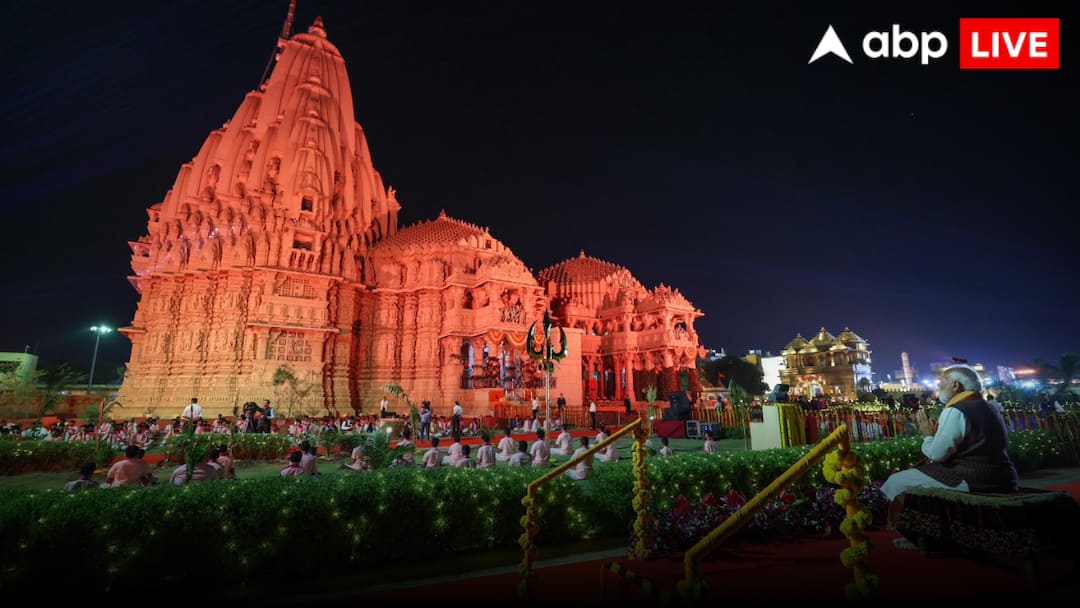
India means Bharat. This sentence of the Constitution is not just a combination of words, but a declaration of a civilization. After independence, our founding fathers had envisioned India not just as a modern nation-state but as a continuous civilization. Restoration of cultural identity along with political independence. This was that incomplete dream, which had to be fulfilled with time. Today the journey from Ayodhya to Kashi and from Kashi to Somnath is the true expression of that dream. This is not the return of any plot, but the re-establishment of Indian culture, consciousness and soul that has flowed for thousands of years.
Prime Minister Narendra Modi has done the work of giving a clear voice to this civilizational vision in contemporary India. The Somnath Swabhiman festival organized on the completion of one thousand years of Somnath is not just a cultural event, but a public proclamation of India’s national self-respect. This is the message that modern India now sees its temples, memories and traditions not on the margins of history, but at the center of national consciousness.
Somnath Temple is the most powerful symbol of this continuity. This Jyotirlinga situated on the sea shore is not just a religious place but is a living memory of Indian civilization. In the last one thousand years, there is hardly any such temple which has endured so many attacks, destructions and insults and yet every time it has stood stronger than before. The history of Somnath makes it clear that Indian civilization can be destroyed, but cannot be erased.
The pages of history show that this revival has not been a one-time event, but a continuous process. In the 7th century, the Maitraka kings of Vallabhi built a second temple in red sandstone. This was not just a work of architecture, but a clear message that faith is not temporary. When the Arab invasions caused destruction in the 9th century, the Pratihara king Nagabhatta II built a third grand temple. History has seen that swords came and went, but Shiva remained there.
Soon after the invasion of Mahamud of Ghazni in the 11th century, King Bhimdev I and Parmar King Bhoj of Malwa together revived the temple. This reconstruction, which began with wood, shows that Hindu society does not waste time—it does not stop in mourning, but turns into resolution. In the 12th century, the Chalukya king Kumarpal built a grand Somnath made of stone and decorated with gems. This was not just a reconstruction, but a declaration that faith cannot decay.
Even after the destruction of the Khilji period in the 13th and 14th centuries, Chudasama king Mahipal and his son Khengara re-established Shivalinga. History once again wrote that Shiva cannot be removed. In the 18th century, when worship at the main site had become impossible, Mata Ahilyabai Holkar proved that faith is not dependent on circumstances by building a temple nearby. She makes her own path.
Ayodhya, Kashi and Somnath. These three places are the three pillars of the soul of India. Ayodhya is the land of dignity and religion, Kashi is the consciousness of knowledge and salvation, and Somnath is the symbol of penance, sacrifice and resurrection. The re-establishment of these places is not a political achievement of any one period, but a return of cultural confidence that had been suppressed for centuries. This is a declaration of an India which wants to move towards modernity by connecting with its roots.
The journey of modern India cannot be limited to just economic development, infrastructure or global ranking. A nation is complete when both its economy and its civilization progress together. In previous decades, the definition of development was often limited to gross domestic product, investment and industrialization. But an ancient nation like India knows that true development is not possible without being separated from the soul. Places like Somnath remind us that continuity of civilization is the real wealth of a nation.
Prime Minister Narendra Modi linking Somnath with India’s self-respect underlines this broader vision. Somnath Swabhiman Parv reminds that the strength of the nation lies not only in current achievements, but also in the memory that connects generations. This event is a sign of the fulfillment of that unfulfilled dream that India is now communicating with its past not with hesitation but with confidence.
Somnath also teaches us that the strength of Indian civilization lies in its pluralism. Here faith is not just a ritual but a vision of life. The temple standing in front of the sea seems to say that the religion of India is not narrow but broad, which binds nature, human and the universe in one thread. That is why Somnath attracts not only devotees, but also historians, philosophers and travelers.
For today’s generation, Somnath is not just a historical story, but a responsibility. To understand our civilization, to live it with confidence, and to establish its relevance in the modern world. When India brings its temples, traditions and cultural sites back to center stage, it is not taking anything away from anyone; He’s just getting himself back.
This journey from Ayodhya to Kashi and from Kashi to Somnath is a nation’s introspection. This journey tells that the future of India passes through its memory. An India that is economically strong, technologically leading, and culturally self-confident. One thousand years of Somnath teaches us that civilization does not live only in the past. She breathes into the present and gives direction to the future.
Ultimately, Somnath is not the story of a single temple. This is the story of India—the story of a civilization that does not break, does not bend, and reinvents itself in every age. This is India. This is the soul of India.

