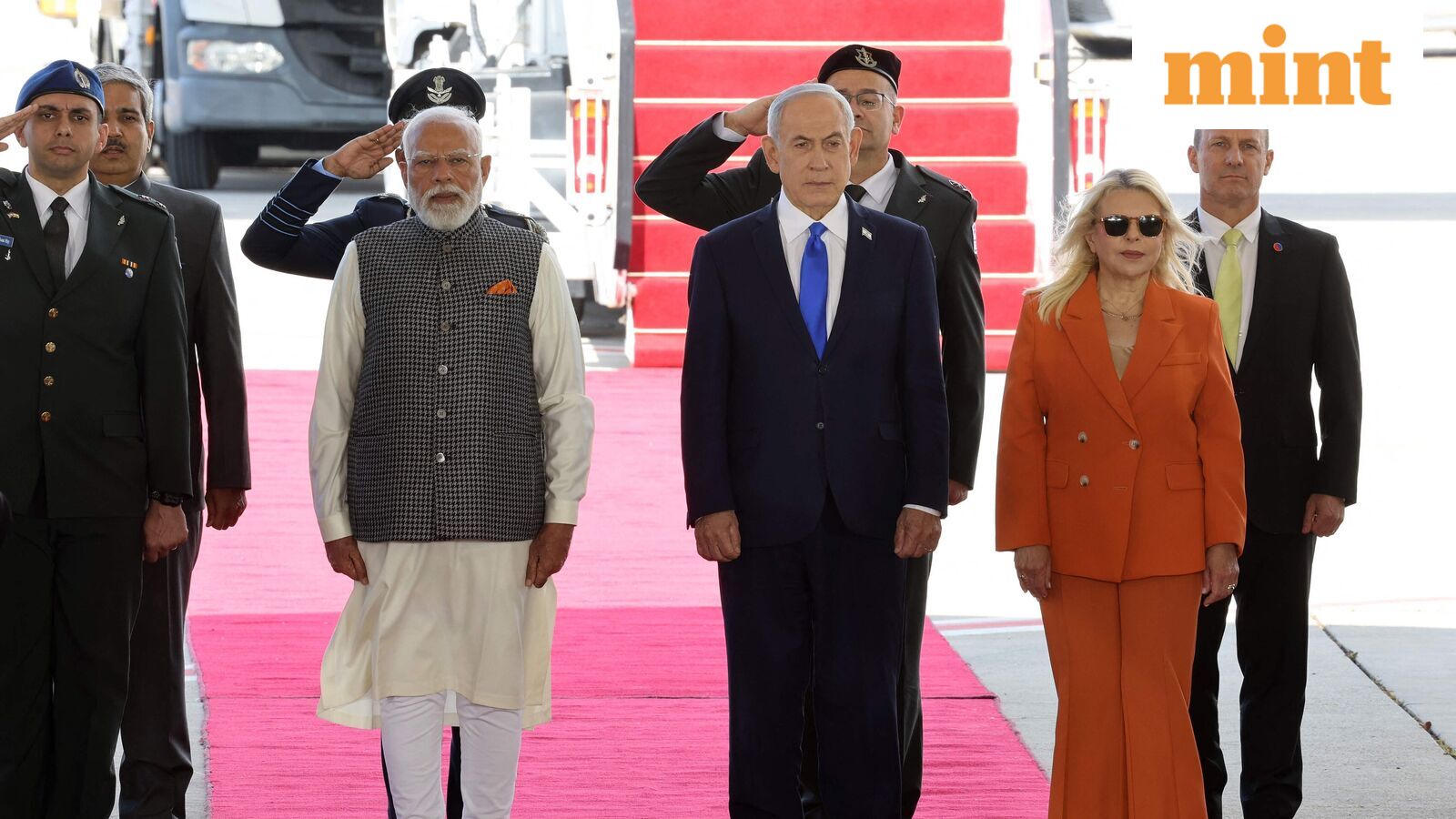
Prime Minister Narendra Modi on Wednesday arrived in Tel Aviv, Israel, for his two-day state visit at the invitation of his Israeli counterpart, Benjamin Netanyahu, aimed at further deepening the “robust and multifaceted Strategic Partnership” between the two countries.
Netanyahu, accompanied by his wife, Sara Netanyahupersonally received Prime Minister Modi at Ben Gurion Airport, reflecting the close personal rapport between the two leaders. The two Prime Ministers exchanged a warm hug upon arrival.
The Israel visit, second for Modi as Indian PM, comes amid rising tensions between the US and Iran, with the Pentagon mobilizing its military assets in the region. Iran and the US are expected to hold new talks in Geneva on Thursday over Iran’s nuclear programme.
India-Israel Diplomatic Ties
India recognized the state of Israel soon after its creation in 1948.
Full diplomatic relations between India and Israel were established in 1992. Days before that, Palestinian President Yasser Arafat visited New Delhi. Arafat had famously told a press conference in New Delhi that “exchange of Ambassadors and recognition (of Israel) are acts of sovereignty in which I cannot interfere… I respect any choice of the Indian government”.
The military ties relationship between the two nations has also evolved over the years. During the Kargil war in 1999, Israel learned to send precision bombs that the Indian Air Force needed. What followed was a series of visits by leaders from both sides.
Union External Affairs Minister Jaswant Singh led India’s first-ever bilateral visit to Israel in 2000. Home Minister LK Advani also visited. Israeli Prime Minister Ariel Sharon’s visit in September 2003.
During the UPA years, Union External Affairs Minister SM Krishna also visited Israel in 2012.
Before Narendra Modi’s tenure as PM in 2014, India–Israel relations were modest, mainly focused on agriculture and technical cooperation.
The Modi Years
Ties between India and Israel, however, deepened after Narendra Modi took office in 2014. Modi and Netanyahu met for the first time in New York on the sidelines of the UN General Assembly in September 2014.
In November 2014, the then Home Minister Rajnath Singh visited Israel. President Pranab Mukherjee visited Israel in October 2015, marking the first-ever Presidential visit from India. Former external affairs minister Sushma Swaraj also visited Israel in January 2016.
In 2017, Modi became the first Indian PM to visit Israel. Netanyahu reciprocated with a visit to India in 2018. Both leaders have called each other a “friend”.
Modi, however, skipped the stop at Palestine that was part of previous official visits. This time, too, Modi is making a standalone visit to Tel Aviv and not traveling to Palestine.
Netanyahu was re-elected to a sixth term as Israeli PM three years ago; he and Modi have spoken on the phone at least 10 times. The two countries signed defense pacts and launched free trade negotiations in November last year.
Israel’s key Asian trading partners
Apart from being a key defense and security partner, Israel is also an important economic partner in the India-Middle East-Europe Economic Corridor.
Today, the key areas of cooperation between the two nations are, defence, security, agriculture, water management, science and technology, trade, economy and people-to-people links.
India is one of Israel’s key Asian trading partners, ranking second among Asian countries in merchandise trade. In FY 2024-25, merchandise trade between India and Israel totaled around $3.62–3.75 billion (about ₹340 billion), with India exporting roughly $2.1 billion worth of goods and importing about $1.5–1.6 billion from Israel.
The ongoing negotiations on a Free Trade Agreement (FTA) and recent investment treaties aim to deepen economic ties and substantially increase this figure over the coming years.
Hamas’s October 7 attack
In September 2023, grand plans were unveiled in New Delhi for an India-Middle East-Europe Economic Corridor — to link railways, ports, electricity, data networks and pipelines, including through Saudi Arabia and Israel.
Those plans were stalled by Hamas’s October 7 attack on Israel in 2023, which Israel responded to with a devastating war in the Gaza Strip.
“What happened on October 7 was received in India with shock and horror, and this is why the support for Israel was quick, instantaneous, and enormous,” Ashok Malik, head of New Delhi-based strategic advisory firm The Asia Group, told news agency AFP.
India-Israel ties, which Modi is “taking forward with this visit”, stem not only from strategic alignment on issues such as terrorism, he added.
“Israel has a lot to contribute in terms of innovative technology, including agriculture, technology, and economic partnerships and of course defense… This is quite independent of the Palestinian issue,” Malik said.
Criticism back home
Months after his 2017 visit to Israel, Modi traveled to Ramallah, the seat of the Palestinian Authority. PM Modi’s current visit, however, has sparked criticism at home.
This is quite independent of the Palestinian issue.
Senior Congress leader Priyanka Gandhi Vadra on Wednesday said she hoped PM Modi would mention the killing of “thousands of innocent men, women and children in Gaza” when he addresses Israel’s parliament – Knesset.
The CPI(M) strongly opposed Prime Minister Narendra Modi’s visit to Israel.
“The visit comes at a juncture when Israel has been waging a genocidal war in Gaza. The Modi visit is a betrayal of the Palestinian cause and legitimises the murderous Netanyahu regime,” the Left party said in a statement.
Key Takeaways
- India–Israel relations have deepened significantly since Modi’s tenure began in 2014.
- The visit reinforces key areas of cooperation including defence, technology, and trade.
- Despite tensions related to the Palestinian issue, Modi’s focus remains on strengthening bilateral ties.