On April 16, 1953, only twelve weeks after taking office as the President of the United States, Dwight D. Eisenhower, delivered a speech on the “issue” of ‘peace’ while addressing the American Society of Newspaper Editors. It was famously called “The Chance for Peace” speech.
Joseph Stalin had just died, and the Cold War was on the horizon. The four-star general who led the effort in Europe in World War II had then said:
This world in arms is not spending money alone. It is spending the sweat of its labourers, the genius of its scientists, the hopes of its children. The cost of one modern heavy bomber is this: a modern brick school in more than 30 cities. It is two electric power plants, each serving a town of 60,000 population. It is two fine, fully equipped hospitals. It is some fifty miles of concrete pavement. We pay for a single fighter plane with a half million bushels of wheat. We pay for a single destroyer with new homes that could have housed more than 8,000 people. This is, I repeat, the best way of life to be found on the road the world has been taking. This is not a way of life at all, in any true sense. Under the cloud of threatening war, it is humanity hanging from a cross of iron. These plain and cruel truths define the peril and point the hope that come with this spring of 1953.
Eisenhower’s remarks were true then, and they are true today.
In a world that is witnessing multi-front wars and conflicts today, Eisenhower’s words leave an impression.
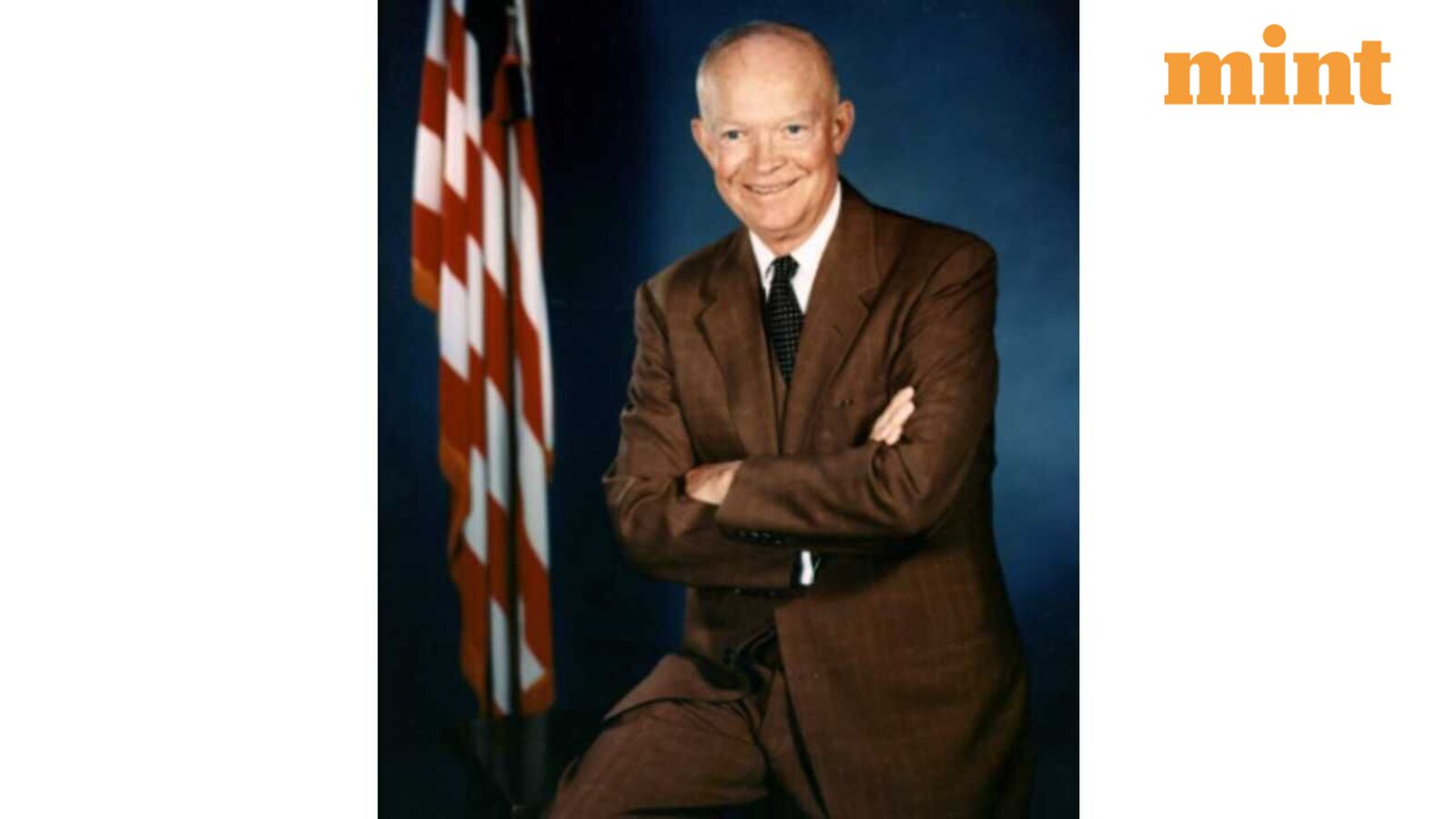
Who was Dwight D. Eisenhower?
Eisenhower was the 34th President of the United States. He served between 1953 and 1961.
According to the National Museum, United States Army, Dwight D. Eisenhower was born on October 14, 1890, in Denison, Texas. He kicked off his career in the US Army on June 14, 1911 as a cadet at the US Military Academy at West Point.
During World War II, Eisenhower rose through the ranks to become the Allied Supreme Commander and five-star General of the Army, orchestrating the June 6, 1944, D-Day landings at Normandy, France, the National Museum said on its website.
After World War II, Eisenhower was elected the 34th President of the United States and served two terms from 1953–61.
https://www.facebook.com/senatorsanders/videos/listen-to-president-eisenhower-on-the-cost-of-war/2907563646125072/
The Eisenhower Doctrine, 1957
President Dwight D. Eisenhower had announced the Eisenhower Doctrine in January 1957. Congress had approved it in March of the same year.
Eisenhower had singled out the Soviet threat in his doctrine by authorizing the commitment of US forces “to secure and protect the territorial integrity and political independence of such nations, requesting such aid against overt armed aggression from any nation controlled by international communism,” according to the US’ Office of the Historian.
Under the Eisenhower Doctrine, a country could request American economic assistance and/or aid from US military forces if it was being threatened by armed aggression from another state.
Eisenhower’s Farewell Address (1961)
On January 17, 1961, President Dwight Eisenhower delivered his farewell speech to the American people from the Oval Office of the White House.
In a speech of less than 10 minutes, Eisenhower strongly warned about the dangers of the “military-industrial complex.”
A vital element in keeping the peace is our military establishment. Our arms must be mighty, ready for instant action, so that no potential aggressor may be tempted to risk his own destruction…American makers of plowshares could, with time and as required, make swords as well. But now we can no longer risk emergency improvisation of national defense; we have been compelled to create a permanent armaments industry of vast proportions…This conjunction of an immense military establishment and a large arms industry is new in the American experience…Yet we must not fail to comprehend its grave implications…In the councils of government, we must guard against the acquisition of unwarranted influence, whether sought or unsought, by the military-industrial complex. The potential for the disastrous rise of misplaced power exists and will persist.
Why is Eisenhower’s quote relevant today?
Several parts of the world today are dealing with wars, missiles, drone attacks, power struggles and border conflicts that have deranged the world order, snatched away the peace, destroyed hundreds of homes and displaced millions, and thousands even died of hunger and malnutrition.
Statistics reveal a grim situation. According to the World Food Program 2026 Global Outlook, A staggering 318 million people face crisis levels of hunger or worse next year – more than double the figure recorded in 2019.
Two simultaneous famines have been confirmed in parts of Gaza and Sudan – a devastating first this century. The WFP claimed that nearly 70 percent of acutely food-insecure people lived in fragile or conflict-affected countries in 2025.
“Violence and instability in the Middle East, East, Central and West Africa as well as in the Caribbean, southern Asia and Eastern Europe are particularly concerning. Conflict disrupts food production, forces people from their homes and sources of income, and often hinders humanitarian access to people in most need,” it added.