

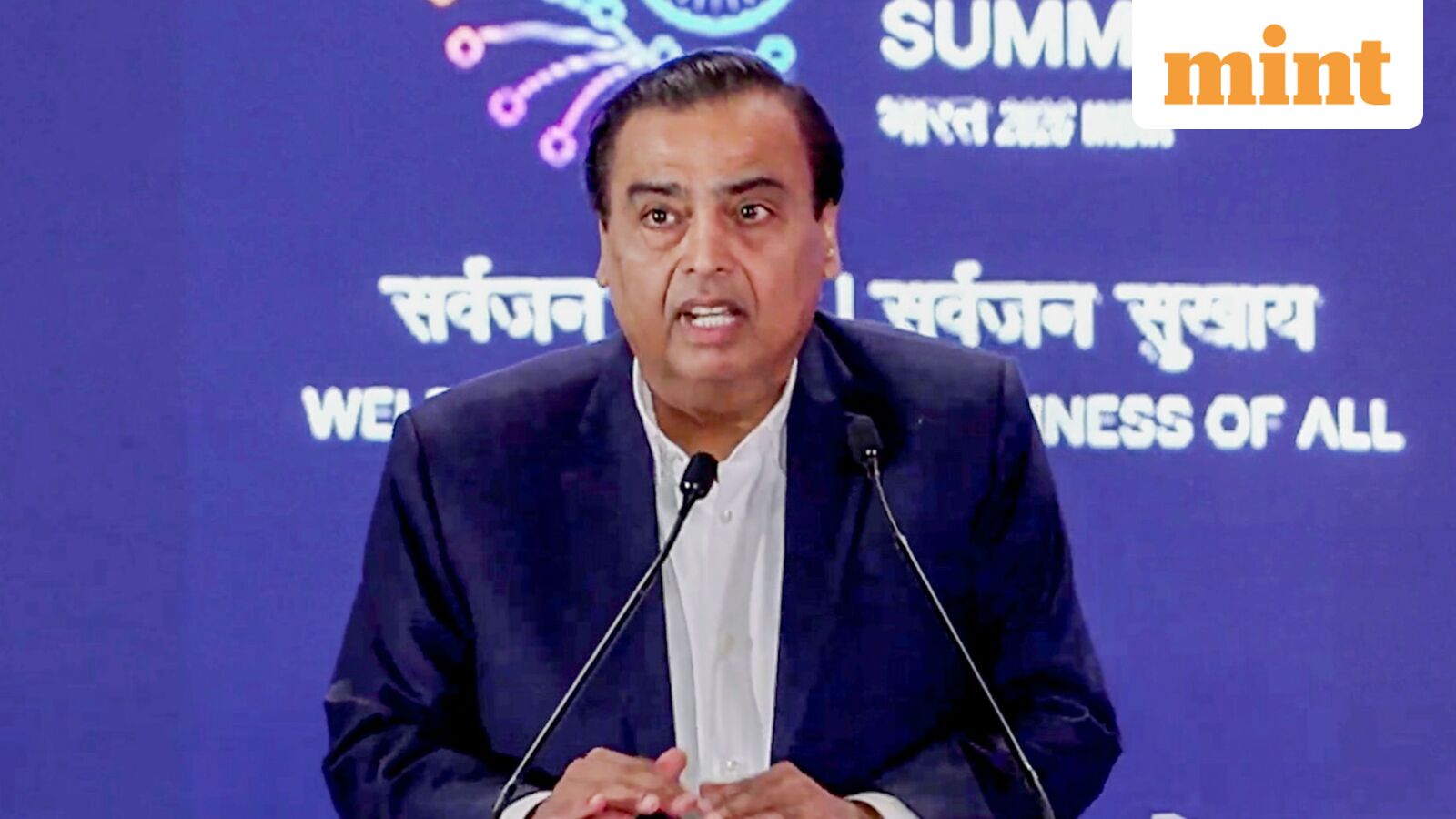
Days after Adani Group announced a mammoth $100 billion plan for artificial intelligence (AI)-ready data centers and power, fellow conglomerate Reliance Industries Ltd (RIL) fired another salvo on Thursday with a $110 billion ( ₹10 trillion) bet to build India’s sovereign AI backbone.
The money would be invested over seven years by RIL and Jio Platforms (its digital business), Reliance Industries chairman Mukesh Ambani said on the fourth day of the India AI Impact Summit 2026 in New Delhi.
Besides, Tata Sons chairman N. Chandrasekaran announced at the same event that Tata Consultancy Services (TCS) has signed up American AI giant OpenAI as the anchor client for its upcoming data centre. The two companies will collaborate to develop secure, India-based AI infrastructure aimed at strengthening data sovereignty and long-term compute capacity.
Ambani said RIL and Jio would build what he described as India’s sovereign compute infrastructure, including multi-gigawatt (GW) AI-ready data centers at Jamnagar, green energy-backed capacity, and a nationwide edge network to make AI affordable and widely accessible.
“India cannot afford to rent intelligence. Therefore, we will reduce the cost of intelligence as dramatically as we did the cost of data,” Ambani said in his address at the summit, adding that “an edge-compute layer, deeply integrated with Jio’s network, will make intelligence responsive, low-latency and affordable—close to where Indians live, learn and work”.
Shares of RIL closed at 2.4% lower ₹1,407.2 on the National Stock Exchange on Thursday.
The company is looking to bring up about 120MW (megawatt) data center capacity in the second half of 2026 to support high-scale compute for training and large-scale inference of AI systems. The company is currently preparing to file draft papers for listing Jio Platforms on the exchanges.
Meanwhile, Tata Sons’ Chandrasekaran said the collaboration between OpenAI and Tata Group marked a major milestone in India’s vision to become a global leader in AI.
“We are pleased to partner with OpenAI to create state-of-the-art AI infrastructure in India. This is a unique opportunity for OpenAI and TCS to transform industries. Together we will skill India’s youth and empower them to succeed in the AI era,” Chandrasekaran said.
Last year, TCS announced a $7 billion ( ₹55,000–57,000 crore) investment over the next five to seven years to build 1GW of AI-ready, sovereign data center capacity in India, beginning with an initial capacity of 100MW.
This infrastructure will enable OpenAI’s most advanced models to run securely in India, delivering lower latency while meeting data residency, security, and compliance requirements for mission-critical and government workloads, the company said in a note.
In a fireside chat later in the evening on Thursday with Sam Altman, cofounder and chief executive of OpenAI, Chandrasekaran said the role of AI will be in fixing public services.
“We may not do small things right, but India is great at big transformations. Look at digital payments—we do 50% of the world’s digital payments. Look at how we’ve modernized the passport system. We still need to bring equality, fix our cities, and equate healthcare—all of this will happen with AI. Thank god there is AI,” he said.
“AI scale needs reliable compute, and data centers are the enabling layer that determines speed, cost, and trust. India’s announced build-out signals a multi-year ramp up in domestic AI and cloud capacity, therefore the outlook is faster enterprise adoption and more local model training,” said S. Anjani Kumar, partner at Deloitte India.
“This investment pattern mirrors global tech leaders who are announcing capex in AI infrastructure. If India executes on capacity delivery, reliable operations, and trusted governance, it can become a preferred AI hub for global workloads and deployments,” Kumar added.
In a note in October, Macquarie Equity Research said India currently has 1.4GW (gigawatt) of operational data center capacity, with another 1.4GW under construction and 5GW in the planning stage.
“Key thematic tailwinds include data localization laws, supportive regulatory environment and subsidies from central and state governments, rising enterprise cloud adoption, surge in mobile data demand and OTT (over-the-top) content, and growth of digital-native businesses,” analysts at Macquarie said in the note.
Chandrasekaran also said TCS and Tata Communications are jointly building an “AI operating system” to create specialized, agentic AI solutions for industries globally. Besides developing AI infrastructure, TCS in an exchange filing said Tata Group employees will also get access to Enterprise ChatGPT.
Post the announcement, shares of TCS on Thursday rose 2% intraday, before closing at ₹2,675, down 0.7%. Lately, stocks of IT companies have been under pressure owing to the new launches of AI models.
“The notion that IT services will disappear in five years ignores the lessons of history on how technology has always evolved to create newer opportunities,” said Ashok Soota, founder and chairman of Happiest Minds.
According to Soota, IT services will remain essential in customizing solutions for diverse industries and ensuring enterprises innovate faster and achieve superior business outcomes. AI is transforming IT services into higher-value offerings, empowering us to deliver smarter, faster, and more cost-effective solutions, he said.
In the chat with Altman, Chandrasekaran said the power of AI to change society, empower individuals and help businesses to reinvent is unquestionable.
“We have 1.1 billion working people. A job in hand will be able to get everyone excited, for which everyone will be AI ready,” Chandrasekaran said. “In India, 750 million (people) will likely become white collar people, and the rest 350 million would be blue collar. Education is key, and it’s not difficult to crack it. Once we do, we’ll see a different world. The question is to see how fast we can get it done.”

