
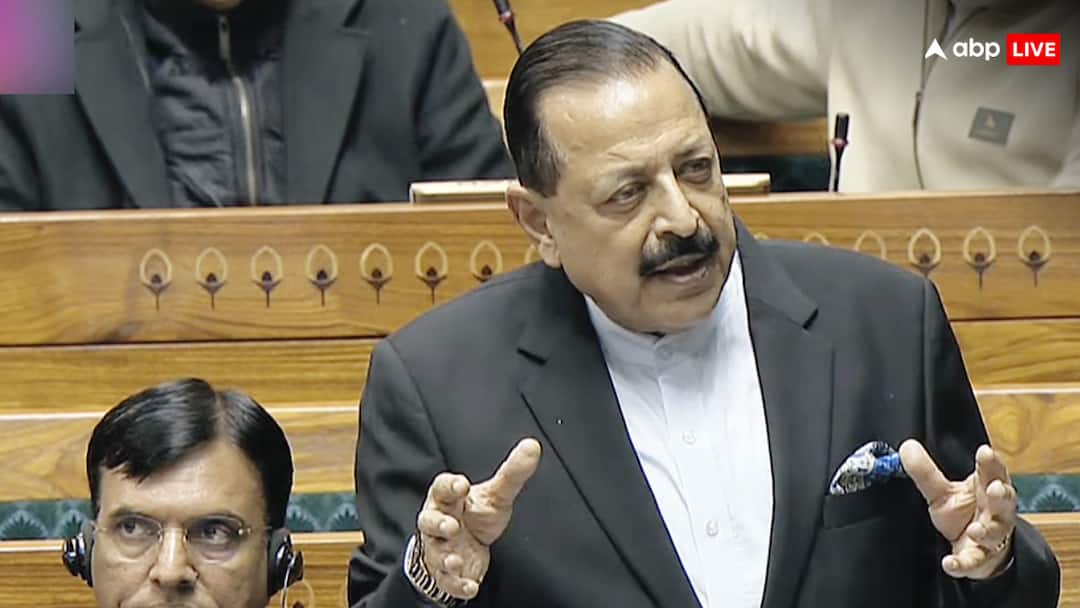
The bill to allow private participation in the nuclear energy sector was introduced in the Lok Sabha on Monday (December 15, 2025), to which members of the Congress and Trinamool Congress raised objections. Minister of State for Atomic Energy, Dr. Jitendra Singh, introduced the Sustainable Exploitation and Augmentation of Nuclear Energy (Peace) Bill, 2025 in the House for the transformation of India, on which opposition members created noise.
The purpose of the bill is to repeal the Atomic Energy Act, 1962 and the Civil Liability for Nuclear Damage Act, 2010. Singh said, ‘The objective of the bill is to create a practical civil liability system for nuclear damage and to provide statutory status to the Atomic Energy Regulatory Board.’
Congress MP expressed objection to the bill
Congress MP Manish Tewari opposed the introduction of the bill, saying that it gives immense powers to the central government for licensing, regulation, acquisition and tariff determination in private contracts. He said that allowing the private sector to enter the highly dangerous nuclear sector and limiting accountability, providing statutory immunity and limiting judicial remedies violates Articles 21 and 48A of the Constitution.
Tiwari said that it centralizes the legislative, executive and regulatory and quasi-judicial powers in the central government. On this, Jitendra Singh said, ‘I would like to mention that most of the objections raised in this regard are related to the merits (of the bill), which can be considered during the discussion on the bill.’
This bill is against the Directive Principles – Premachandran
N. of Revolutionary Socialist Party (RSP). Of. Premachandran also opposed the bill, saying that it is against the Directive Principles of State Policy. He said, ‘You can see that the basic objective of this bill is to open the nuclear energy sector to private companies. There are abundant reserves of thorium in his constituency, but unfortunately the public sector undertakings have not exploited and utilized it.
The RSAP member alleged that this bill has been brought with the aim of using it (thorium) on behalf of private companies. While Saugata Roy of Trinamool Congress (TMC) said that through this step the nuclear energy sector is being gradually given to the private sector. He said that the government had been talking about this for some time and now it is promoting a private company through this bill.
Parliamentary Affairs Minister Kiren Rijiju speaks amid protests over the bill
Meanwhile, Parliamentary Affairs Minister Kiren Rijiju said, ‘We are not passing the bill today, it is not proposed to be considered. The bill is merely being introduced. He said that the House has the legislative capacity to introduce this bill under the relevant rules.
At the same time, Jitendra Singh said that even if it is assumed that the government does not have the capacity to bring this bill, I still want to remind that this same House had initiated the Atomic Energy Act, 1962, when Pandit Jawaharlal Nehru was the Prime Minister.
He said that when Manmohan Singh was the Prime Minister, the Civil Liability Bill for nuclear damage was brought in this House. Amid uproar from opposition members, the minister said, ‘If a bill (related to the nuclear sector) could be brought during Nehru ji’s tenure as Prime Minister and then during Dr. Manmohan Singh’s tenure as Prime Minister, then how did the various political parties in power at that time suddenly forget the powers to bring a bill on this subject.’ After this, the Minister of State for Atomic Energy introduced the bill.
What is the purpose of introducing the peace bill?
The Union Cabinet had approved this bill on Friday (December 12, 2025). As per the objects and reasons of the Bill, it aims to provide for the promotion and development of nuclear energy, ensuring its application for nuclear power generation and innovation in health care, food, water, agriculture, industry, research, environment, nuclear science and technology. It also aims to provide for a strong regulatory framework for the welfare of the people of the country and for its safe use and matters related thereto.
Also read: ‘Officials should also perform my last rites…’, said TMC councilor after being found dead in the draft voter list of SIR in Bengal.