

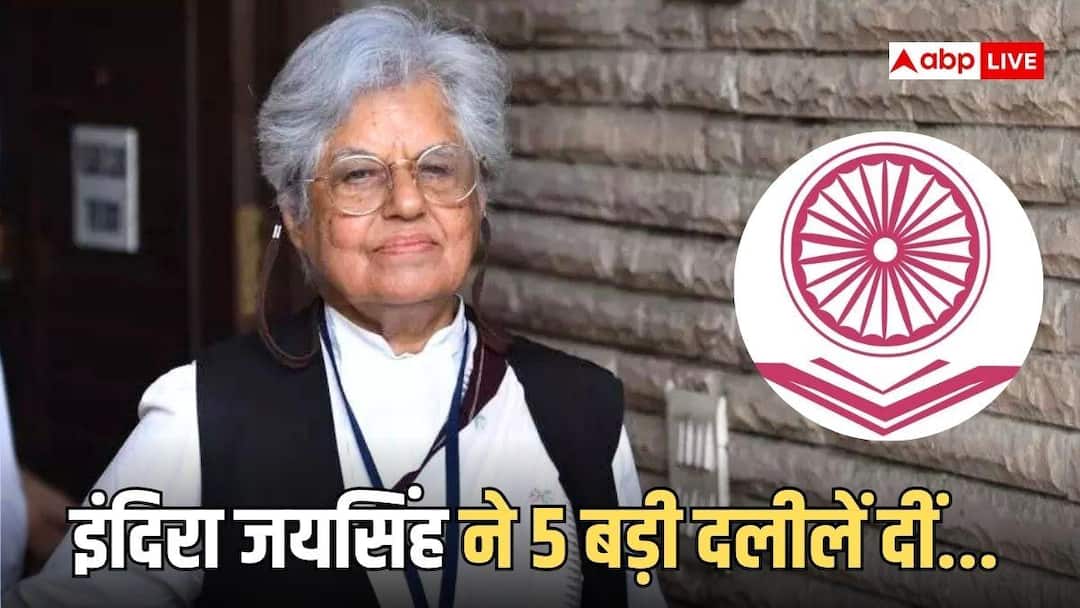
The Supreme Court on Thursday put a stay on the new rules of the University Grants Commission (UGC) till further orders. The bench of CJI Surya Kant and Justice Joymalya said that its provisions are not clear and can be misused. In this matter, senior Supreme Court lawyer Indira Jaisingh intervened and opposed the petitions which were challenging the new rules.
Indira Jaisingh gave 5 arguments in support of UGC
These regulations have been made to prevent caste-based discrimination in universities. But the petitioners said that these rules are discriminatory because they provide protection only to the members of SC, ST and OBC. Whereas people of general category and upper castes have been kept out of it. But this is wrong. Indira Jaisingh has given 5 big arguments on behalf of UGC…
- It would be wrong to suspend these regulations as they highlight the real problem of discrimination against students from Dalit and historically oppressed communities.
- These rules are an improvement on the old regulations of 2012, which were inadequate and did not provide for punishment for violations.
- The new rules have been made under the supervision of the Supreme Court and are necessary to remove structural inequality.
- The protest by student organizations is a ‘reaction of the upper caste’. These rules still do not completely solve the problem, but they should be kept in force so that strict action can be taken against caste discrimination in universities.
- Referring to a petition filed in 2019, it was said that two mothers had drawn attention to the cases of discrimination and suicide against SC/ST students.
At present the Supreme Court has put a stay on these regulations. The court has sought answers from the Central Government and UGC, but Indira Jaising’s arguments have strongly brought forward the aspect of social justice in the case.
Who is Indira Jaisingh?
Senior lawyer Indira Jaisingh is a leading human rights lawyer and activist of India, who has made major contributions in the field of women’s rights, social justice and human rights. He was born on 3 June 1940 in Mumbai in a middle class Sindhi family and completed his early education from Mumbai and Bengaluru. After that he also obtained fellowship from the Institute of Advanced Legal Studies, London. She started her career with a law firm in Mumbai and became the first woman senior advocate of the Bombay High Court in 1986. In 1981, she founded a human rights organization called ‘Lawyers Collective’ with her husband Anand Grover, which fights legal battles for the poor, women and marginalized people.
Indira Jaisingh became the first woman Additional Solicitor General of India in 2009. She participated in many landmark cases, such as contributing to the creation of laws to protect women from domestic violence, rights related to HIV/AIDS and cases related to gender equality. In 2005, he was awarded the Padma Shri for his public contributions, and in 2018, Fortune magazine ranked him 20th on its list of the world’s 50 most influential leaders. She has also been a member of the Committee for the Elimination of Discrimination against Women of the United Nations.

