
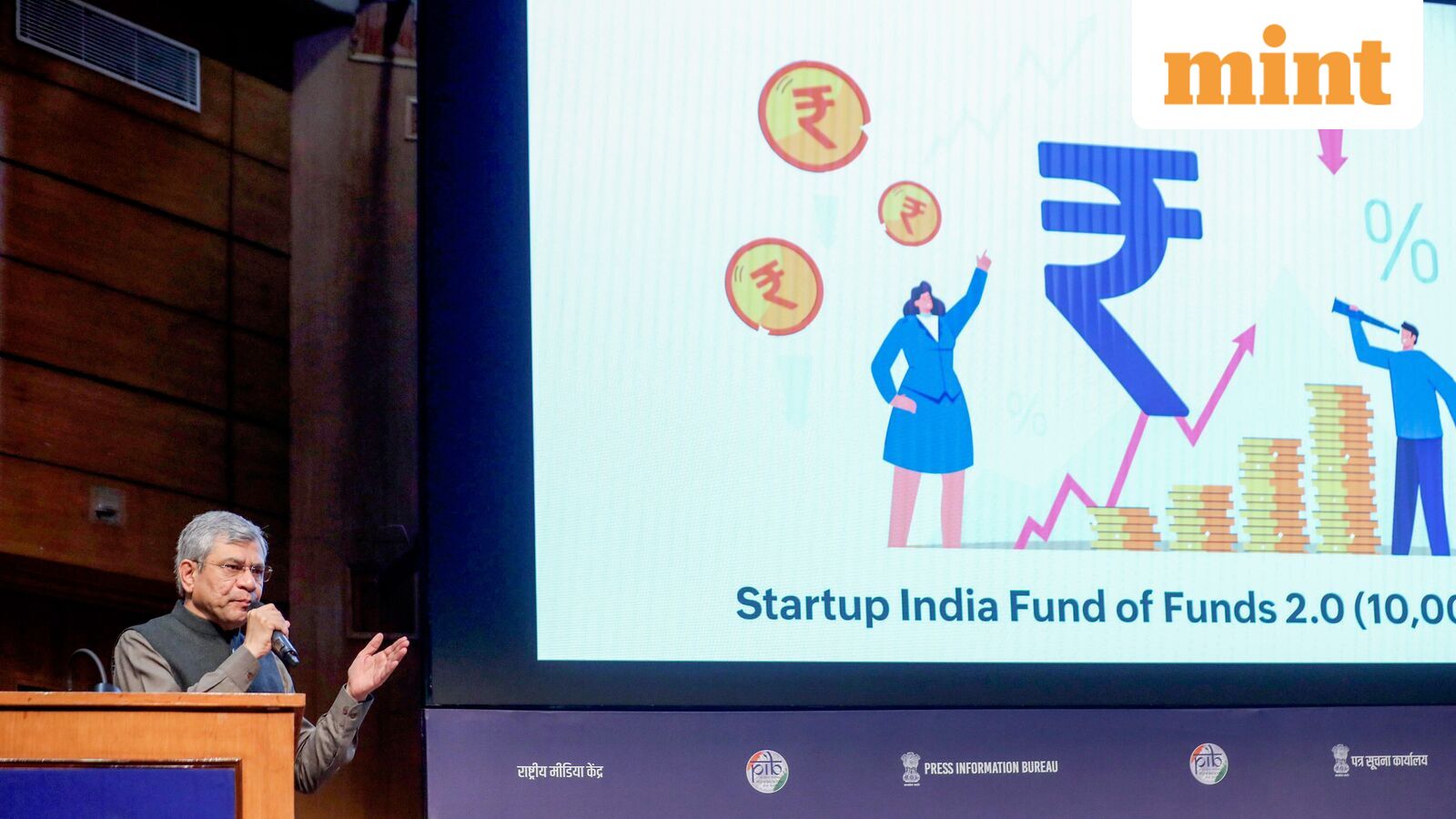
NEW DELHI: The Union cabinet has approved schemes and infrastructure projects with a cumulative outlay of ₹1.6 trillion, including the Urban Challenge Fund for urban development and the ₹10,000 crore Startup India Fund of Funds 2.0, union minister for information & broadcasting Ashwini Vaishnaw said on Saturday.
The decisions were taken at a cabinet meeting on Friday.
Urban Challenge Fund
With central assistance of ₹1 trillion, the Urban Challenge Fund will leverage market finance and private participation for urban development projects and, according to the government, attract investments worth ₹4 trillion over the next five years.
The fund will be operational from FY26 to FY31, with project implementation allowed to continue till FY34.
Vaishnaw said the central assistance will cover 25% of project cost, subject to raising a minimum 50% from the market through municipal bonds, bank loans and public-private partnerships (PPP). The remaining share will be contributed by states, union territories (UT) and urban local bodies (ULB).
“The fund aims to build resilient, productive, inclusive and climate-responsive cities, positioning those as key drivers of the country’s next phase of economic growth,” said a statement from the ministry of housing and urban affairs.
Projects will be selected through a transparent and competitive challenge mode. The government will emphasize reforms across urban governance, market and financial systems, operational efficiency and urban planning to enable urban centers to access capital.
The cabinet also approved a ₹5,000 crore credit guarantee scheme aimed at enhancing the creditworthiness of cities and towns, primarily in hilly states, northeastern states and smaller urban local bodies with populations below 1 lakh.
“The scheme will provide a central guarantee of up to ₹7 crore or 70 per cent of the loan amount (whichever is lower) for first-time loans. On successful repayment of the first loan, central guarantee of ₹7 crore or 50 per cent of the loan amount (whichever is lower) will be provided. This will effectively support projects of minimum ₹20 crore for the first time and Rs.28 crore for subsequent projects in smaller cities,” he said.
Urban rejuvenation was also a focus of the Union Budget for FY27.
Presenting the budget on 1 February 2026, finance minister Nirmala Sitharaman had said, “Cities are India’s engines of growth, innovation, and opportunities. We shall now focus on Tier II and Tier III cities, and even temple-towns, which need modern infrastructure and basic amenities. This Budget aims to further amplify the potential of cities to deliver the economic power of agglomerations by mapping city economic regions (CER), based on their specific growth drivers.”
She proposed an allocation of ₹5,000 crore per city economic region over five years.
Startup India Fund of Funds 2.0
The cabinet also approved the Startup India Fund of Funds 2.0 (Startup India FoF 2.0) with a corpus of ₹10,000 crore to mobilize venture capital for the country’s startup ecosystem.
The scheme aims to accelerate the next phase of India’s startup journey by mobilizing long-term domestic capital, strengthening the venture capital ecosystem and supporting innovation-led entrepreneurship.
The first such fund, the Fund of Funds for Startups (FFS 1.0), was launched in 2016 to address funding gaps and catalyse the domestic venture capital market. Under the first fund, the entire corpus of ₹10,000 crore has been committed to 145 alternative investment funds (AIFs), which have invested over ₹25,500 crore in more than 1,370 startups across sectors including agriculture, artificial intelligence, robotics, automotive, clean tech, consumer goods and services, e-commerce, education, fintech, food and beverages, healthcare, manufacturing, space tech and biotechnology.
“While the first phase built the ecosystem, Startup India FoF 2.0 is designed to take Indian innovation to the next level. The new fund will have a targeted, segmented funding approach,” said another official statement.
The fund will support deep-tech startups and technology-driven innovative manufacturing segments that require long-term capital.
Infrastructure approvals
Among other decisions, the Union cabinet approved construction of a four-lane access-controlled greenfield connectivity project from Gohpur on NH-15 to Numaligarh on NH-715 in Assam, including a 15.79-km road-cum-rail tunnel under the Brahmaputra river, at a total cost of ₹18,662 crores.
The Cabinet also cleared three multitracking railway projects covering 12 districts across Delhi, Haryana, Maharashtra and Karnataka, expanding the Indian Railways network by about 389 km at an estimated cost of ₹Rs 18,509 crore.
Government offices shift
Vaishnaw said this was the last Union cabinet meeting held in South Block, as the Prime Minister’s Office has shifted to Seva Teerth, a newly developed building in the Central Vista area. With the relocation of offices to Kartavya Bhawans and Seva Teerth, North Block and South Block will be converted into a museum, he said.
Seva Teerth houses the Prime Minister’s Office, the National Security Council Secretariat and the Cabinet Secretariat, which were earlier located across different premises.
“Today, the Cabinet also resolves that North and South Blocks be made part of the “Yuge Yugeen Bharat National Museum,” which will continue to inspire generations from our thousands of years old civilization. This museum will celebrate our timeless and eternal cultural heritage and connect our glorious past with a prosperous future,” the minister quoted from a cabinet resolution.