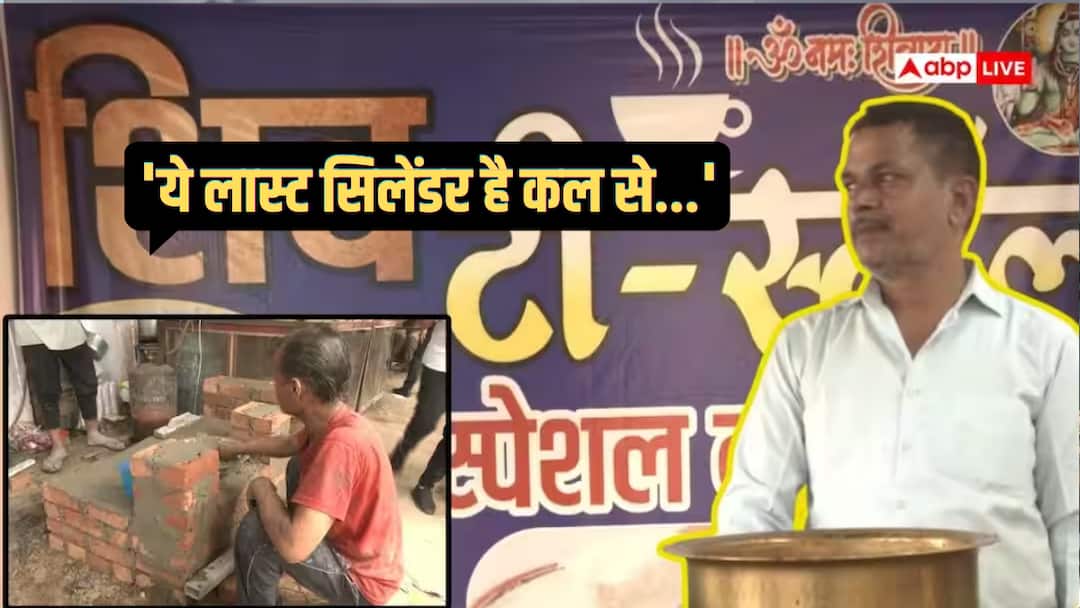
‘Commercial cylinder has been closed, no cylinder is available, only this last cylinder is left, after that I have run out of gas…going back to the old systems. Now we will get a coal furnace built and make tea on it…what to do, employment has to be done, it has to be done however you want, otherwise I would have made some other arrangement….’
When Shivpal, who runs a tea shop in Lucknow, speaks these lines, helplessness, pain, hope and fear are clearly heard in his voice, which is probably going to affect his employment in the future. He expressed his pain, his fear and his reality word by word without any change. Has the issue of commercial gas really become so serious, why are people scared and how suddenly this gas shortage has brought such havoc in their lives. To know the answers to these questions and to come face to face with the ground reality, it is necessary to examine the entire system closely.
#WATCH | Lucknow | Shivpal, the tea stall owner, says, “I am getting a coal furnace made here so that my business continues to operate. I am operating on the last cylinder today, and from tomorrow I will use this ‘bhatti’.” pic.twitter.com/zo0XzaV3EK
— ANI (@ANI) March 11, 2026
Gas crisis looms due to US-Iran war
In fact, due to the war between US-Israel and Iran, the supply through the Strait of Hormuz has come to a standstill. This is the reason why the country is facing shortage of LPG. The supply of commercial gas has been banned in many states from Uttar Pradesh to Maharashtra and Rajasthan. In such a situation, the problems of small shopkeepers running hotels, restaurants and tea shops have also increased in many cities.
Government implemented ‘Essential Commodities Act 1955’
The central government has made preparations to deal with these challenges. ‘Essential Commodities Act 1955’ to stop hoarding of essential commodities including gas
Has been implemented. Gas is divided into four categories. The first category includes PNG supplied to homes and CNG used in vehicles, which will not have any impact. The second category includes fertilizer factories, where 70 percent gas will be provided. The third category includes big industries (tea factories and big industries) which will get about 80 percent of the gas requirement. Whereas in the fourth category, about 80 percent gas will be given to small factories, hotels and restaurants connected to the gas network of cities.
How dependent is India on LPG?
If we look at India’s dependence on LPG, about 33.15 million metric tons is consumed annually. About 67 percent of which is imported. About 80 to 90 percent of the total imports are imported from the Middle East.
PM Modi said- India is ready for this crisis
Prime Minister Narendra Modi clearly told the ministers in the cabinet meeting on Tuesday (March 10) to maintain public trust in the midst of global turmoil. Said, India has enough stock. The PM said that a supply chain management system has been prepared for this crisis, the minister should go and tell this among the people.
Necessary steps taken by the government
India has changed its strategy for supply of crude oil and gas. The government has given priority to commercial and domestic LPG supply. Understanding the problems of the restaurant association, instructions have been given to oil marketing companies to talk to them. A high-level committee has also been formed, which is monitoring the supplies. At the same time, domestic production has been increased and its dependence has been secured by using alternative sea routes for imports. According to government sources, LPG production has increased by 10 percent in the last two days.
The government has also said that there is no shortage of LPG, petrol and diesel in the country and people have been appealed to avoid rumours. If there is a problem somewhere, it could be due to a problem in the supply chain. It was said that all the petrol pumps and LPG distributors in the country have the same fuel available for supply as before. It was also said that domestic consumers will get priority. According to government sources, even before this crisis, 60 lakh gas cylinders were distributed daily and even now the same number of gas cylinders is being distributed every day.
Union Home Secretary spoke to DGP-Secretaries of the states
The Union Home Secretary talked to the DGPs and Secretaries of all the states regarding the prevailing situation and said that they should ensure that strict action is taken against hoarding and black marketing by any means.