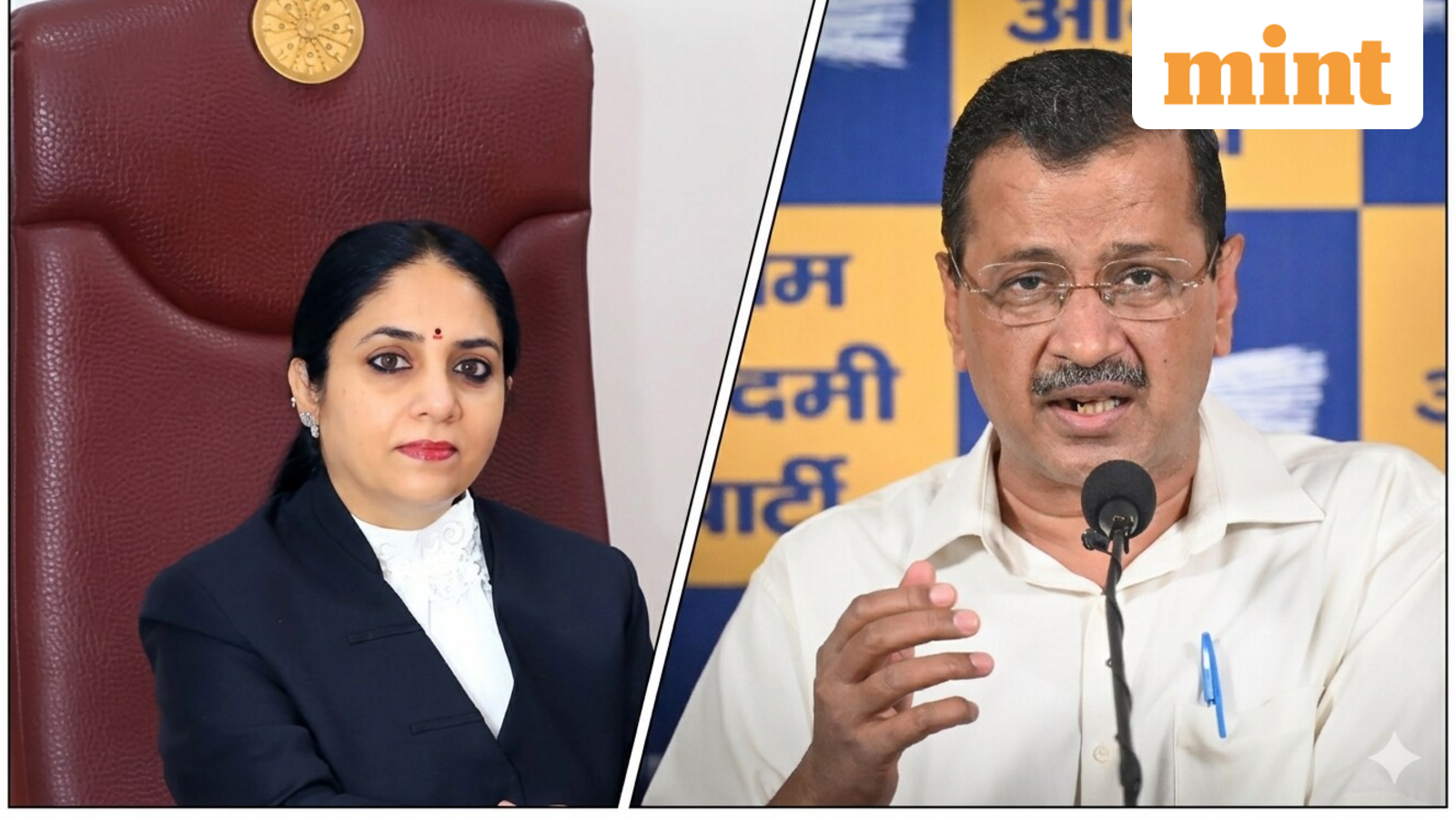
Former Delhi Chief Minister Arvind Kejriwal wants the excise policy case transferred from Justice Swarana Kanta Sharma to another judge.
According to Bar and BenchKejriwal approached the Supreme Court against the Delhi High Court Chief Justice’s decision rejecting his request to transfer the case from Justice Swarana Kanta Sharma.
Earlier in January, the Aam Aadmi Party (AAP) supremo was cleared by a Delhi court in two lawsuits filed by the Enforcement Directorate (ED) requesting action against him for ignoring the department’s summons regarding the excise policy probe.
A trial court had on February 27 discharged Kejriwal and 22 other accused in the excise policy case. CBI challenged the order and the same is currently being heard by Justice Sharma.
Recently, Delhi High Court Chief Justice Devendra Kumar Upadhyaya denied Arvind Kejriwal’s request to transfer the excise policy case from Justice Sharma, Bar and Bench reported.
Who is Justice Swarana Kanta Sharma?
Justice Swarana Kanta Sharma is a Delhi High Court judge.
Justice Swarana Sharma’s education: According to a profile shared by the High Court of Delhi, Sharma graduated in BA (Hons.) in English Literature from Delhi University.
She acquired her LL.B. in 1991 and completed her LL.M. in 2004. She also holds a Diploma in Marketing Management, Advertising, and Public Relations.
In 2025, after four years of extensive research, she was awarded a PhD for doctoral thesis titled “Achieving Constitutional Vision of Justice Through Judicial Education: A Comparative Study of the Best Practices in the UK, USA, Singapore, and Canada.”
Justice Swarana Sharma’s career: Sharma became a Magistrate at the age of 24 and a Sessions Judge when she turned 35. She was elevated as a permanent Judge of the High Court of Delhi on March 28, 2022.
Justice Sharma is a trained Judicial Mediator and has successfully settled many cases through mediation.
She served as Chairperson of committees constituted to examine complaints of sexual harassment against women employees in Tis Hazari, Patiala House, and Rohini Courts, at different points in time.
During her tenure in the Delhi district courts, she presided over various civil and criminal courts, including as Special Judge (CBI), Principal Judge of the Family Court, Motor Accident Claims Tribunal, Mahila Court, and Special Court (Sexual Offenses against Women).
In November 2019, she was appointed as Principal District and Sessions Judge (North District), and in March 2022, she took charge as Principal District and Sessions Judge-cum-Special Judge (CBI) at Rouse Avenue Court.
Justice Sharma, the author: Justice Sharma has authored several books aimed at creating awareness and supporting the public.
Her first book, ‘Don’t Break After Break-Up’, offers guidance to women who have chosen to remain single or have experienced difficult break-ups. Her second book, ‘Beyond Baghban’, explores emotional and financial challenges faced by senior citizens, her profile reads.
Her third book, ‘Tumhari Sakhi’, seeks to raise awareness among women about their rights and the importance of speaking up against violence. She has also ventured into fiction with her fourth book ‘Love Full Circle’.
Her fifth book ‘Judicial Education – Achieving Constitutional Vision of Justice’ aims to highlight the importance of judicial education in strengthening the justice delivery system and helping judges realize the constitutional vision of justice.
Why Kejriwal wants Justice Swarana Kanta Sharma removed from excise policy case?
In a letter written on March 11, Kejriwal expressed apprehension that if the matter stays with Justice Sharma, the “matter may not receive a hearing marked by impartiality and neutrality”.
On March 9, Justice Sharma had stayed the trial court direction for department proceedings against the CBI officer who investigated the case.
Justice Sharma had also returned a prima facie finding that some of the trial court’s observations while dismissing Kejriwal and 22 others were erroneous.
In his letter to Chief Justice Upadhyaya, Kejriwal said, according to Bar and Bench, that the order of March 9 does not disclose any reasons as to what “perversity” warranted an ex parte restraint.
He alleged that the order assumes significance because it is settled that interim intervention with an order of discharge is an extraordinary course to be exercised only in rarest of rare circumstances and upon clear grounds of illegality and perversity.
Kejriwal reportedly added that in the same order, the High Court also issued a direction to the trial court to defer the Prevention of money-laundering (PMLA) proceedings even though the ED was not a party before the High Court.
“That the grant of such wide and consequential relief—without the same being pleaded, and in a proceeding where the ED is not a party—at the threshold stage and without hearing the discharged accused, materially fortifies the applicant’s reasonable apprehension that the present revision may not be approached with the requisite degree of judicial detachment, and that the matter may not receive a hearing that is manifestly impartial, as required by settled principles governing apparent bias,” the letter. states, as per Bar and Bench.
Kejriwal has also said that in the normal course, in a revision petition of this magnitude, at least four to five weeks is granted to parties to file their response, but the Court’s approach in this case “conveys an apprehension of predisposition”.
Kejriwal added that the same judge had earlier dealt with the excise policy matters and “expressed detailed prima facie views on the same nucleus of facts and roles”.
“Importantly, several of these detailed judgments have been subsequently set aside by the Hon’ble Supreme Court (three set aside, one referred to larger bench). In all the above matter – Hon’ble Supreme Court granted relief to the accused persons. This further strengthens the Applicant’s apprehension that the approach earlier adopted in the same controversy has already been found legally vulnerable,” the letter states.
What has Kejriwal done now?
A lawyer told Bar and Bench that the petition has been filed under Article 32 of the Constitution. The article guarantees the “Right to Constitutional Remedies”. It allows citizens the right to directly approach the Supreme Court for the enforcement of their fundamental rights.
The lawyer reportedly said that along with the Delhi High Court Chief Justice’s order refusing to change the judge, Kejriwal also challenged Justice Sharma’s order of March 9 by which she stayed the trial court’s direction to investigate CBI officer who investigated the excise policy case.