


India is also the world’s second-largest consumer of gold, accounting for around 26% of global demand, trailing only China at 28%.
The demand is so strong that despite record-high gold prices, sales have shown limited signs of weakening. Higher prices are also accelerating the shift from unorganized to organized players.
As a result, the share of organized players in the jewelery market has reached 40% in FY25, compared with 32% in FY20, while unorganized players steadily lost ground.
The December quarter of FY26 (Q3FY26) once again reaffirmed the structural strength of India’s organized jewelery space, even amid record-high gold prices.
Gold prices touched ₹140,000 at the end of Q3FY26, up around 20% from the end of Q2FY26, and 75% from Q3FY25. The surge translated into stronger value growth for jewelery companies, even as volumes saw a marginal slowdown.
To deal with higher gold prices, companies are also focusing on 9-karat, 14-karat, and 18-karat jewelery rather than traditional 22-karat options. This has helped them meet consumer demand for products at lower ticket size levels. Based on business updates shared by the companies, here is how revenues evolved across the four players.
Senco Gold is the quarter’s fastest grower
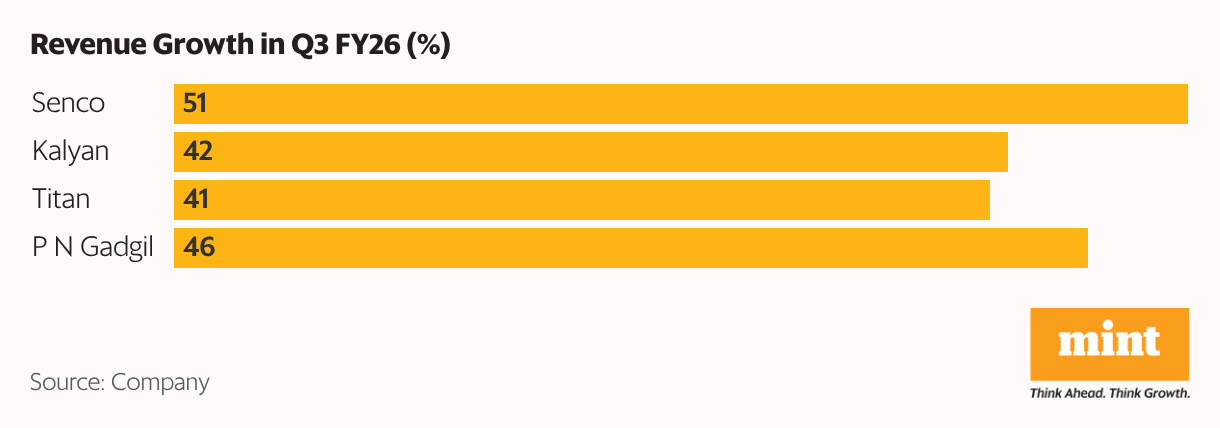
Senco Gold outperformed its peers during the quarter, with standalone revenue increasing 51% year-on-year. Growth was relatively subdued in Q2, with revenue increasing 6.5% due to heavy rains and flooding in eastern India, especially in West Bengal and Kolkata during the last two weeks of September.
This, along with deferment after the GST cut and a higher base effect from last year, moderated Senco’s Q2 performance, according to management. Thus, the 51% growth, coupled with same-store sales growth (SSSG) of around 39% in Q3, shows a clear improvement in demand.
Even over the first nine months of FY26, Senco reported 31% revenue growth, well ahead of its long-term guidance and historical growth range of 18-20%. With gold prices rising, demand for studded jewelery and diamonds increased. Diamond jewelery sales grew by 36% during the quarter, driven by strong wedding demand and a continued improvement in the studded mix.
Its aim is to continuously improve the studded jewelery share. Operationally, Senco navigated gold price volatility through a sharper focus on lightweight (9/14/18 Karat), and value-led designs. This approach helped protect volumes without resorting to aggressive discounting.
Management remains confident of sustaining the momentum and has reiterated guidance of 25%+ revenue growth for FY26. Senco also added four new showrooms during Q3, taking the total network to 196 stores, and plans to open 3-4 additional stores in Q4, which would take the count to 200.
Kalyan Jewelers turns scale into growth
Kalyan Jewelers reported consolidated revenue growth of 42% year-on-year, driven by SSSG of around 27%. India revenues increased 42% year-on-year, supported by festive demand and the wedding season. The company saw good growth in both the plain gold and studded categories.
Higher gold prices have made diamond jewelery relatively more attractive, supporting demand for studded jewellery. A focus on regional (South) designs and wedding demand helped offset the impact of higher gold prices. Revenue from international operations also increased by 36%, with revenue from the Middle East increasing by 28%.
Kalyan’s digital-first platform, Candere, saw 147% revenue growth. This strong growth reflects the growing acceptance of online jewelery in the lightweight and gifting categories. Kalyan also remained aggressive on expansion, adding 21 stores in India and opening its first showroom in the UK, taking its global network to 469 stores by December-end.
Titan’s value-led growth
Market leader Titan Company also reported strong performance. Its jewelery portfolio, which includes Tanishq, Mia, and Zoya, recorded 41% year-on-year revenue growth. Growth during the quarter was driven by higher average selling prices and value-led purchases. A gold exchange program also aided the growth.
Sales of gold coins nearly doubled, while sales of plain gold increased by around 30%. Studded jewelery segment delivered its best performance in FY26, showing good double-digit growth in the mid-twenties. Titan’s international jewelery business also grew 81%, supported by the opening of new Tanishq stores in Boston and Orlando.
Interestingly, the company has also ventured into lab-grown diamond jewelery with the launch of beYon. Titan added 56 stores during the quarter, taking the total retail network to 3,433 stores.
PN Gadgil and a quarter of milestones
PN Gadgil Jewellers’ total revenue (excluding other segments) grew by 46% year-on-year to ₹3,169 crore, with 32% SSSG. Its growth was also driven by festive and wedding season demand. E-commerce revenues increased 138%, albeit on a smaller base. Studded jewelery continued to gain prominence, with its contribution rising 52% over the 9M of the fiscal year, supporting margin stability.
PNG posted several milestones during Q3, including its highest-ever monthly revenue of ₹1,807 crore in October 2025 and record Dhanteras sales of ₹277 crore in a single day. The company added 3 stores this quarter, taking its store network to 66 by December 2025. It plans to open 12-14 new stores and reach 78-80 stores by the end of this FY26.
Taken together, the performance of jewelery companies remained strong in Q3FY26, driven by value-led growth, even as volume growth showed some moderation amid elevated gold prices. Higher prices are also accelerating formalization across the industry, steadily pushing consumers toward branded and organized players.
With revenues scaling at this pace, expectations are that the sector will also deliver strong profitability growth, supported by operating leverage and an improving studded mix.
Valuations diverge, profitability key
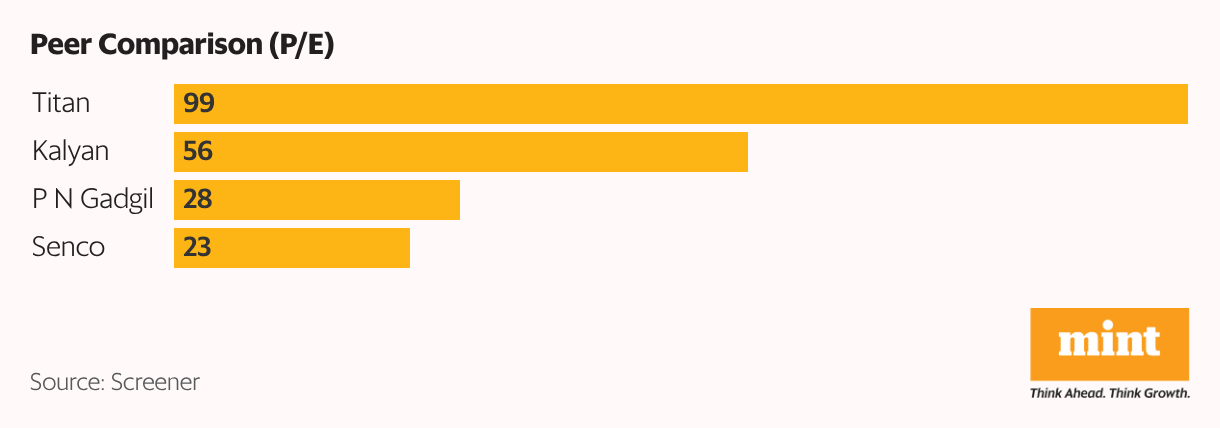
Valuations, however, remain divergent across companies. Titan continues to trade at a premium of around 99 times price-to-earnings multiple. In comparison, Kalyan trades at 56, while PN Gadgil (28) and Senco Gold (23) trade at significantly lower multiples.
If profitability improves, these valuations could compress meaningfully, making the sector worth watching for a rebound.
For more such analysis, read Profit Pulse
Madhvendra has over seven years of experience in equity markets and writes detailed research articles on listed Indian companies, sectoral trends, and macroeconomic developments.
The writer does not hold the stocks discussed in this article.
The purpose of this article is only to share interesting charts, data points, and thought-provoking opinions. This is NOT a recommendation. If you wish to consider an investment, you are strongly advised to consult your advisor. This article is strictly for educational purposes only.

