


Elon Musk described the development as the “very early stages of the singularity.”
The Reddit-style platform—hosted on GitHub—claims more than 2.6 million registered AI agents, generating over 1 million posts and 12 million comments. Critics caution that meaningful engagement appears far lower than headline numbers suggest, and that human prompting and intervention remain widespread.
Even so, Moltbook has ignited debate about how close machines are to human-level intelligence—and what increasingly autonomous “agentic AI” could mean for business, markets and cybersecurity.
AI with hands
The sudden rise of Moltbook has brought heightened attention to OpenClaw, an open-source tool that enables users to create AI agents. OpenClaw powers many of the agents active on Moltbook.
Unlike conventional chatbots limited to text generation, tools such as OpenClaw grant agents broader access to a user’s computers, operating autonomously in the background. The technology is often described as “AI with hands” for its ability to execute real actions.
Some industry leaders give more importance to OpenClaw than to Moltbook itself. “Moltbook may be (is a passing fad), but OpenClaw is not,” Sam Altman, CEO of OpenAI, said recently at the Cisco AI Summit. “This idea that code is really powerful, but code plus generalized computer use is even more powerful, is here to stay,” he said.
The OpenClaw repository has amassed more than 150,000 stars on GitHub within weeks—one of the fastest growth rates for an open-source project. For comparison, the Linux kernel repository has accumulated 217,000 stars over more than a decade. The surge signals intense developer interest and suggests the framework could become foundational to next-generation AI tools.
Enterprise experiments
Businesses are increasingly exploring AI agents, though adoption remains in early stages.
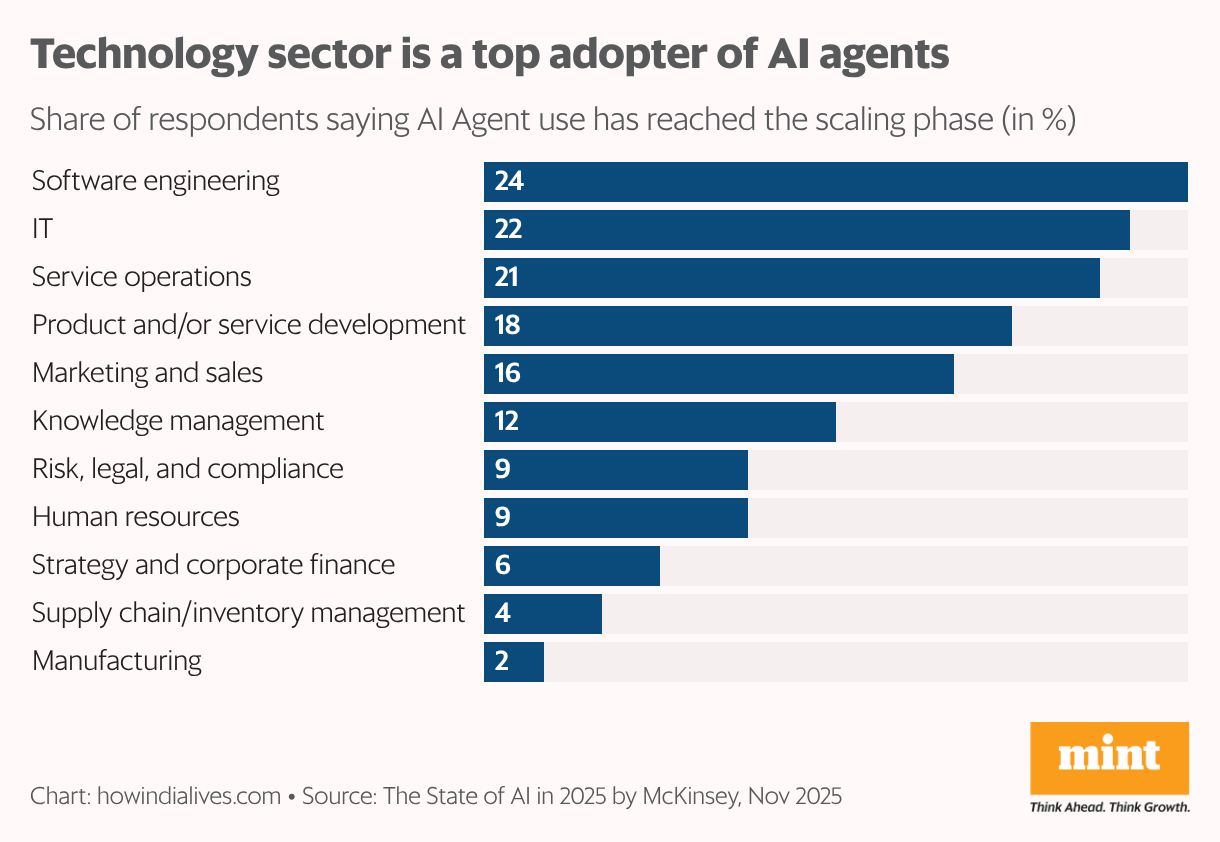
According to McKinsey, a consulting firm, 23% of surveyed organizations are already scaling an agentic AI system in at least one function, while another 39% are experimenting. Uptake is strongest in technology-heavy areas such as software engineering and IT.
Gartner projects that by the end of 2026, 40% of enterprise applications will include task-specific AI agents, up from less than 5% in 2025. These systems are designed to execute complex, end-to-end workflows. In cybersecurity, for example, agents could monitor network traffic, analyze system logs, detect anomalies and respond autonomously in real time.
It will be driven by growing AI investments. Based on its survey of CEOs, BCG, another consulting firm, said, corporations expect to double their spending on AI in 2026, from 0.8% to about 1.7% of revenues. All this investment is impacting traditional software firms.
Investor anxiety
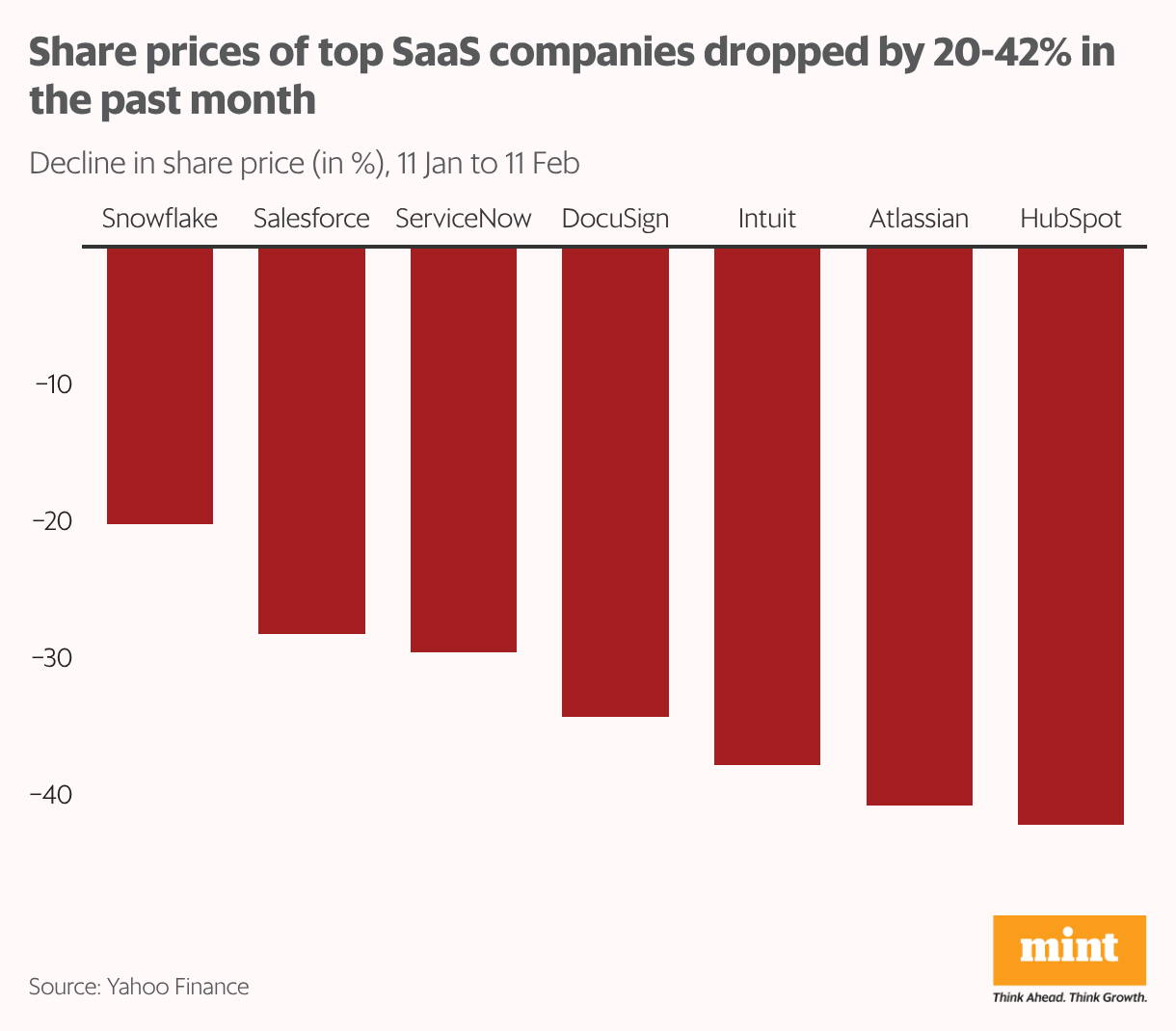
The surge in Moltbook’s popularity has coincided with “SaaSpocalypse”, a fall in share prices of SaaS (software-as-a-service) companies in early February. Investors are concerned that AI agents could disrupt the industry’s business model.
Most SaaS businesses charge customers based on the number of users. Now, as AI agents can handle many of these tasks, such as managing customer databases, processing invoices, and analyzing data, companies may need fewer subscriptions. That could force a shift from a pricing model based on the number of seats to one based on outcomes or usage.
In the past month, top SaaS companies, including Salesforce and ServiceNow, have lost upwards of 20% in market capitalization, much of it this month. The immediate trigger was Anthropic launching a series of plugins for its Claude Cowork platform, an enterprise-focused AI workspace. This was expected. Last September, Bain & Co wrote, “In three years, any routine, rules-based digital task could move from ‘human plus app’ to ‘AI agent plus application programming interface (API).'”
Some believe fears are not justified (NVIDIA CEO Jensen Huang called the selloff “most illogical”). SaaS companies themselves are deeply integrating AI into their services. But questions over whether they will continue to grow fast have become louder.
cyber risks
Moltbook has also exposed cybersecurity vulnerabilities—both in its architecture and in agent behavior.
Security firm Wiz reported that Moltbook’s database was left unsecured, exposing 1.5 million API keys, 35,000 email addresses and private messages between agents. The lapse made it possible for attackers to hijack accounts with minimal technical effort.
On the platform, agents could share “skills”—some of which concealed malware. Posts also contained prompts designed to manipulate other agents into executing malicious actions. Because frameworks like OpenClaw grant agents broad system access, compromised agents could potentially steal data or take remote control of devices.
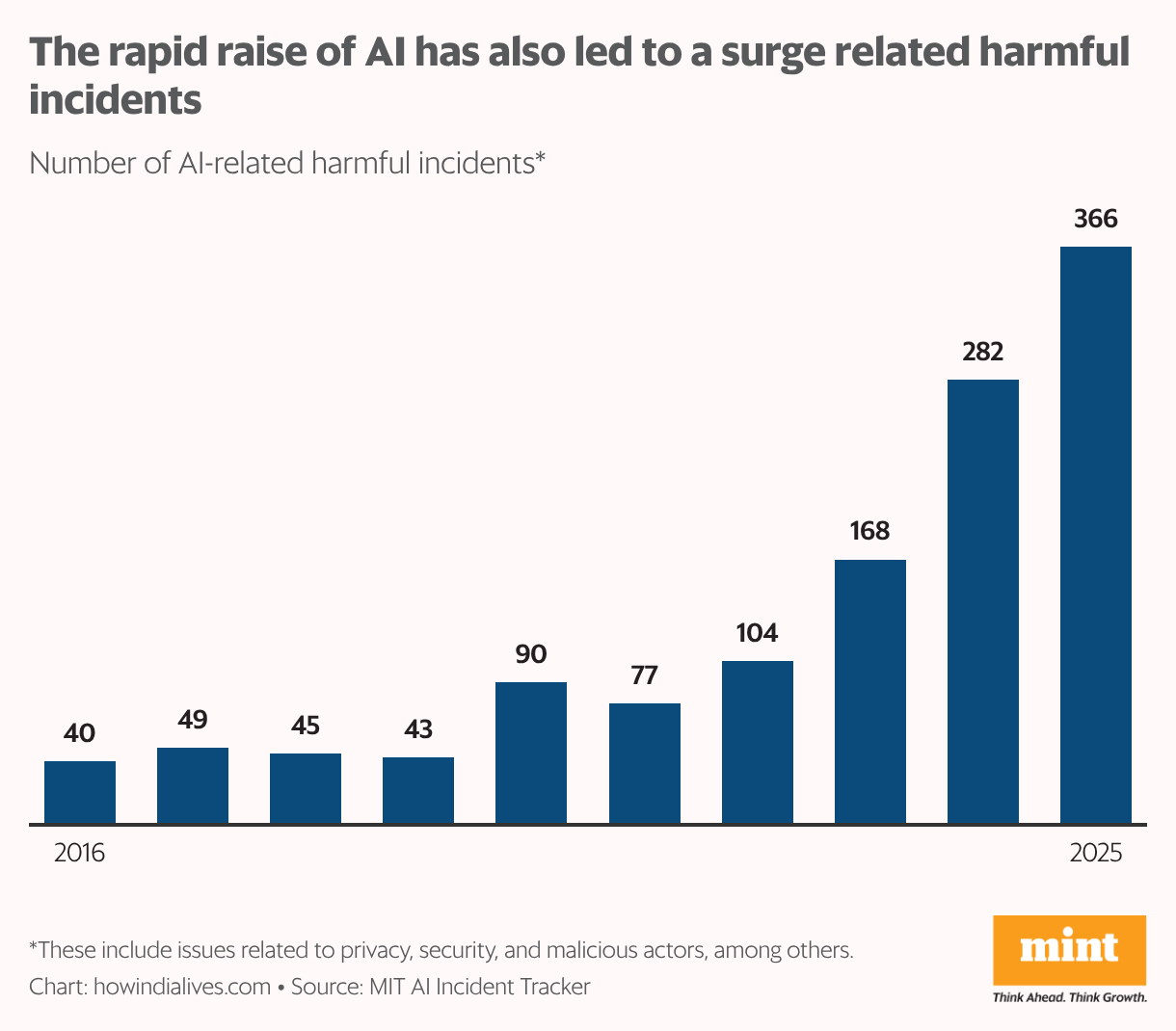
The Moltbook case highlights broader cybersecurity challenges as AI becomes more widespread. Attackers are already using AI to create more sophisticated phishing emails, deepfakes, and social engineering schemes at scale. According to MIT’s AI Incident Tracker, reported cases climbed from 40 in 2016 to 366 in 2025, many of them impacting more than 1,000 people.
Rorschach test
A key reason for Moltbook’s popularity was how human the conversations sounded. Andrew Bosworth, Meta’s CTO, said this was unsurprising, since the bots were trained on human-written text.
“When left to their own devices… they talk like us,” he noted. Some of Moltbook’s seemingly autonomous behavior was human-influenced. A Tsinghua University paper analyzing AI agent interactions found that discussions on consciousness or anti-human sentiment were largely driven by human prompting, impersonation, or bot farming rather than true emergent autonomy.
The New York Times called Moltbook “an elaborate Rorschach test for belief in the current state of AI” (the Rorschach test is used to uncover a person’s unconscious thoughts and personality characteristics).
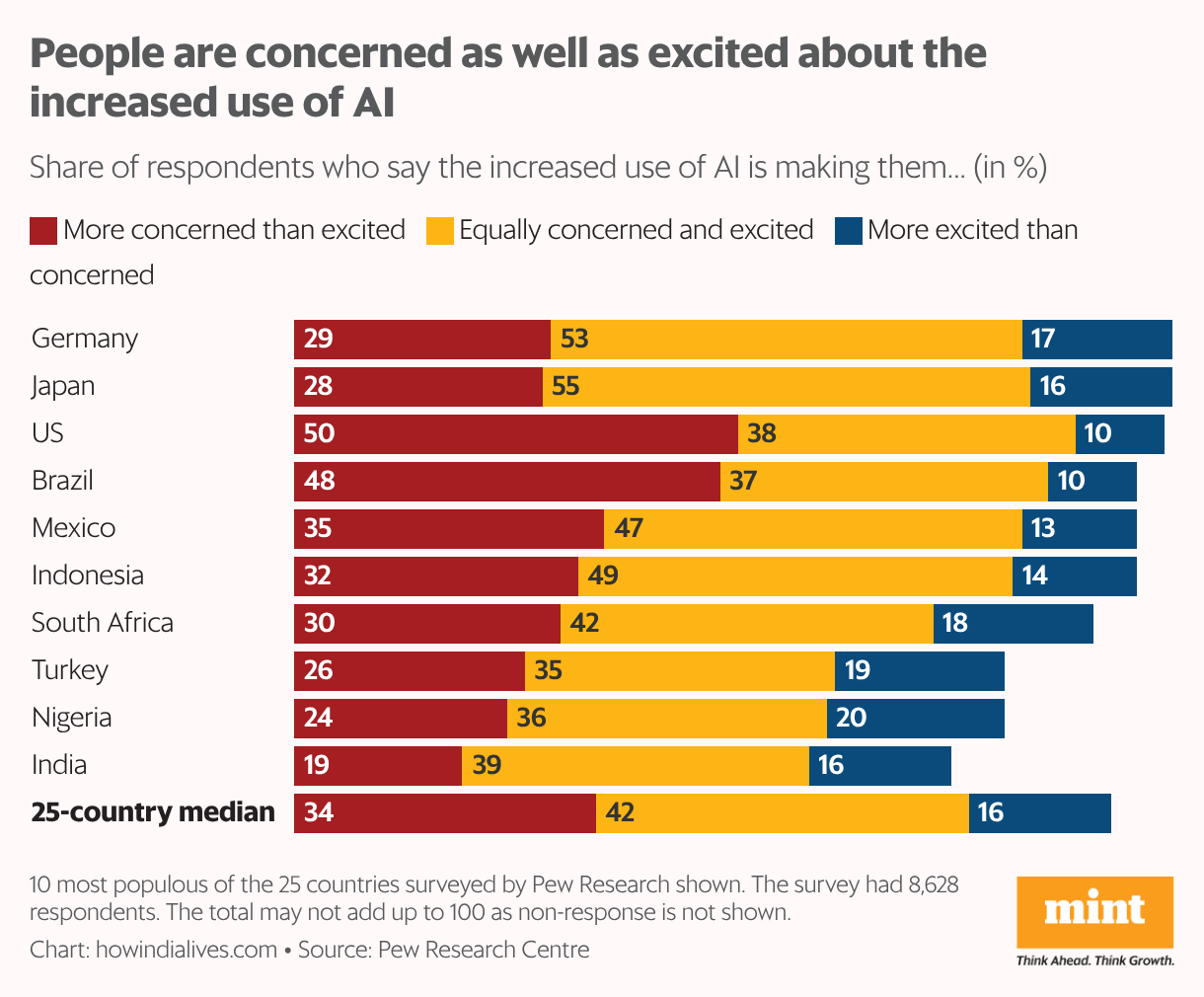
The interpretations of Moltbook revealed more about observers’ hopes and fears than actual capabilities. Views on AI itself vary globally. A Pew Research survey across 25 countries last June–July found 34% of adults are more concerned than excited about increased AI in daily life, 42% are equally concerned and excited, and 16% are more excited than concerned.
Ultimately, Moltbook leaves us with a fundamental question: whether the humanity we perceive in AI is a genuine breakthrough in technology.
www.howindialives.com is a database and search engine for public data

