

The conflict between religion and power is not new. The current tussle that is going on between Shankaracharya Avimukteshwarananda Saraswati and the Uttar Pradesh government is a new chapter in the same history which was created by Shankaracharya himself. Because Shankaracharya is not a person but a title, the holder of which is the biggest leader of Hindutva and no one can challenge him on the basis of religion, but there have been many such occasions in history when Shankaracharyas have directly challenged the power and have had to suffer the consequences of it.
A similar story is also from Tamil Nadu, when Shankaracharya was not only accused of murder when Jayalalitha was the Chief Minister, but he was also arrested and had to go to jail. Hello, I am Avinash and today we will talk in clear cut about those controversies related to Shankaracharya, which changed the direction of both religion and politics.
Tamil Nadu police reached the monastery
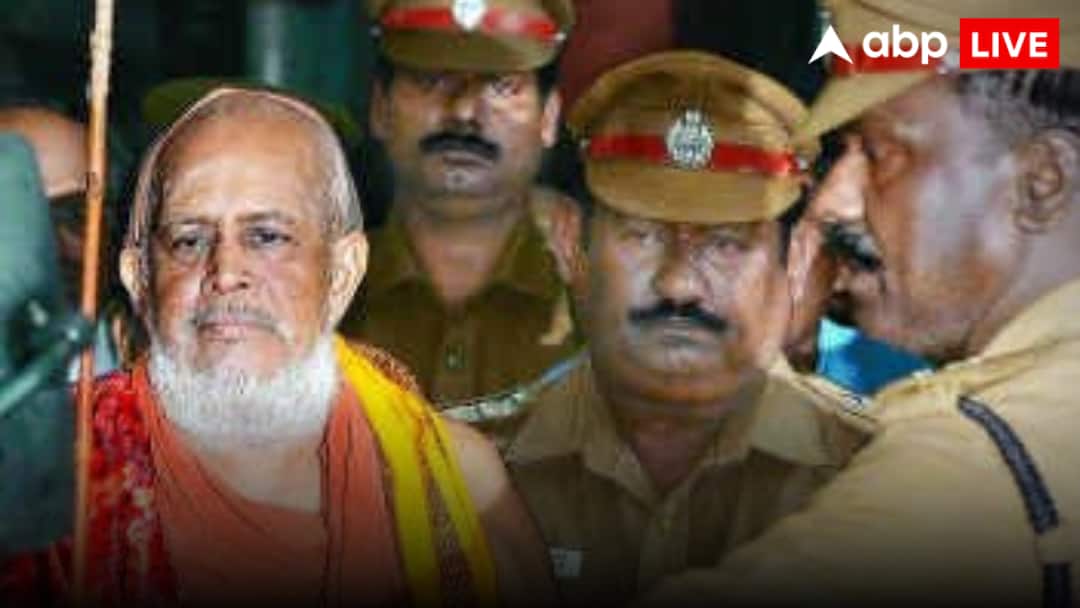
The date was 11 November 2004. That day the entire country was celebrating Diwali. At that time, Jayendra Saraswati used to be the Shankaracharya of Kanchi Kamakoti Peeth. That day he was in Mahabubnagar, Andhra Pradesh and was preparing for the special Trikal Puja of Diwali. Suddenly Tamil Nadu police reached his monastery and arrested him. He was brought to Chennai the same night by a special plane and then lodged in Vellore Central Jail.
Made accused in murder conspiracy
In the reason given by Tamil Nadu Police for this arrest, Shankaracharya was made accused of a murder conspiracy. The deceased was Shankar Raman, who used to be the manager of Varadaraja Perumal Temple in Kanchipuram. On September 3, 2004, he was murdered with a sharp weapon inside the temple premises. The police found in their investigation that Shankararaman had an old feud with the Math and Shankaracharya. Shankararaman had raised serious questions on the functioning of the Math and Shankaracharya. Was accused of financial irregularities and many big scams. To confirm his allegations, Shankararaman had written several anonymous letters to the government in the name of Somasekhar Ganpadigal.
Work done in Jayalalitha’s government
J Jayalalitha used to be the head of the government of Tamil Nadu. At the Centre, she was part of the NDA, which was led by the BJP and its biggest leader was Atal Bihari Vajpayee. At that time Jayalalitha considered Shankaracharya Jayendra Saraswati as her spiritual guru. The relationship between the two was like that of guru and disciple. But in the 2004 Lok Sabha elections, when the NDA under the leadership of Vajpayee was defeated and the UPA government was formed under the leadership of Manmohan Singh, its partner in that government was Karunanidhi’s DMK, who was a staunch opponent of Jayalalitha. At that time, the closeness between Shankaracharya Jayendra Saraswati and the UPA government started increasing. Many leaders of UPA and especially DMK started attending Kanchi Kamakoti Peeth of Shankaracharya Jayendra Saraswati to seek blessings.
Why did Jayalalitha get angry?
Jayalalitha got angry with this. Due to the increasing presence of leaders in Jayendra Saraswati’s bench, Jayalalitha also started feeling that Kanchi Kamakoti Peeth was now becoming a parallel center of power, due to which her chair could be in danger at any time. Jayalalitha was also trying to get rid of her soft Hindutva image, due to which she had suffered a loss in the Lok Sabha elections also. In such a situation, he was looking for an opportunity by which he could teach a lesson to Shankaracharya and also come out of his soft Hindutva image. And he got his opportunity after the murder of Shankararaman, who had written several anonymous letters under the name ‘Somashekar Ganapadigal’ to Jayalalitha about the scams going on in the Math.
Tamil Nadu Police gets freedom to arrest Shankaracharya
Jayalalitha took strict action. In an attempt to improve his image, he took one of the toughest decisions of his life and gave the Tamil Nadu Police the freedom to arrest Shankaracharya. Shankaracharya was arrested. Because of this, Jayalalitha’s ally Bharatiya Janata Party also got angry. Lal Krishna Advani himself opposed this decision of Jayalalitha. International President of Vishwa Hindu Parishad Ashok Singhal opened a front against Jayalalitha. Sages and saints from all over the country got involved in the movement. But Jayalalitha did not budge. He did not make any separate arrangement for Shankaracharya in the jail, rather he was given the same facilities as normal prisoners.
Treated like a common prisoner in jail
The rule for Shankaracharya is that he will eat only food prepared by himself. He would drink only Ganga water, perform Trikal puja and rituals, but Jayalalitha took strict action against him in jail. Initially, he had to sleep on the floor, but after repeated requests from the Math and protests across the country against the treatment meted out to Shankaracharya, he was allowed to eat milk and fruits from the Math, got a wooden cot to sleep on, limited idols, flowers and lamps were kept so that he could worship. After spending about two months in jail, Shankaracharya was granted bail by the Supreme Court in early 2005 due to lack of evidence.
Seen as an attack on Hindutva
This step of Jayalalitha was seen as an attack on Hindutva throughout the country. This fear ingrained in the minds of the devotees of Hindu religion that when Shankaracharya can be arrested for political reasons then no saint or mahatma is safe. And this is the reason why when Shankaracharya got bail, a huge crowd of devotees gathered to welcome him. Thousands of devotees took to the streets several hours before Shankaracharya reached Kanchipuram. As soon as his vehicle entered the city, people showered him with flowers and the entire city echoed with slogans of ‘Jai Jai Shankar’. On reaching the monastery, he was welcomed with Vedic chanting and Kalash which is called ‘Poornakumbham’.
What were the conditions of bail?
Shankaracharya himself visited the temple, performed religious rituals of purification and then got busy with his religious work. There were some conditions of bail, so he had to follow them also. While doing all this, Shankaracharya’s lawyers reached the Supreme Court and demanded to transfer the case out of Tamil Nadu. Due to the intervention of the Supreme Court, this case was transferred from Tamil Nadu to Puducherry. This case was heard there for about 9 years. During this period, a total of 189 witnesses were interrogated, out of which 83 witnesses retracted their statements. Shankararaman’s wife and daughter also could not identify the accused in the court. The police could not prove that the money used for the murder or the strings of the conspiracy were directly linked to Shankaracharya. In such a situation, on 27 November 2013, a special court of Puducherry honorably acquitted Shankaracharya Jayendra Saraswati, his successor Vijayendra Saraswati and 21 other accused.
Also read: Big terrorist conspiracy busted before January 26, 4 terrorists arrested with 2.5 kg RDX from Punjab

