

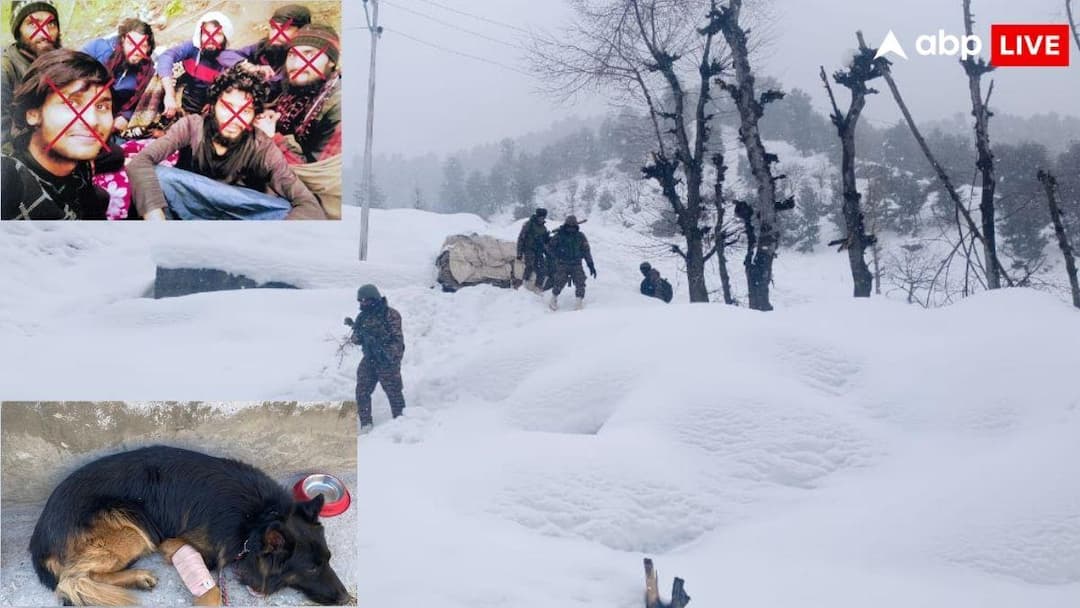
With three terrorists killed on Sunday (22 February 2026) in Kishtwar, Jammu and Kashmir, the Indian Army has claimed to have eliminated a major module of Jaish-e-Mohammed. There were a total of seven terrorists in this module, led by Jaish’s top commander Saifullah, who was known as Israel Group. In the operation going on for the last 326 days, the Army with the help of Jammu Kashmir Police and CRPF has eliminated all these seven terrorists.
Indian Army’s Delta Force (local unit of Rashtriya Rifles) organized a press conference on Monday (23 February 2026) and released photographs of all these seven terrorists. The Army said that to eliminate this entire group, help from drones to satellites was taken.
Saifullah group terrorist killed by army
According to Major General APL Bal, Divisional Commander of Delta Force, a major success regarding this group was achieved on the 4th of this month, when a Pakistani terrorist named Adil was killed during Operation Trashi-1. Adil was also a Pakistani citizen like Saifullah and other terrorists. Adil was considered to be Saifullah’s deputy commander, but Saifullah had managed to dodge him. On the same day, in another operation, two other terrorists of this group were killed in the same area.
These weapons were recovered from the terrorists
According to the information, Saifullah (Israel) group had infiltrated the Indian border from the LOC (Line of Control) in April 2024 and was active in Doda-Kishtwar area for the last one and a half-two years. During this period, Saifullah had managed to dodge the security forces 15-20 times, but in the operation conducted on 21-22 February, the army killed Saifullah and his two (02) associates Farman Ali and Bashara alias Hurera. After the encounter, the Army recovered 02 AK-47 and 01 M-4 rifles along with steel bullets from the terrorists. These bullets are successful in penetrating even bulletproof jackets.
Operation started on 14 February
This operation was started on 14 February. On February 18 also, security forces had contact with this group and a huge quantity of weapons and other war material was seized from the spot. Army’s dog Tyson also played an important role in the Saturday-Sunday operation and was seriously injured. Tyson was the first to enter the terrorists’ hideout. The terrorists had opened fire on him. The Army has saluted Tyson’s bravery because he was not wearing a bulletproof jacket.
Army operation in Doda-Kishtwar area
According to the Army, after the Pahalgam massacre, the Indian Army had started an operation to kill terrorists in the inaccessible high altitude areas of Doda-Kishtwar area. Even during heavy snowfall in the winter season, the Army continued the search operation along with CRPF, Assam Rifles and Police. For this, the dhok (living place of local shepherds) and caves built in the forests were explored one by one. CRPF and police prepared FOB i.e. Forward Operating Base in the vacant Dhok so that the terrorists do not make it their hideout again. In the last 7-8 months, a total of 43 such FOBs were prepared in which 20-25 CRPF personnel and 3-4 policemen were deployed.
Actually, due to the cold winter, the terrorists had reached the high altitude areas of Doda and Kishtwar to hide. In such a situation, Rashtriya Rifles (RR) units of the Indian Army have been deployed in these high altitude and extremely dangerous areas for counter-terrorism operations. These units have been equipped with drones and thermal imaging equipment.
Elimination of a large network of terrorists
In the chilly Kalan season of Jammu and Kashmir, there is bone-melting cold. This season usually lasts from 21st December to 31st January. During this period, there is heavy snowfall in the high altitude areas of Doda and Kishtwar, but the Indian Army was fully geared up for winter operations. The special thing is that the Pakistani terrorists who carried out the Pahalgam massacre had also reached Anantnag in South Kashmir via Doda and Kishtwar. This is the reason why the army was not ready to leave any scope this time.
According to the Army, with the elimination of Saifullah Group, a large network of terrorists has been eliminated, but according to the latest input from intelligence agencies, about 30 Pakistani terrorists are still active in Jammu region (Doda, Kishtwar, Poonch, Rajouri etc.). In such a situation, eliminating the remaining terrorists is also a big challenge for the security forces. Apart from this, 40-50 terrorists are also active in Kashmir valley. Of these, except two, all the rest are foreign terrorists i.e. terrorists of Pakistani origin.

