

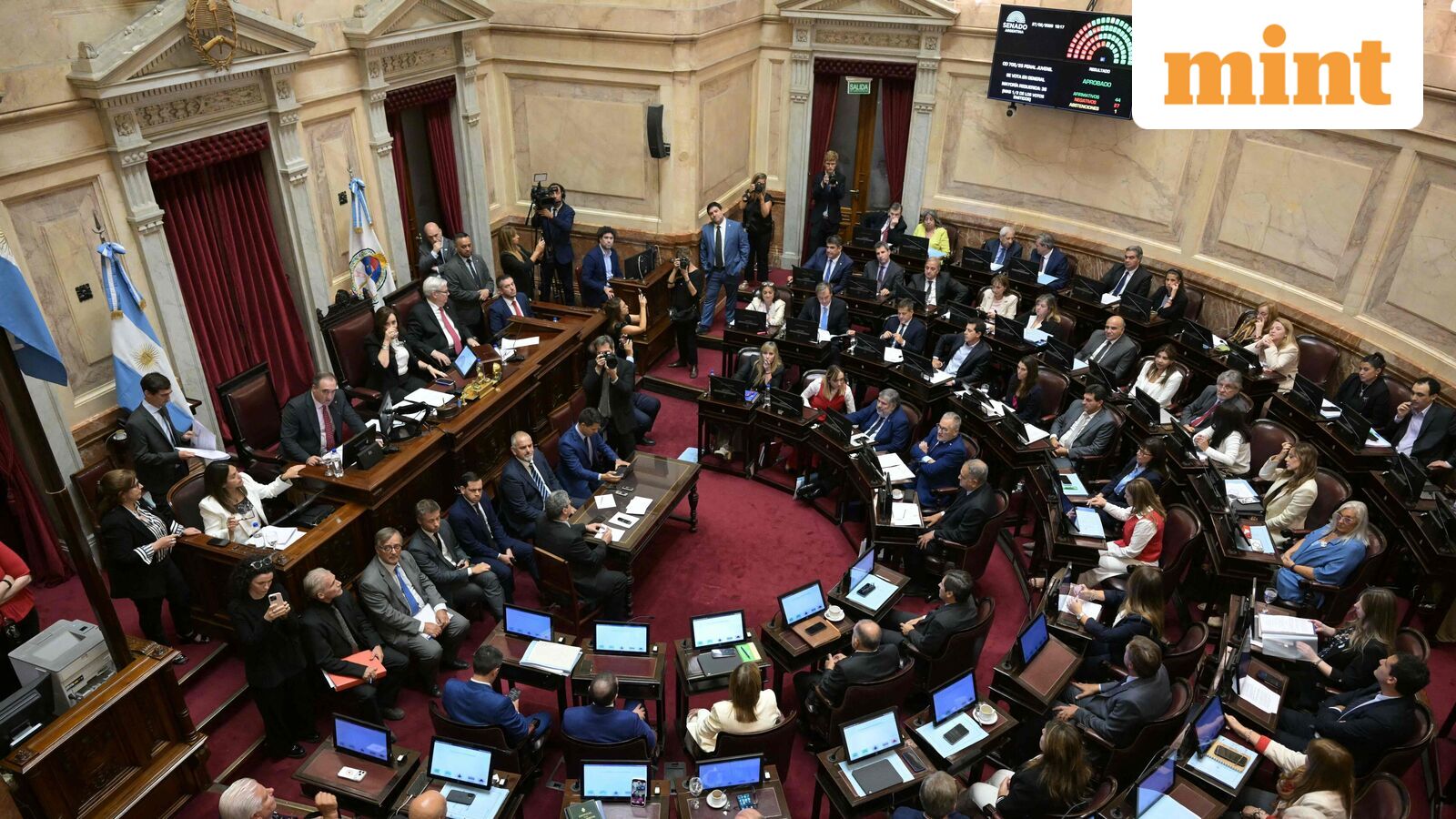
Argentina’s Congress adopted President Javier Milei’s flagship labor reform on Friday. The labor reform bill changes several aspects of employment regulation, loosening rules on working hours, dismissals and overtime.
What changes now?
The so-called “labor modernization law” allows working days of up to 12 hours, reduces severance pay, limits the right to strike and lowers employer taxes, among other provisions, news agency AFP reported.
The bill is a 100-page, 218-article text that modifies existing laws that regulate salaries, shifts, trial periods and other aspects of work-life balance and workers’ rights. It also grants fiscal benefits for employers who register their employees, the Buenos Aires Herald reported.
The main changes include:
1. Severance pay: As per the new bill, the amount calculated for employees fired without cause will exclude any extra income, like bonuses, paid vacation, and the thirteenth salary (known as aguinaldo). The base number for calculation cannot surpass three times the average salary for the position.
2. Working hours: The maximum shift length in Argentina is currently 8 hours per day, or 48 hours per week. Now, as per the reform, employees could “voluntarily” agree to work extra hours in exchange for docking those hours off future shifts.
Workers could work up to 12-hour shifts under that system, but would still be required to keep a minimum 12-hour rest period between shifts (the latter is a norm already in place). They would not receive overtime pay.
3. Labor negotiations: The law would allow companies to conduct labor and wage negotiations directly with their workers.
4. Salary: Employers can opt to pay their employees’ salaries according to productivity or merit. They can also choose to do so in foreign currency.
5. Limiting protests: Workers will have to request permission to carry out union assemblies at the work place. Affecting the activities of employees who are not taking part in the assembly will be considered a sanctionable offence.
Several sectors, including telecommunications, hospitals, waste collection, education, aviation, and port workers are now considered essential, which means they have to guarantee at least a 75% operation at all times. This means most workers won’t be able to join strikes, greatly affecting union protests, the Buenos Aires Herald reported.
6.Vacations: Employers can now fraction their employees’ paid vacation in 7-day segments, instead of the full two weeks they currently get. They could also decide to make employees take their vacations during summer at least every three years.
7. Professional status: The bill establishes the elimination of labor statutes of certain sectors, including hair stylists, drivers, and journalists, six months after the law enters into force.
8. Labor trials: Labor-specific courts at a national level will be eliminated.
It affects all those who were hired under the conditions of the Labor Contract Law, which the reform modified. This means that it not only affects workers from the private sector, but also public employees who work for state organizations or companies that also use that regulation.
When will it become a law?
According to Buenos Aires Herald, the bill has been approved by both senators and deputies, although it needs to go back to the upper house for a final green-light before it becomes law.
As per the report, President Javier Milei aims for the bill to be approved before March 1, when he will give a speech to kickstart the ordinary sessions period in Congress. There, he is expected to celebrate the feat.
Argentina divided over labor reform
The law brought thousands of people onto the streets in the past two weeks in protest over what they see as a rollback in workers’ rights.
Two protests outside parliament ended in clashes between the police and protesters but a third demonstration on Friday saw only minor disturbances.
Polls show Argentines divided on the reform, with 48.6 percent in favor and 45.2 percent against in a recent survey.
The General Confederation of Labor (CGT), which called a general strike last week that ground Argentina to a halt, said ahead of the Senate vote that it would now take its fight to the courts.
The law is the centerpiece of Milei’s radical free market agenda.
He insists that Argentina’s labor laws are outdated, too restrictive and discourage formal hiring.
Over 43 percent of Argentine workers lack formal employment contracts.
Sergio Emiliozzi, a 60-year-old teacher, said that while the law was being promoted as a job creation tool, “it’s quite the opposite.”
“What this allows is for me to be easily fired,” he said.
‘False premise’
Opposition parties and unions have poured scorn on Milei’s claim that the reform will spur a hiring bonanza.
They reportedly point to the closure of some 21,000 companies and loss of 300,000 jobs since he took office as proof that his budget-slashing, deregulatory agenda, while praised for driving down inflation, is hurting the economy.
For Matias Cremonte, President of the Latin American Association of Labor Lawyers, the reform is “regressive” and “based on a false premise.”
“Studies have shown that in no country in the world has labor legislation been decisive in creating or destroying jobs. That depends on economic policy,” he told AFP.
A report by the national statistics institute Indec on business sentiment showed 80 percent of companies have no hiring plans for the next three months and 15 percent even planning to lay off staff.
The president of the Argentine Industrial Union, Martin Rappallini, welcomed the law’s aim to reduce the number of workplace lawsuits but cautioned that unemployment “cannot be solved with a single law.”
Milei has accelerated his reforms since winning October mid-terms, backed by US President Donald Trump, who promised to withhold a financial aid package for Argentina’s currency unless his candidate won.
(With inputs from AFP and Buenos Aires Herald)

