

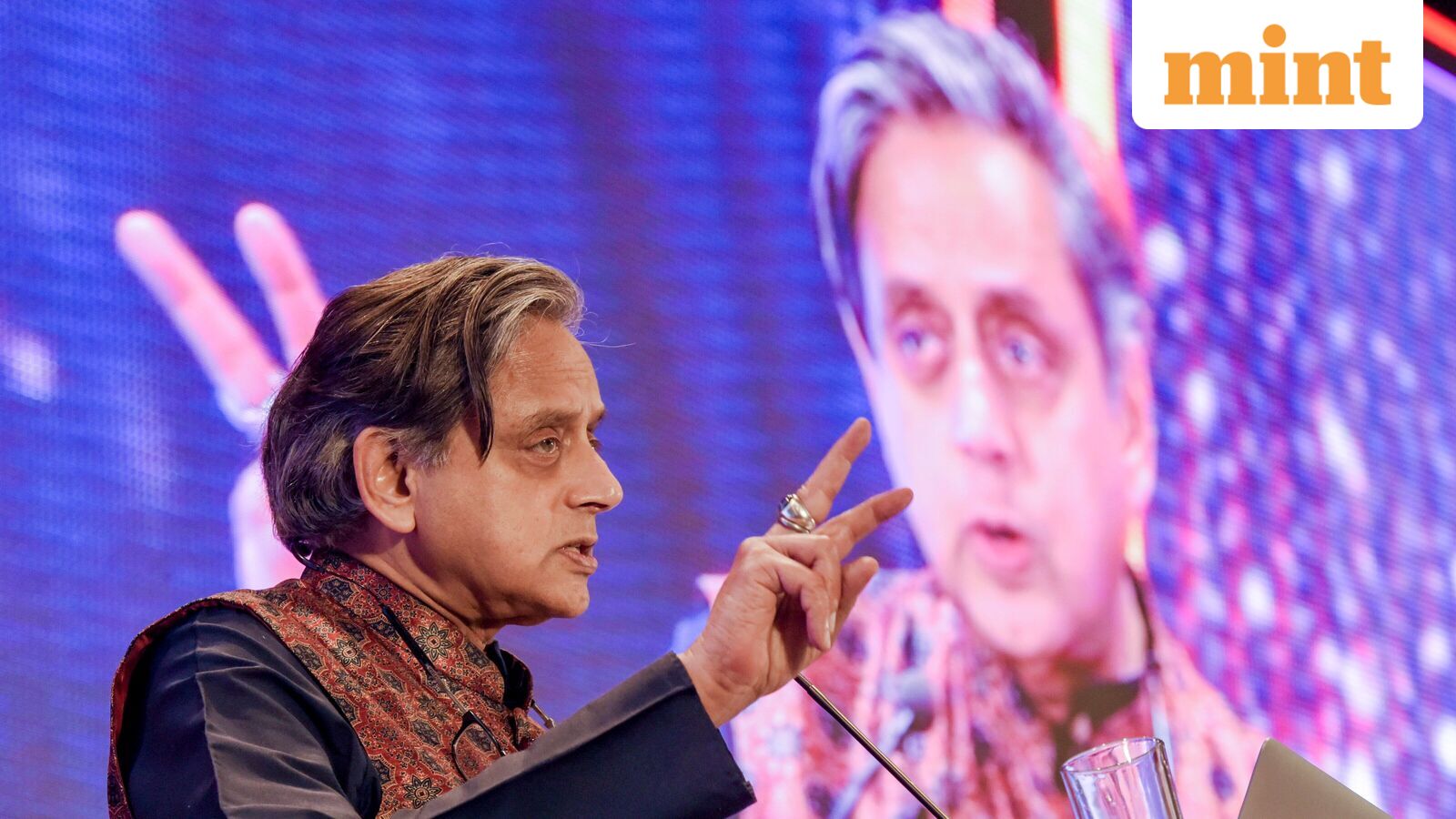
Congress leader Shashi Tharoor has raised questions about the fairness and efficiency of India’s federal structure in the context of the “triple-engine” governance model, suggesting that political alignment between the Center and the states may affect project delivery.
The term “triple-engine” governance is often used by the Bharatiya Janata Party (BJP) to describe a scenario where the same party governs at the Centre, the state, and the local body level, arguing that such alignment ensures smoother coordination and faster development.
In the case of Delhi, for example, while the BJP is in power in the assembly and municipality, the saffron party also rules at the Centre.
Tharoor, the Congress MP from Kerala, was responding to a research paper titled “The Triple Engine Effect: Does Full Vertical Alignment Unlock the State?” published by the Stanford Institute for Economic Policy Research (SIEPR). The paper was shared on
‘My experience as a Member of Parliament’
In a post on
“With the change of government at the Center in 2014 and then in the state in 2016, many challenges arose in getting major new projects approved and executed,” he wrote. While acknowledging there were exceptions, Tharoor said these required “exceptional individual goodwill” and had to be “fought for.”
The former Union Minister then posed a broader constitutional question and asked, “What does this say about the fairness of our constitutional federalism? That it’s more democratic but less efficient than unitary ‘triple-engine’ rule?”
Tharoor’s remarks appear to question whether such vertical political alignment improves administrative efficiency at the cost of weakening the spirit of competitive federalism. The comments also add to the ongoing debate over Centre–state relations and the balance between political alignment and institutional autonomy in India’s federal framework.
What does the research paper say?
The Stanford paper examines whether full vertical political alignment across different levels of government enhances state capacity and governance outcomes—a proposition that has gained increasing political traction in recent years.
“Does ‘full vertical alignment’—political congruence across national, state, and local tiers—drive economic development? Using a sharp regression discontinuity design based on close state elections in India, we estimate the causal effects of multilevel alignment on growth, inequality, and public service delivery,” it said.
I was most effective in delivering projects to my constituency when the Congress party was in power at both the Center and the state.
The paper finds that the research found that a full vertical alignment reduces annual nightlight-based inequality by 2.5%, boosts local growth by 2%, and significantly expands welfare access and banking penetration.
Critically, these redistributive effects are concentrated in marginalized (SC/ST) constituencies and are absent under partial (dyadic) alignment. These results suggest a vital non-linearity in political economy: a “critical mass” of congruence is required to overcome entrenched bureaucratic friction and unlock the state’s distributive capacity,” it said.

