

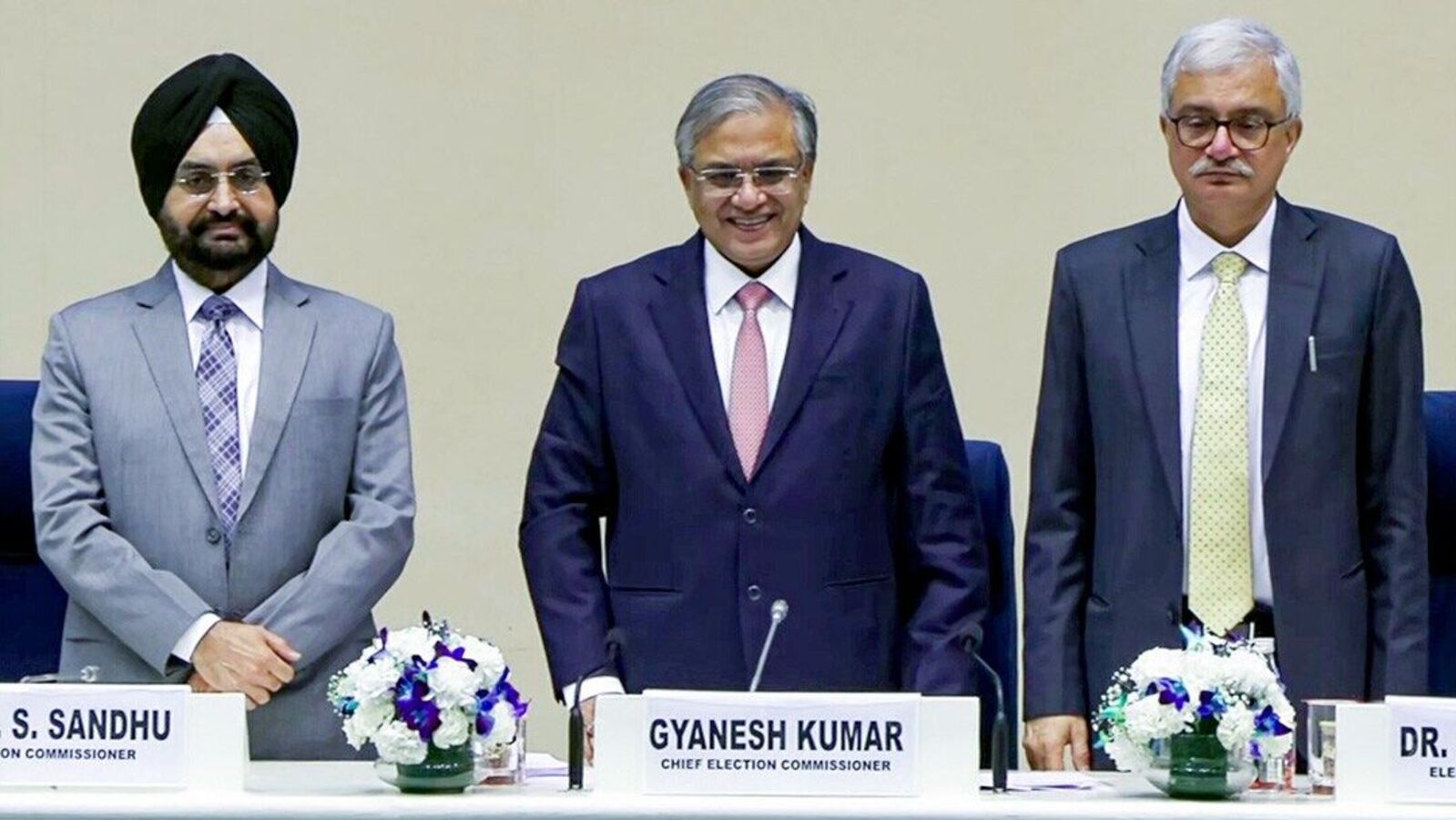
The Election Commission on Sunday declared the schedule for Assembly elections in four states and one Union Territory. As per the announcement, voting in Assam, Kerala and Puducherry will take place in a single phase on April 9. In West Bengal, polling will be conducted in two phases on April 23 and 29, while Tamil Nadu will go to the polls on April 23.
Speaking at a press conference, Chief Election Commissioner Gyanesh Kumar stated that counting of votes for all Assembly seats across the four states and the Union Territory will be carried out on May 4.
A look at numbers from 4 states, 1 UT as they go to polls next month
17.4 crore voters
The total number of electors across the poll-bound regions reflects a significant voter base. In Tamil Nadu, the electorate is estimated at around 6.44 crore, while West Bengal has approximately 5.67 crore registered voters. Kerala accounts for nearly 2.70 crore electors, and Assam has about 2.50 crore voters. Puducherry, meanwhile, has an electorate of roughly 9.44 lakh.
The data also indicates the presence of third gender voters across these states and the Union Territory, highlighting efforts towards inclusive electoral participation. Overall, the combined electorate in the five poll-bound states and Union Territory is estimated to be around 17.4 crore voters.
824 assembly constituencies
In terms of Assembly strength, Assam has 126 constituencies, West Bengal has 294, Kerala has 140, Tamil Nadu has 234, and Puducherry has 30 seats. The distribution of seats across General, Scheduled Caste (SC) and Scheduled Tribe (ST) categories also varies among these states and the Union Territory. Assam has 98 General, 9 SC and 19 ST seats, while Kerala has 124 General, 14 SC and 2 ST constituencies. Puducherry comprises 25 General and 5 SC seats, with no ST-reserved constituencies. Tamil Nadu has 188 General, 44 SC and 2 ST seats, whereas West Bengal accounts for 210 General, 68 SC and 16 ST constituencies.
Overall, the five poll-bound states and Union Territory together have a total of 824 Assembly constituencies.
2,18,807 polling stations
A comprehensive overview of polling infrastructure across the poll-bound states and Union Territory shows that a total of about 2,18,807 polling stations have been set up. In Assam, there are around 31,486 polling stations, including 3,775 in urban areas and 27,711 in rural regions, with an average of about 793 electors per station. Kerala has approximately 30,471 polling stations, comprising 6,130 urban and 24,341 rural booths, with an average of 885 voters per station. Puducherry has 1,099 polling stations, of which 610 are located in urban areas and 489 in rural areas, catering to an average of 859 electors per booth.
Tamil Nadu accounts for nearly 75,032 polling stations, including 30,967 in urban and 44,065 in rural locations, with an average of about 756 voters per station. West Bengal has the highest number at around 80,719 polling stations, including 19,708 urban and 61,011 rural booths, with an average of roughly 798 electors per station. Special initiatives such as women-managed polling stations, model polling stations, webcasting facilities at 100 per cent locations, and booths managed by persons with disabilities have also been planned across these states to ensure smooth and inclusive polling arrangements.
25 lakh election officials’ deployment
Around 25 lakh election officials are set to be deployed across the five poll-bound states and the Union Territory to ensure the smooth conduct of the Assembly elections. This includes nearly 15 lakh polling personnel who will manage voting operations at polling stations. In addition, about 49,000 observers and micro observers will be assigned to monitor polling arrangements and maintain transparency during the electoral process.
Security arrangements will also be extensive, with approximately 4.85 lakh security personnel expected to be deployed to maintain law and order. For the counting process, around 40,000 officials will be engaged, while nearly 21,000 sector officers will oversee coordination and supervision in their respective areas. Furthermore, about 15,000 micro observers will be stationed during the counting of votes to ensure accuracy and fairness in the tabulation process.
28.7 lakh people in EVM awareness
Extensive voter awareness initiatives on the use of Electronic Voting Machines (EVMs) have been carried out in Assam, Kerala, Puducherry, Tamil Nadu and West Bengal ahead of the 2026 elections. As part of these efforts, a total of 717 EVM Demonstration Centers have been set up at District Election Officer, Returning Officer and Revenue Sub-Division headquarters to familiarize voters with the voting process. In addition, Mobile Demonstration Vans have covered around 1,24,172 polling station locations to spread awareness at the grassroots level.
These outreach programs have witnessed significant public participation, with more than 28.7 lakh people taking part in EVM awareness activities. Of these, over 25 lakh individuals have cast mock votes on EVMs, helping them gain practical understanding and confidence in the electoral system.

