

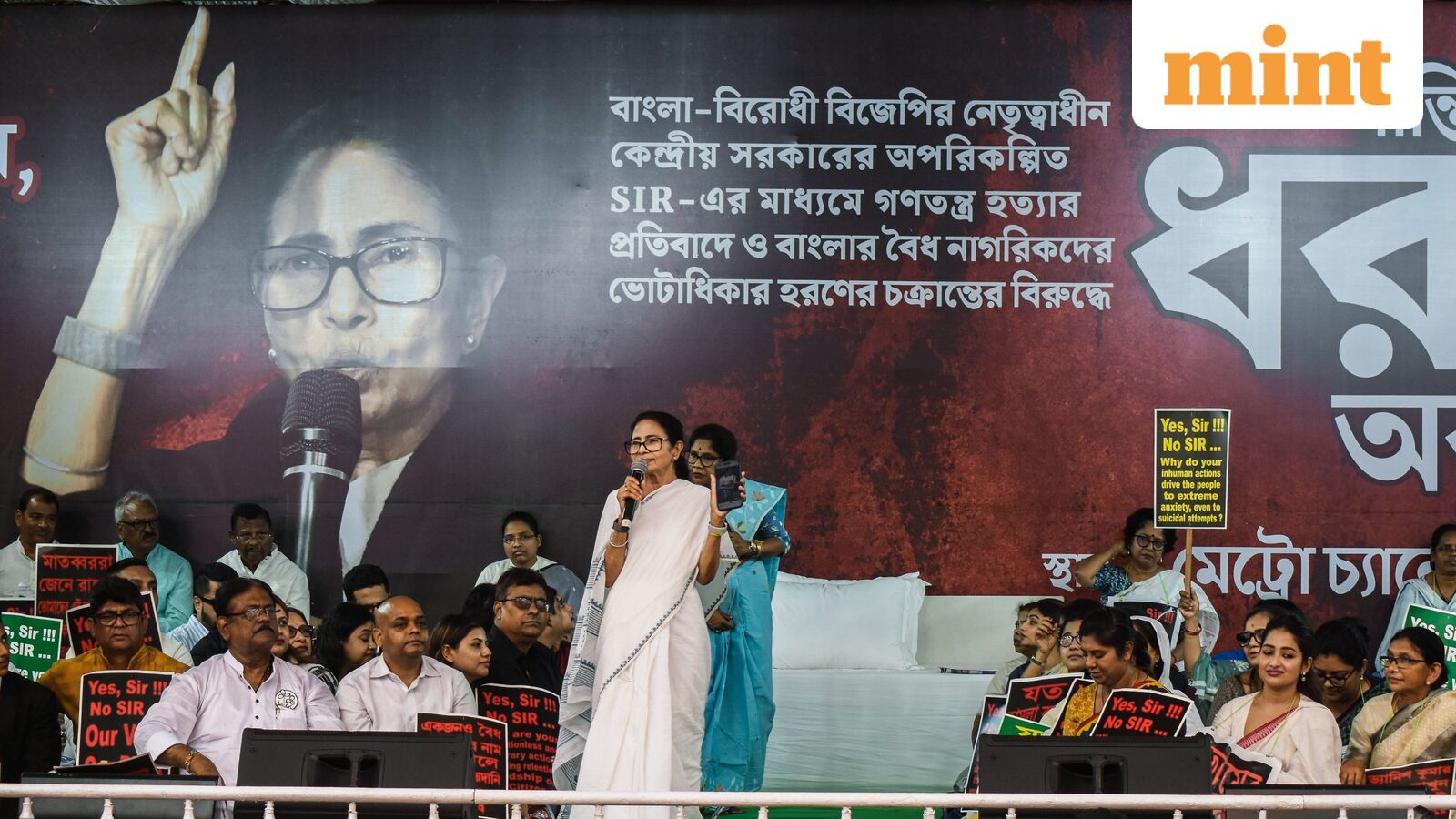
Assembly Elections 2026: West Bengal is all set for the assembly elections to be held in two phases – 23 and 29 April. The votes will be counted on 4 May.
The Election Commission announced the poll schedule for West Bengal, along with Kerala, Tamil Nadu, Assam and Puducherry, on Sunday, 15 March.
The West Bengal election is being seen as a fight between the ruling Trinamool Congress and the Bharatiya Janata Party (BJP). The TMC, led by Chief Minister Mamata Banerjeehas been in power in West Bengal since 2011, for three consecutive terms.
The end of the 34-year-long Left rule in Bengal
Before 2011, the Left Front ruled West Bengal for 34 years — one of the longest democratically elected communist governments in the world.
The Left rule started in West Bengal in 1977. Jyoti Basu was the chief minister from 1977 to 2000 – the longest-serving Chief Minister of the state. From 2000, Buddhadeb Bhattacharjee was the chief minister till 2011. The government was led by the Communist Party of India (Marxist) as part of the Left Front coalition.
The Left Front lost power in the 2011 West Bengal Legislative Assembly election, when Mamata Banerjee-led the Trinamool Congress (TMC) defeated them.
Since then, the TMC has won three successive elections, the last one in 2021.
The rise of the BJP post 2014
Over the past few years, the Bharatiya Janata Party has witnessed a steady rise in West Bengal.
For decades, the state was dominated first by the Left Front and then by the All India Trinamool Congress (TMC) led by Mamata Banerjee, and the saffron party was almost non-existent before 2014.
The BJP has never been in power in the Bengal assembly. It won zero seats in the 2009 Lok Sabha polls. In the 2011 assembly elections, the party’s vote share was around 4%.
State politics were mainly a contest between the Left and the TMC until the 2014 Lok Sabha elections. The first big breakthrough came in the 2014 Indian general election when the BJP won 2 of the 42 Lok Sabha seats in the state. The vote share jumped to about 17 percent in the general elections.
Since then, the party began expanding organizationally across districts. In the 2016 West Bengal Legislative Assembly electionthe BJP’s vote share rose to around 10%, and it won 3 seats. The real surge came in the 2019 Indian general election when the BJP won 18 of 42 Lok Sabha seats, and the vote share crossed 40%.
What happened in 2021?
This turned the BJP into the main challenger to TMC, replacing the Left and Congress.
The 2021 West Bengal Legislative Assembly election was held in eight phases between 27 March and 29 April to elect all 294 members of the Legislative Assembly during the COVID-19 pandemic.
The incumbent Trinamool Congress The government led by Mamata Banerjee won the election by a landslide, despite opinion polls generally predicting a close race against the Bharatiya Janata Party (BJP), which became the official opposition with 77 seats.
For the first time in the history of Bengal, no members from the Congress and the Communist Party were elected.
Although Mamata Banerjee retained power, the BJP became the principal opposition in the state.
Who is the most popular CM?
As the polling dates draw near, who do people in Bengal want to see as the next chief minister? Well, at least 42% of respondents in a recent survey prefer three-time chief minister Mamata Banerjee to continue, while 19% want BJP’s Suvendu Official to be the chief minister, according to the findings in a recent survey.
Mamata Banerjee remains the dominant force in West Bengal ahead of elections, according to the ‘West Bengal Elections 2026: Round 2 -Thematic’ survey by Vote Vibe.
The survey also listed the strengths and weaknesses of the TMC and the BJP.
On risks, it said the TMC is seeing erosion of SC/ST votes and the alienation of youth. Unemployment and Mamata Banerjee’s equation with Prime Minister Narendra Modi highlight the party’s weaknesses.
For the BJP, the survey found, the illegal immigration narrative resonates. The survey also found that SIR is largely seen as a legitimate exercise, but fragmented CM choices are among the BJP’s weak points, the survey said.
SIR, RG Kar and Urban Anger
Before the Special Intensive Exercise (SIR) acquired political center stage in West Bengal, the TMC campaigned, both on the streets as well as in judicial corridors and parliament, against alleged coordinated attacks on Bengali-speaking migrants across BJP-ruled states.
The issue of Bengali sub-nationalism in the context of migrant persecution is an extension of its previous attempts to isolate the saffron brigade from Bengal’s political landscape and carve out a niche for itself by claiming to be the vanguard of Bengali ‘asmita’, the news agency PTI reported.
The street protests over the rape and murder of the medical intern at RG Kar Hospital in 2024triggered a simmering discontent among the cross-section of urban women, youth and even senior citizens against the TMC dispensation, according to experts
What followed in urban and semi-urban pockets of Bengal were spontaneous on-street protests which lasted for months, PTI said. The movement demanded justice for the victim, workplace safety reforms, and the right of women to occupy public spaces at night. The outpour of anger, directed mainly against TMC’s stranglehold on Bengal’s state-run institutions, was unprecedented.
The TMC faced challenging times in containing the social resistance from taking political form, PTI said.
Social Welfare Schemes
A slew of social welfare schemes by the TMC government could play a pivotal role in the elections. The initiatives aiming at unemployed youth, women, farmers, students, workers and marginalized communities brought rich dividends in past elections and may influence the outcome of the upcoming polls. Several of these schemes involve direct cash transfers and benefits delivered at the grassroots level, PTI said.
Of the 294-member West Bengal assembly, the TMC in 2021 won 215 seats, up 4 from its tally in the 2016 state polls, while the BJP won 77 seats, up 74 from its tally in the 2016 state polls.
What do analysts say?
There is anti-incumbency against the ruling government in West Bengal, according to experts.
Political analyst Ashutosh said the BJP made a blunder by removing Dilip Ghosh as West Bengal president.
“BJP won 18 Lok Sabha seats in 2019 due to DIlip Ghosh. No one knows who is Samik Bhattacharya,” the former AAP leader told India Today during a debate.
Bhattacharya has been serving as the state president of Bharatiya Janata Party, West Bengal, since July 2025. Mamata Banerjee has played adual game in West Bengal, according to Ashutosh. “She was a ruling party in West Bengal and the opposition at the Centre. See how he made SIR a political issue and organized protests,” he said.
Ashutosh said she is a smart politician and is worried about anti-incumbency against her government.
“But she also knows BJP can’t cash on the anti-incumbency factor. She turned out into Bengal vs Delhi issue,” he said.
Ashutosh recalled the December 2025 incident in Lok Sabha, TMC MP Saugata Roy objected to Prime Minister Narendra Modi calling Vande Mataram composer Bankim Chandra ‘Da’ instead of ‘Babu’.
‘Da’ is the short form of ‘dada’, meaning elder brother, used informally for someone older, familiar, or respected in a friendly way. Calling someone ‘Bankim Da’ feels friendly and familiar.
“When Modi said dada.. Saugata Roy jumped on his chair,” Ashutosh said.
TMC’s Muslim vote is firm and has won the perception battle during Enforcement Directorate raids on IPAC, the Saugata Roy survey said.
Among issues, unemployment affects about 36% of respondents, while law and order affect 19%.
As things stand, the fight between the BJP and the ruling TMC in West Bengal looks like a direct, highly polarized contest, with several structural advantages still favoring Mamata Banerjee, yet the BJP remains the only credible challenger.
Mamata Banerjee remains the dominant force in West Bengal ahead of elections.
Clearly, the BJP is stronger than ever before in Bengal, but the TMC still enters the election as the favourite, as surveys suggest, mainly because of welfare schemes, minority consolidation and organizational depth.
So will Mamata Banerjee extend her record-breaking run, or will the Bhartiya Janata Party finally breach the West Bengal bastion? The answer will be clear when votes are counted on 4 May.
