

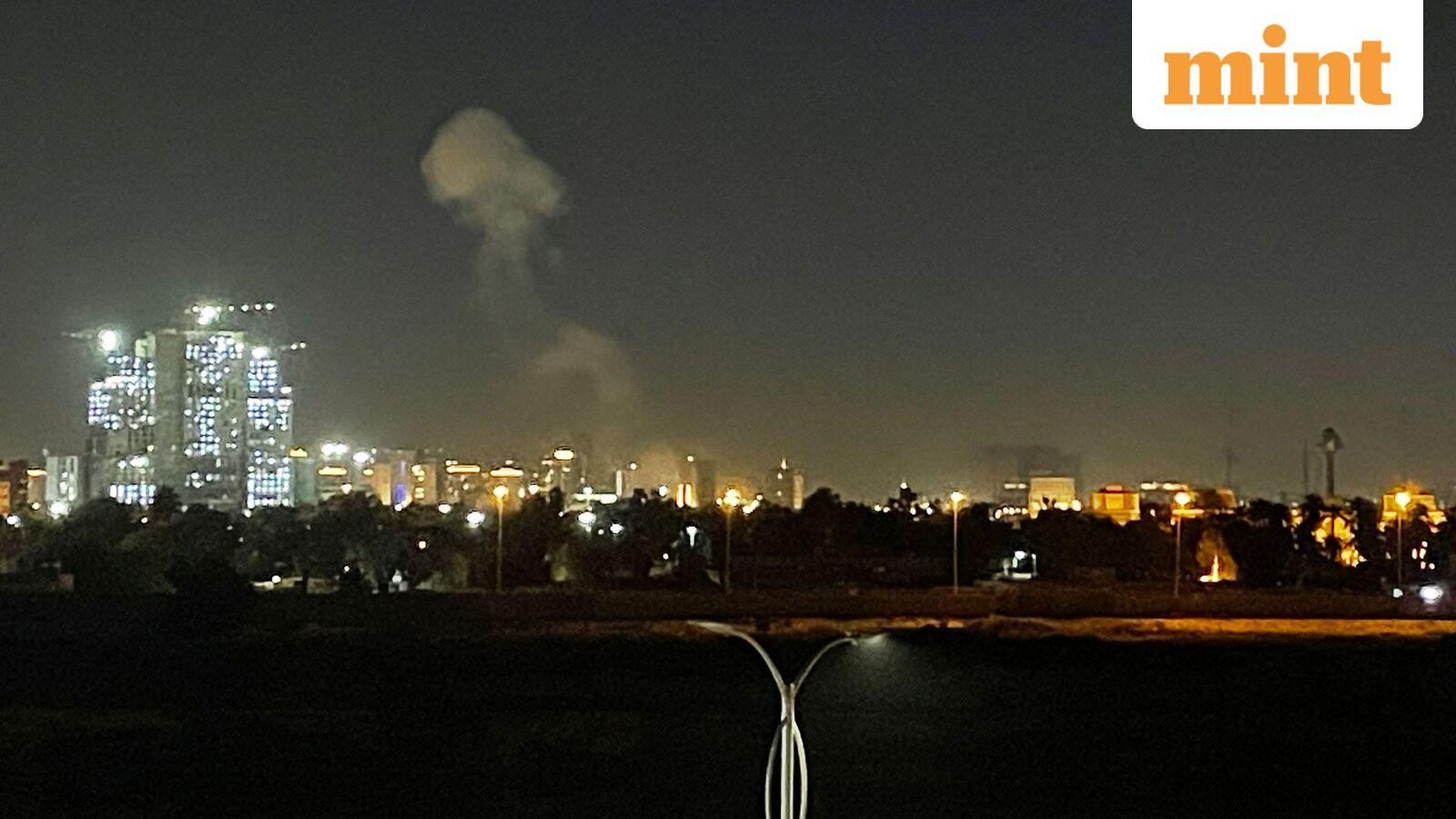
The skies above Baghdad lit up early on Tuesday (17 March) as a volley of drones and rockets bore down on the US embassy in the Iraqi capital, news media agencies reported quoting Iraqi security who described it as the most ferocious such assault since the US and Israel’s war with Iran began on 28 February.
At least five drones were deployed in the strike. A powerful explosion reverberated across the city, witnessed by a reuters correspondent on the ground.
This is the second time in three days that the US embassy in Baghdad was hit by drones. Two Iraqi security officials had said on 14 March, that a missile hit a helipad within the US Embassy compound in Baghdad, and footage from the Associated Press showed smoke rising over the embassy Saturday morning.
Watch Scary Visuals of Drone Strike on US Embassy in Iraq
Iraq’s Green Zone in Flames: Hotel Hit, Embassy Targeted
Hours before the Tuesday morning assault, the violence had already announced itself with chilling clarity. On Monday evening, a drone struck the roof of the al-Rasheed Hotel — a luxury establishment inside Baghdad’s heavily fortified Green Zone, frequented by foreign diplomats and home to several diplomatic missions.
Iraq’s interior ministry initially described the incident as “a projectile” before clarifying that it was, in fact, a drone. Officials confirmed there were no casualties or material damage.
Moments later, the situation escalated. A loud blast was heard across Baghdad as air defense systems engaged an incoming attack directed at the US embassy, located within the same Green Zone perimeter.
A security official confirmed to AFP that “air defenses thwarted an attack with four rockets” targeting the diplomatic compound. Firefighters and ambulances were deployed to the scene, and a street leading to the hotel was cordoned off by a large security presence.
Separately, strikes also hit an oil field in Iraq’s south and a border area in the west, signaling a deliberate, coordinated campaign across multiple targets.
Iraq’s Prime Minister Vows to Hunt Down Perpetrators
The Iraqi government responded with unambiguous fury. Prime Minister Mohammed Shia al-Sudani, who also serves as commander-in-chief of the armed forces, condemned the incidents as “terrorist attacks” and ordered security forces to act without delay.
“Track down and apprehend the perpetrators of these acts and bring them to justice immediately so they receive the punishment they deserve,” al-Sudani instructed, according to a statement from his spokesperson, Sabah al-Numan.
The statement left no room for ambiguity about the stakes: “These criminal acts have serious repercussions for our country and undermine the government’s efforts toward reconstruction and prosperity.”
Kataeb Hezbollah’s Senior Commander Killed — Then the Attacks Began
The timing of the assault was not lost on analysts. Shortly before the strikes commenced, the powerful Tehran-backed militant group Kataeb Hezbollah announced the death of its senior security commander, Abu Ali al-Askari, a figure who also served as the group’s primary public voice, responsible for issuing all key statements on its behalf. The group offered no details on how or when he was killed.
A security official subsequently told AFP that Askari was the same individual as Abu Ali al-Amiri, who had been killed in a strike on Baghdad the previous Saturday. The connection between his death and the subsequent wave of attacks was left implicit — but difficult to ignore.
Oil Fields and Paramilitary Forces Also Struck
The violence extended well beyond the capital. Two drones targeted the southern Majnoon oil field — a facility that had already suspended production — with one drone striking a telecommunications tower and a second hitting the offices of a US firm operating at the site, according to a security official.
In a separate incident near the Syrian border in western Iraq, eight fighters from the Hashed al-Shaabi, also known as the Popular Mobilization Forces, a former paramilitary coalition now formally integrated into Iraq’s regular army — were killed in strikes. Al-Numan, the prime ministerial military spokesperson, did not hold back in his assessment of that attack.
“It is a blatant aggression against the sovereignty of the state,” he said, describing the targeting of “an official force that operates under the command of the Commander-in-Chief of the Armed Forces” as an affront that could not go unanswered.
