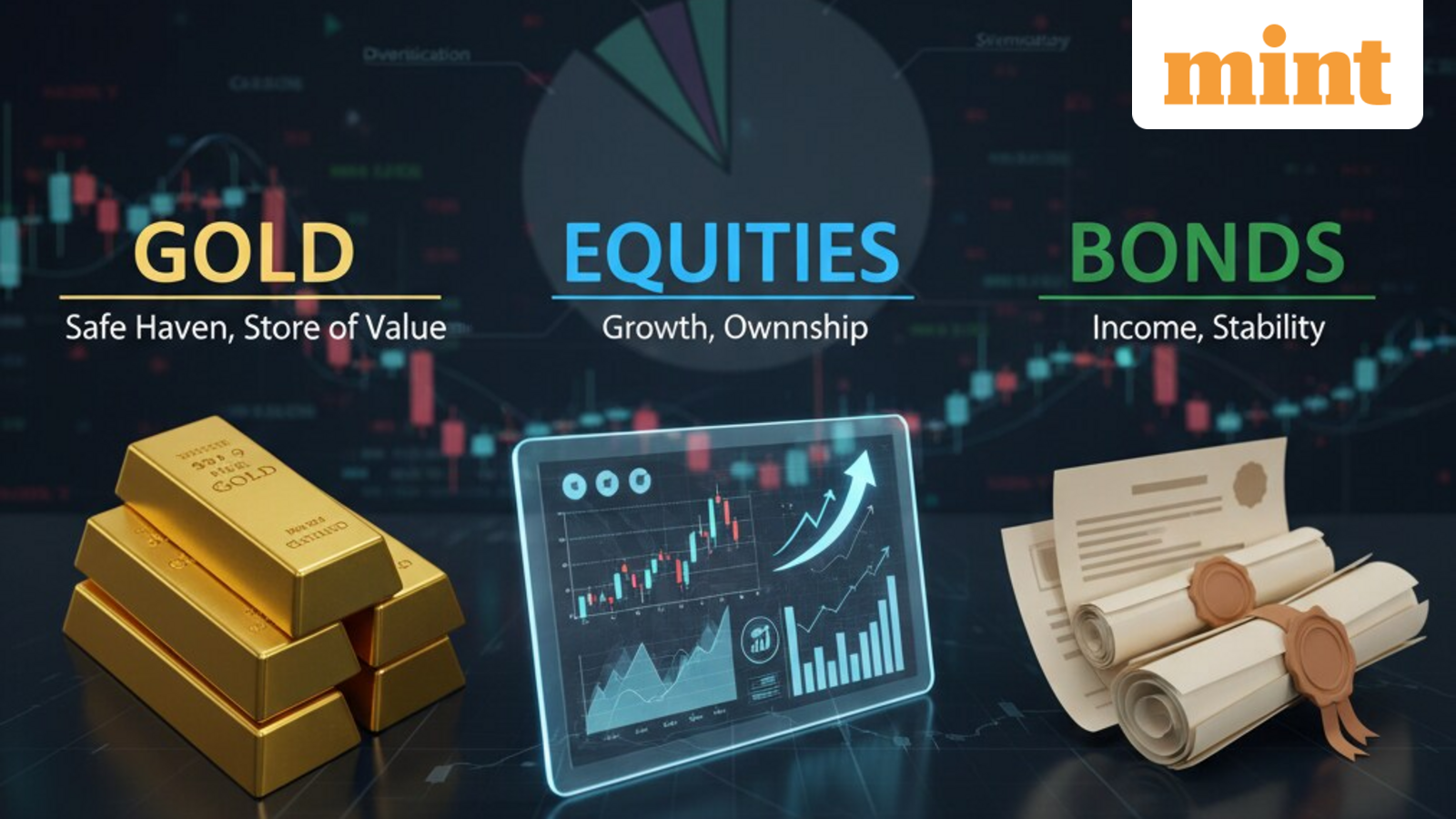
With the stock market witnessing bouts of volatility and gold and silver prices swinging amid persisting uncertainties over geopolitical tensions, global interest rate trajectory, and economic growth, retail investors appear to be grappling with a classic question: how to invest?
The prevailing macro conditions amid elevated geopolitical risks have raised questions about where to put their money and what strategy to pursue for gold, equities, or bonds.
Many new retail investors try to figure out what is best for them. However, experts explain that a good portfolio is a mix of different types of asset classes, as they complement each other.
One’s investment strategy should be aligned with their risk appetite and financial goals. However, it is important to adjust the portfolio according to prevailing market conditions.
So, how should an investor invest at the current juncture?
Investment strategy for equities
Equities are considered to be the best asset class for the long term. However, it is important to understand that they tend to be the most volatile too.
Inexperienced retail investors may panic in periods of prolonged market correction and exit at the wrong time, whereas they should ideally continue investing in equities through systematic investment plans (SIPs).
“Volatility in equities and record-level gold prices are not signals to react, they are signals to rebalance. Equities continue to be the primary compounding engine, but with emphasis on quality and staggered deployment,” said Anuj Badjate, Managing Director, Badjate Stock & shares Pvt Ltd.
Gaurav Didwania, Partner and Fund Manager at Qode Advisors, said for most Indian retail investors with a medium to long horizon, equities are and should remain the primary driver of wealth creation.
“Historically, Indian equities have delivered strong compounded returns over multi year periods, outpacing many other asset classes when measured over 5, 10 and 15 year windows, provided investors can withstand volatility along the way,” said Didwania.
This does not mean equity investing is comfortable.
During volatile phases like the present, indices can swing 10 to 20% within a year. Drawdowns feel sharp and headlines amplify anxiety.
“But the practical reality is simple. Timing markets rarely works. Disciplined, diversified exposure does. Instead of reducing equity exposure in reaction to short term moves, investors should build an equity foundation that reflects the breadth and depth of growth opportunities across India and global markets,” said Didwania.
investment strategy for gold
Gold should certainly be part of one’s portfolio, as it is a hedge against inflation and protects one’s portfolio in times of economic and political crisis and stock market downtrend.
However, experts caution that gold should not be treated as a high-return asset.
“Geopolitical flashpoints have amplified safe-haven flows. Central banks globally added over 1,000 tonnes of gold in each of the past two years, one of the highest levels in decades. In such a backdrop, a 10–15% allocation to gold and 5–10% to silver within the commodities sleeve can act as an effective hedge against currency volatility and geopolitical shocks,” said Naren Agarwal, CEO, Wealth1.
Investment strategy for bonds
Unlike equities, bonds provide relatively stable returns and act as a cushion during market downturns.
However, bond prices can also fluctuate depending on interest rate movements. Longer-duration bonds are more sensitive to rate changes, which is why experts advise investors to prefer short- to medium-duration debt funds, target maturity funds, or high-quality corporate bonds.
According to Badjate, retail portfolios should prioritize structure over sentiment. For a 5 -7 year investor, a disciplined allocation of 60% equities, 25% high-quality bonds, and 15% gold remains prudent.
“Bonds today offer meaningful yields and portfolio stability, a combination absent for years. Gold should remain a hedge, not a growth substitute,” said Badjate.
“For retail investors who can wait out short term turbulence and commit to a disciplined, diversified plan, equities remain the most powerful engine of long term wealth creation in India. Gold adds value when regimes demand protection or inflation hedging. Bonds may serve specific liquidity or income needs, but for long horizon investors they should not displace the equity growth engine,” said Didwania.
Read all market-related news here
Read more stories by Nishant Kumar
Disclaimer: This story is for educational purposes only. The views and recommendations expressed are those of individual analysts or broking firms, not Mint. We advise investors to consult with certified experts before making any investment decisions, as market conditions can change rapidly and circumstances may vary.