

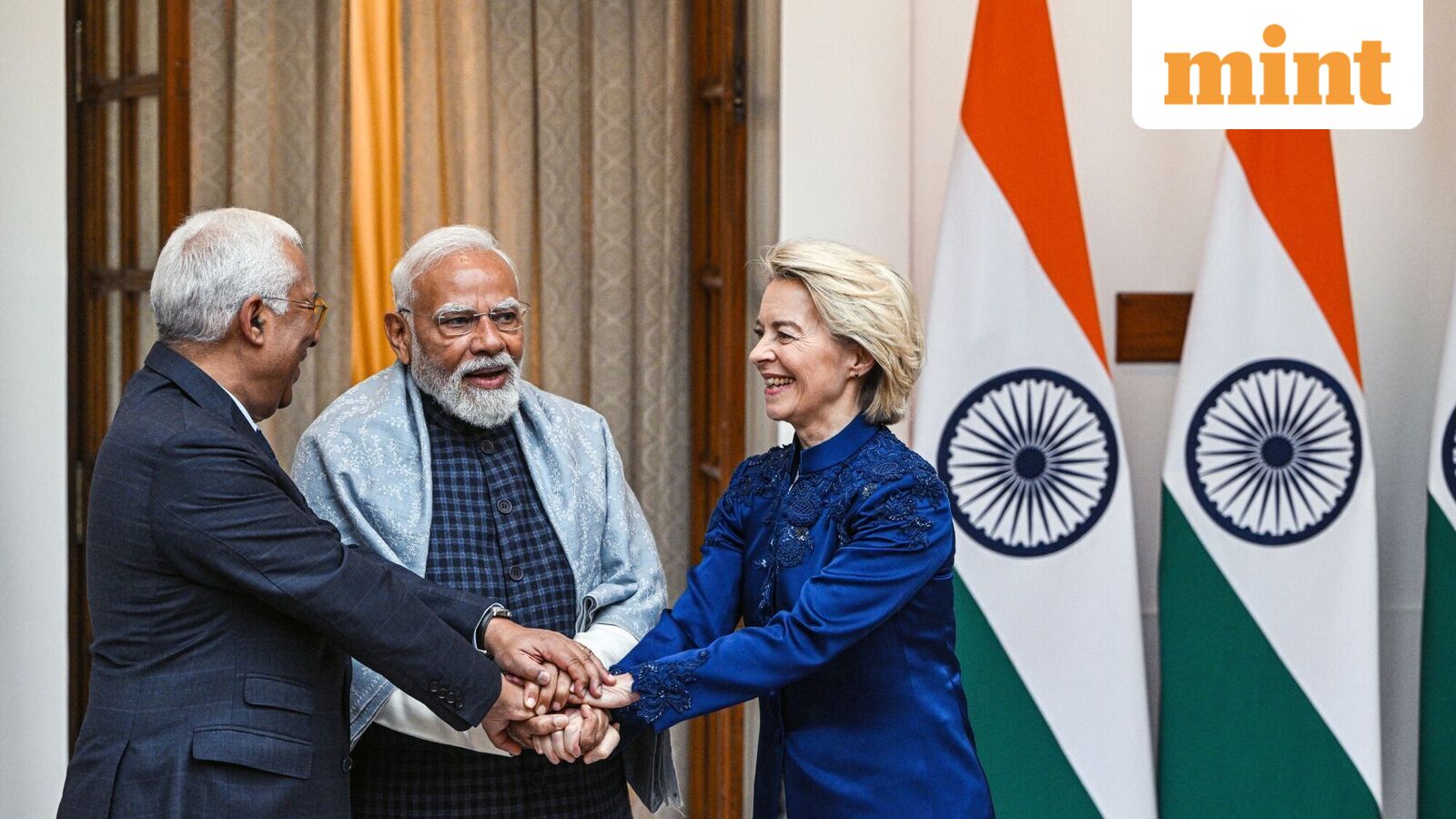
India-EU free trade agreement: Prime Minister Narendra Modi on Tuesday, January 27, announced a historic trade deal with the European Union (EU). The landmark free trade agreement (FTA), which the Prime Minister called the “mother of all deals,” was finalized after nearly two decades of intermittent negotiations and comes at a time when the global economy is grappling with the US President Donald Trump’s tariff policies.
The India-EU trade deal will allow New Delhi to gradually open its large and tightly regulated market to free trade with the 27-member EU, its largest trading partner.
According to Ravi Singh, Chief Research Officer from Master Capital Services, the India-EU FTA is structurally positive for India’s trade and investment outlook. It will boost exports, attract FDI, and diversify markets, but requires domestic industry adaptation to withstand intensified import competition.
Track India-EU trade deal LIVE updates here
How can an India-EU trade deal impact the Indian stock market?
The EU is a major economic bloc of the world, the second largest after the United States of America.
According to Madhavi Arora, Lead Economist for Emkay Global, the India-EU deal could act as an effective counter-cyclical buffer by improving India’s export participation in global value chains and expanding market access.
“With EU accounting for nearly 17% of India’s goods exports, we estimate that a bilateral alignment could lift India’s exports to the EU by nearly $50 billion by 2031, led by medium-tech manufacturing,” said Arora.
“Improved import efficiency and higher FDIs would further support productivity gains and tech transfers, while greater regulatory certainty could aid IT services exports, where the EU already accounts for nearly one-third of demand. We see pharma, textiles, and chemicals as the key beneficiaries to play this theme,” said Arora.
Experts believe the deal could mitigate the US tariff pain significantly and improve market sentiment, even though the composition of India’s exports to the EU and the US is not identical.
“India-EU trade deal is very significant. The EU is India’s single largest trading bloc. Given the current situation—where India is facing elevated tariffs from the US—this deal could have a meaningful positive impact on India’s trade outlook,” said Sujan Hajra, Chief Economist and Executive Director, Anand Rathi Group.
“There is considerable overlap in key sectors affected by US tariffs, such as gems and jewellery, marine products, textiles, and garments. To a large extent, this agreement can help mitigate the pain from US tariffs. Moreover, after nearly two decades of negotiations, this deal may also put some pressure on the US to move forward with its own trade discussions with India,” Hajra said.
However, the deal is a long-term positive for the Indian stock market and may not give an immediate fillip to sentiment, which is pressured by massive foreign capital outflow, increased geopolitical risks and mixed Q3 results.
Market participants pointed out that to a large extent, the India-EU deal was discounted by the market. Therefore, the announcement did not trigger a sharp rally in the market. The Sensex ended at 81,857.48, gaining 320 points, or 0.39%, while the Nifty 50 closed at 25,175.40, up 127 points, or 0.51%.
India and the EU have concluded negotiations on a free trade agreement, which is overall positive for the Indian equity market, even if the near-term market reaction remains muted. The benefits will accrue gradually, which can show potential re-rating in select sectors over time,” said Singh.
Some experts also highlighted that the India-EU deal should not be seen as a substitute for an India-US trade deal.
India’s FTA with the EU, which accounts for 25% of global GDP and 33% of global trade, is a major breakthrough, particularly in the context of the prolonged India-US trade deal. However, this India-US deal should not be viewed as a substitute for an India-US deal,” said VK Vijayakumar, Chief Investment Strategist, Geojit Investments.
“It is important to understand that India has a trade surplus of $45 billion with the US but only $25 billion with the EU. Therefore, even as we celebrate this India-EU deal, we should tirelessly pursue the US-India deal, which India badly needs. Also, this India-EU deal will become operational only in early 2027,” Vijayakumar said.
Disclaimer: This story is for educational purposes only. The views and recommendations expressed are those of individual analysts or broking firms, not Mint. We advise investors to consult with certified experts before making any investment decisions, as market conditions can change rapidly and circumstances may vary.

