

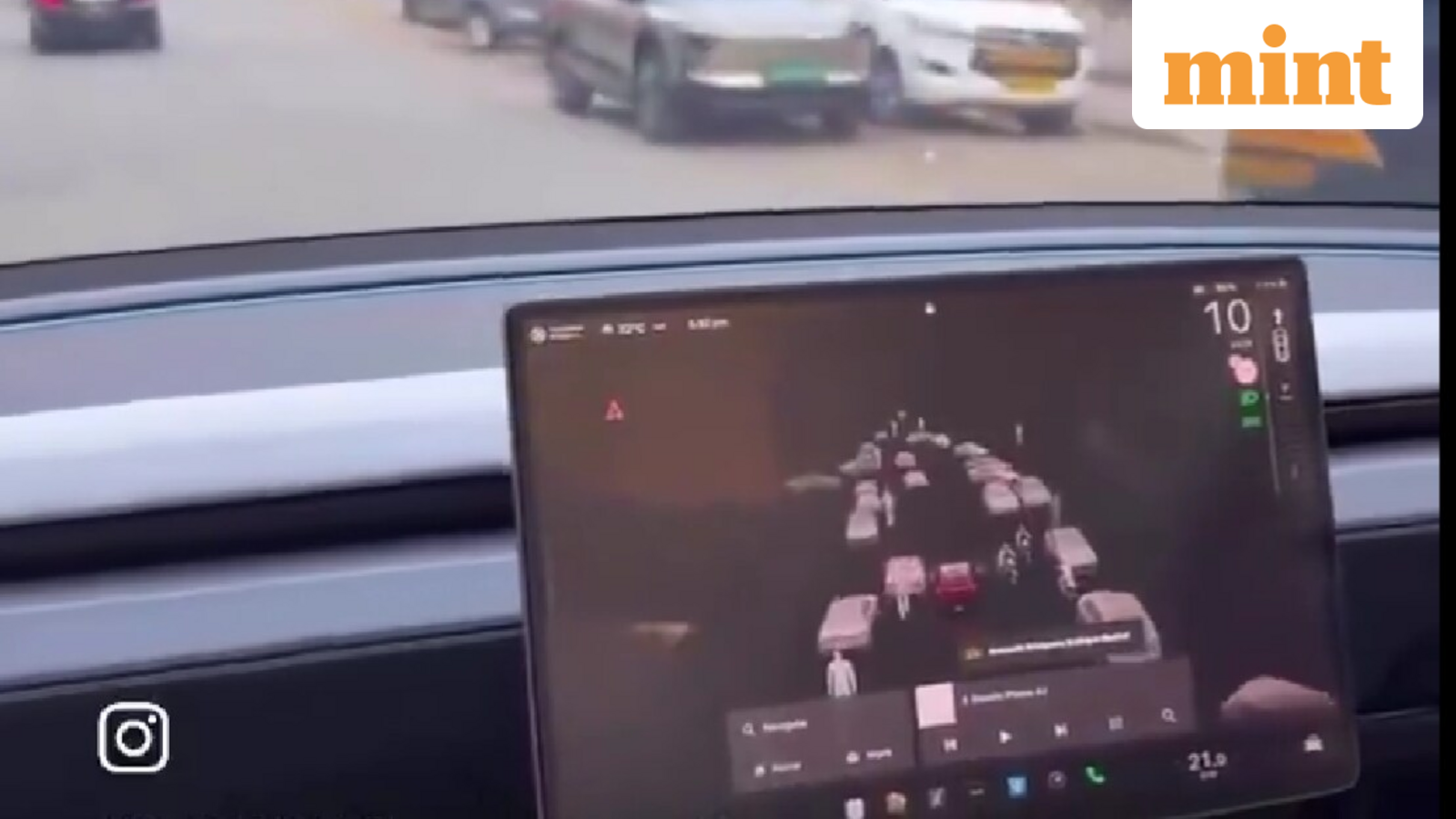
A video purportedly featuring a Tesla car navigating heavy Indian traffic has gone viral on social media, sparking amusement and debate online over the readiness of autonomous driving technologies for the country’s complex road conditions.
The now-viral clip, shared on X on Monday, appears to have been recorded from inside the vehicle, clearly showing Tesla’s central touchscreen display. The visualization system is seen detecting multiple vehicles, pedestrians, scooters and auto-rickshaws moving closely together on a crowded road.
As the video circulated online, many users joked that the car seemed overwhelmed by the sheer unpredictability of Indian traffic. Within hours, the clip drew thousands of views and comments, with netizens questioning whether advanced driver-assistance systems (ADAS) are equipped to handle such dense, non-lane-driven environments.
From the footage, the vehicle appears to struggle while relying on what looks like Tesla Vision, the company’s camera-based driver-assistance system. Tesla Vision is designed to offer high-definition spatial awareness and identify surrounding objects without the use of radar, but the clip suggests that interpreting India’s mixed traffic may pose unique challenges.
Social media reactions ranged from humor to serious concern. “Better it is limited to brain migraine and no road rage happened. Otherwise, Indian roads feels like Final Destination,” one user commented, while another quipped, “Tesla needs to go fully manual on Indian roads.” Others pointed to infrastructure-related issues, with remarks questioning whether the system could detect potholes or sudden lane changes common on Indian streets.
A user wrote, “Lmao no, that’s not a migraine, That’s FSD getting its PhD in absolute chaos navigation. India just handed Tesla the hardest real-world training data on Earth, after this, every other country is a Sunday drive.”
“Tesla thought it was smart. Indian roads said: “Hold my pothole,” the fourth wrote.
“It will glitch and die. It was not manufactured to handle so much load,” the fifth wrote.
Some users also suggested that autonomous software may require localization. “It needs a software upgrade to understand India’s demography and road behaviour,” read one comment.
The location where the video was shot remains unverified, and no additional details accompanied the post. The caption simply read: “Tesla got brain migraine on Indian roads.”
While Tesla’s ADAS features are built to read lane markings, traffic flow and nearby objects, experts note that their effectiveness can vary significantly across regions due to differences in road discipline, infrastructure and regulatory approvals. The viral clip has once again underlined the broader challenge of deploying autonomous and semi-autonomous driving systems in countries with highly dynamic traffic conditions like India.
